
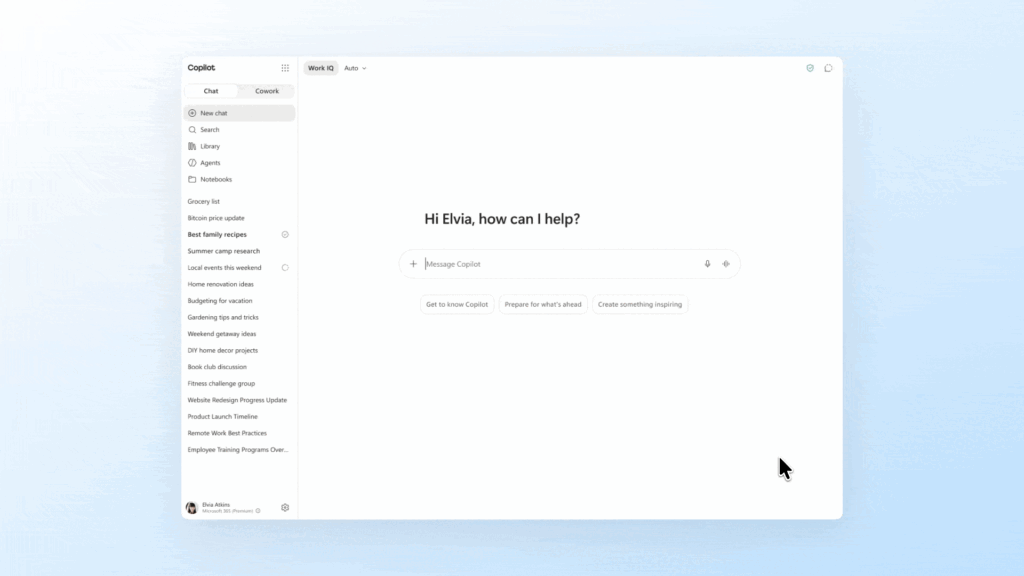
In a move that signals a significant shift in the landscape of workplace productivity, Microsoft has officially announced the general availability of Copilot Cowork. The tool, which represents the next evolution of the company’s artificial intelligence strategy, is now available to Microsoft 365 Copilot customers worldwide. Moving beyond the conversational boundaries of traditional AI chatbots, Copilot Cowork is designed as an "agentic" system—a platform capable of executing complex, multi-stage workflows autonomously from start to finish.
The global rollout follows a highly successful three-month preview period within Microsoft’s "Frontier" program. During this incubation phase, the technology saw rapid adoption across various sectors, with more than half of the Fortune 500 integrating the tool into their daily operations. Early adopters include global consulting giants such as Accenture and Avanade, as well as industry leaders like Koch, Capital Group, Zurich Insurance, and Ooredoo Qatar. The breadth of this early adoption suggests a high level of market confidence in AI systems that do more than just draft text, but actually perform labor-intensive business processes.
Redefining Work Through Autonomous Execution
The core appeal of Copilot Cowork lies in its ability to handle "agentic" work. While previous iterations of Copilot focused on assisting users with specific prompts—such as summarizing a meeting or drafting an email—Cowork is built for long-running, multi-tool tasks. Microsoft defines this as a system where the user defines the objective, and the AI manages the execution end-to-end, returning a completed result rather than a mere recommendation or a rough draft.
Early feedback from the Frontier program has highlighted the transformative potential of this approach. In one instance, an engineering team utilized Cowork to manage complex batch-job spreadsheets. The AI was trained to safely edit these documents and automatically generate dependency flow charts after every modification—a task that previously necessitated meticulous manual intervention to avoid system errors.

In another case, the tool demonstrated its capacity for massive data processing by comparing nearly four thousand files across two different product versions. According to Microsoft, this task would traditionally have consumed weeks of human labor; Cowork completed the analysis in a fraction of that time. Sales departments have also seen immediate returns. One sales lead reported using Cowork to analyze a stalled pipeline. The AI returned a prioritized list of at-risk opportunities, identifying the exact point where follow-up communications had ceased. What was once a week-long manual review process was effectively collapsed into a single morning of automated analysis.
Microsoft reports that Cowork has become the fastest-growing feature in the history of the Frontier program. Furthermore, it has earned some of the highest user satisfaction ratings of any AI experience the company has released to date.
Technical Differentiators and Model Flexibility
Microsoft has positioned Copilot Cowork as a more accurate, secure, and cost-effective alternative to competing autonomous AI agents. A primary driver of this efficiency is the platform’s multi-model architecture. At launch, Copilot Cowork utilizes a range of frontier models, including Anthropic’s Opus 4.8 and Sonnet 4.6. Customers within the Frontier program also have access to GPT 5.5.
The company is also preparing to launch its own proprietary model, "Cowork 1," in the coming weeks. This model is described as a secure, fine-tuned engine post-trained specifically to handle enterprise tasks at a substantially lower cost than general-purpose frontier models. Microsoft emphasized that users are not locked into a single provider; the system is designed to allow organizations to toggle between the most efficient models for routine tasks and high-power frontier models for more complex reasoning.
Cost-efficiency remains a central pillar of the Cowork value proposition. Internal testing conducted by Microsoft compared the cost per prompt of Copilot Cowork against Claude Cowork using a Microsoft 365 connector. The results indicated that Copilot Cowork was, on average, 30% to 40% cheaper. These savings are attributed to the system’s ability to optimize context retrieval and tool calls, reducing the computational overhead required to complete a task.

A New Paradigm for Pricing: Copilot Credits
With the launch of Cowork, Microsoft is introducing a usage-based pricing model that reflects the high computational demands of agentic AI. To access Cowork, organizations must first hold a Microsoft 365 Copilot User Subscription License (USL). This base subscription continues to provide the standard suite of AI tools, including Copilot Chat and AI integration within Word, Excel, PowerPoint, Outlook, and Teams.
However, the advanced capabilities of Copilot Cowork are billed on a variable basis using a system of "Copilot Credits." The price for each specific task is calculated based on four distinct inputs: the specific AI model used, the amount of context retrieval required from the organization’s data, the number of external tool calls made, and the total runtime of the task.
To help organizations navigate this shift from predictable monthly fees to variable usage billing, Microsoft has identified three common task patterns observed during the preview phase:
- Light Tasks: These involve a small number of knowledge sources, require limited reasoning, and typically produce a single output.
- Medium Tasks: These draw on multiple data sources, require structured reasoning across different formats, and generate two or more outputs.
- Heavy Tasks: These are high-complexity operations that aggregate data broadly across the enterprise, apply deep reasoning, and produce a high volume of outputs.
Microsoft has also identified four primary user personas—Corporate Knowledge Workers, Management and Senior Leaders, Customer-Facing Knowledge Workers, and Technical Workers—each with distinct usage patterns. By mapping these personas against the frequency of light, medium, and heavy tasks, Microsoft aims to help IT administrators and CFOs create more accurate budget estimates. To assist with this, the company has released a "Customer Cowork Estimator" spreadsheet to help businesses model their expected expenditures.
Governance and Cost Management Controls
Recognizing that usage-based billing can create budgetary uncertainty, Microsoft has integrated a robust suite of cost management features into the general availability release. These features are organized around three themes: control, visibility, and efficiency.

Under the "Control" pillar, administrators have the authority to decide exactly when Cowork is enabled and which specific users or departments have access. Crucially, the system allows for the implementation of spending limits, enabling organizations to allocate specific budgets and prevent unexpected overages.
In terms of "Visibility," the platform provides detailed dashboards that allow customers to see exactly what is being used and the specific cost associated with each task. This level of transparency is intended to help businesses calculate the direct return on investment (ROI) for their AI deployments.
Finally, "Efficiency" features provide options for managing costs over the long term. Microsoft noted that as models become more efficient and the system improves its ability to match the right model to the right task, costs are expected to decrease. In the interim, the company is providing tools to help users optimize their prompt strategies and tool usage to minimize credit consumption.
Immediate Availability and Transition Period
Billing for Copilot Cowork commences today. However, to facilitate a smooth transition for those who participated in the early testing phases, Microsoft is offering a grace period. Tenants that had at least one user in the Frontier program between March 30 and June 16, 2026, will not be billed for Cowork usage until July 1, 2026. This window is intended to allow administrators to set their spending limits and familiarize themselves with the new cost management interface before live billing takes full effect.
The user experience has also been streamlined for general availability. The Microsoft 365 Copilot app now features a dedicated toggle that allows users to switch instantly into the Cowork environment. This interface shift is designed to move the user from a "chat" mindset into an "action" mindset, providing a clear workspace for managing ongoing autonomous tasks.

As organizations begin to adopt these agentic capabilities, Microsoft is providing a range of resources on its Adoption site to help companies integrate Cowork into their existing workflows. The company’s focus now shifts to the upcoming release of the "Cowork 1" model, which promises to further refine the balance between high-performance reasoning and enterprise-grade cost efficiency.
With the launch of Copilot Cowork, Microsoft is betting that the future of the enterprise lies not just in AI that talks, but in AI that acts. For the Fortune 500 and beyond, the era of the autonomous digital coworker has officially arrived.
 Productivity Software & Office Suites
Microsoft Unveils Reimagined Copilot with Agentic Capabilities and New "Autopilot" Digital Teammate
Microsoft has announced a sweeping overhaul of its Copilot platform, signaling a...
 Productivity Software & Office Suites
Microsoft Launches Copilot Cowork Globally, Bringing Agentic AI to the Fortune 500
Microsoft has officially announced the general availability of Copilot Cowork, marking a...
 Productivity Software & Office Suites
Microsoft Announces Fifth Annual Power Platform Community Conference in Las Vegas to Address the Future of AI-Driven Business Processes
As modern enterprises continue to navigate an era defined by rapid digital...







