
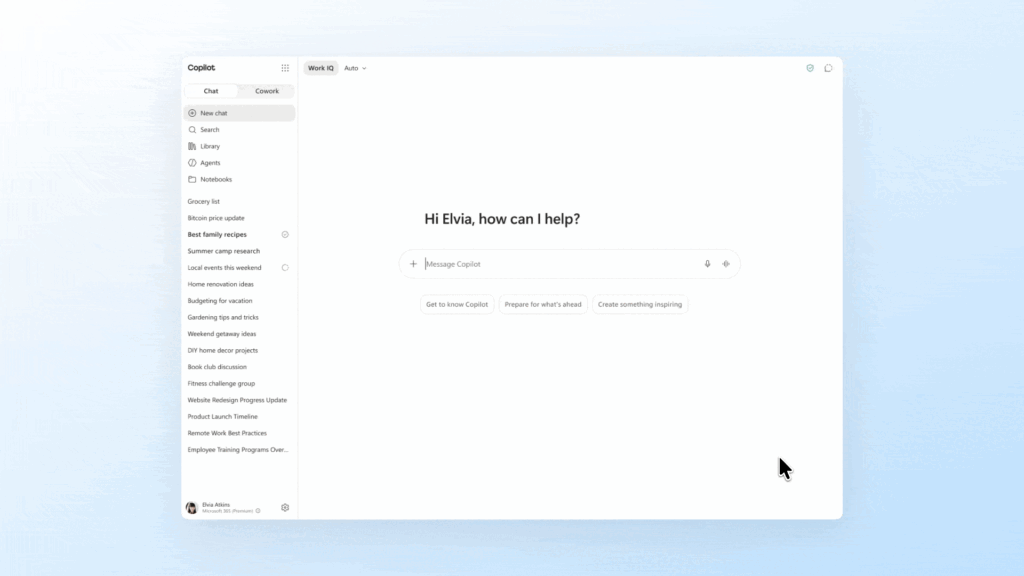
The company is also preparing to launch its own proprietary model, "Cowork 1," in the coming weeks. This model is described as a secure, fine-tuned engine post-trained specifically to handle enterprise tasks at a substantially lower cost than general-purpose frontier models. Microsoft emphasized that users are not locked into a single provider; the system is designed to allow organizations to toggle between the most efficient models for routine tasks and high-power frontier models for more complex reasoning.
Cost-efficiency remains a central pillar of the Cowork value proposition. Internal testing conducted by Microsoft compared the cost per prompt of Copilot Cowork against Claude Cowork using a Microsoft 365 connector. The results indicated that Copilot Cowork was, on average, 30% to 40% cheaper. These savings are attributed to the system’s ability to optimize context retrieval and tool calls, reducing the computational overhead required to complete a task.

A New Paradigm for Pricing: Copilot Credits
With the launch of Cowork, Microsoft is introducing a usage-based pricing model that reflects the high computational demands of agentic AI. To access Cowork, organizations must first hold a Microsoft 365 Copilot User Subscription License (USL). This base subscription continues to provide the standard suite of AI tools, including Copilot Chat and AI integration within Word, Excel, PowerPoint, Outlook, and Teams.
However, the advanced capabilities of Copilot Cowork are billed on a variable basis using a system of "Copilot Credits." The price for each specific task is calculated based on four distinct inputs: the specific AI model used, the amount of context retrieval required from the organization’s data, the number of external tool calls made, and the total runtime of the task.
To help organizations navigate this shift from predictable monthly fees to variable usage billing, Microsoft has identified three common task patterns observed during the preview phase:
- Light Tasks: These involve a small number of knowledge sources, require limited reasoning, and typically produce a single output.
- Medium Tasks: These draw on multiple data sources, require structured reasoning across different formats, and generate two or more outputs.
- Heavy Tasks: These are high-complexity operations that aggregate data broadly across the enterprise, apply deep reasoning, and produce a high volume of outputs.
Microsoft has also identified four primary user personas—Corporate Knowledge Workers, Management and Senior Leaders, Customer-Facing Knowledge Workers, and Technical Workers—each with distinct usage patterns. By mapping these personas against the frequency of light, medium, and heavy tasks, Microsoft aims to help IT administrators and CFOs create more accurate budget estimates. To assist with this, the company has released a "Customer Cowork Estimator" spreadsheet to help businesses model their expected expenditures.
Governance and Cost Management Controls
Recognizing that usage-based billing can create budgetary uncertainty, Microsoft has integrated a robust suite of cost management features into the general availability release. These features are organized around three themes: control, visibility, and efficiency.
 Productivity Software & Office Suites
Microsoft Unveils ‘Autopilots’ and Microsoft Scout: The Next Evolution of Autonomous AI Agents for the Enterprise
The landscape of digital productivity is undergoing a fundamental shift, moving away...
 Productivity Software & Office Suites
Microsoft Announces Fifth Annual Power Platform Community Conference in Las Vegas to Address the Future of AI-Driven Business Processes
As modern enterprises continue to navigate an era defined by rapid digital...
 Productivity Software & Office Suites
Microsoft to Headline ESPC 2026 in Amsterdam as the European Tech Community Pivots Toward an Agentic AI Future
As the global landscape of work undergoes its most significant transformation since...







