
Attack Conditions and Exploitation Status
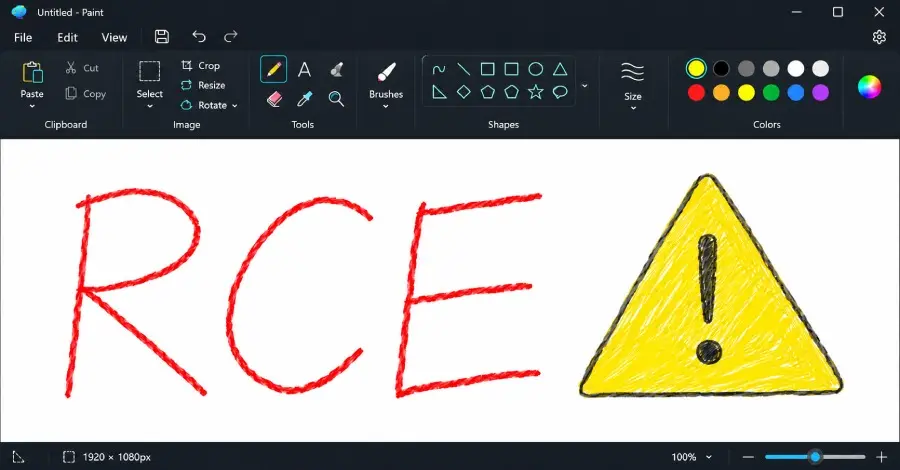
The technical nature of CVE-2026-83844 involves a memory safety issue where the application reads data outside the intended buffer. According to Microsoft’s advisory, the exploitation of this out-of-bounds read occurs when a "specially crafted packet" is sent to an affected service over the network. Interestingly, the advisory does not specify which underlying service Paint interacts with to facilitate this network-based attack. However, the critical takeaway for defenders is that the attack requires no authentication and no user interaction, placing it in the category of "zero-click" potential vulnerabilities.
In a typical remote code execution scenario involving an image editor, one might expect the attack to require a user to open a malicious file. However, the description of a "specially crafted packet" over a network suggests a different vector, possibly involving how Paint handles networked resources or how it integrates with other Windows services that process image data.
Currently, the U.S. Cybersecurity and Infrastructure Security Agency (CISA) has not added CVE-2026-83844 to its Known Exploited Vulnerabilities (KEV) catalog. The catalog, which serves as a definitive list of flaws known to be actively used by threat actors, was last updated earlier this week without the inclusion of this Paint flaw. This suggests that while the risk is high due to the nature of the vulnerability, there is currently no evidence of widespread exploitation.
Microsoft has stated that there are no known workarounds or mitigations for this flaw. This means that users cannot simply disable a specific feature or change a registry setting to protect themselves; the only path to security is the installation of the updated build. In high-security environments where the Microsoft Store is disabled or restricted, researchers like Vitko have suggested that the only temporary safeguard is the complete removal of the Paint package from both the active user profiles and the provisioned image. While this step effectively eliminates the attack surface, it also removes a core utility that many users rely on for basic tasks.
As the fixed build continues to propagate through the Microsoft Store’s global network, the incident serves as a reminder of the complexities inherent in modern software delivery. For a tool as ubiquitous as Windows Paint, the transition to a Store-based update model brings the benefits of faster feature iterations but also introduces new hurdles for the synchronized deployment of critical security patches. Owners of Windows systems are encouraged to verify their current Paint version and ensure that the Microsoft Store is permitted to perform background updates to maintain protection against this and future vulnerabilities.
 Cybersecurity Basics & Security News
The Evolution of the Vulnerability Gap: Defending Against the Rise of Mythos-Class AI Attacks
In the modern cybersecurity landscape, the arrival of a new Common Vulnerabilities...
 Cybersecurity Basics & Security News
Security Researcher Unveils ‘Tailworm’ Report, Highlighting Critical Privilege Escalation Risks in Tailscale SSH
A comprehensive security analysis published this week has sent ripples through the...
 Cybersecurity Basics & Security News
Critical Memory Corruption Vulnerability in Google’s Brotli Decoder Impacts Node.js, Bun, and Enterprise Infrastructure
A pervasive memory-corruption vulnerability has been identified within Google’s Brotli compression library,...







