
"The first step toward better AI governance is visibility. That means taking an inventory of what’s actually running on endpoints," Zaccone said. "From there, I’d encourage leaders to name an approved fallback tool before an outage, so nobody has to choose another one under pressure."
Providing a pre-approved "Plan B" can mitigate the panic that sets in when a primary tool like Copilot fails. If employees know there is a secondary, secure tool they are permitted to use, they are far less likely to resort to unverified free platforms. This guidance should be embedded into the company’s incident communications plan, ensuring that the advice remains consistent whether it is a normal workday or a day of major technical failure.
Michael Marriott, VP at Harmonic Security, suggested that a purely restrictive approach—simply blocking all unauthorized tools—may not be the most effective strategy. Instead, he advocates for a more nuanced control system that looks at the content being shared rather than the tool itself.
"Start from the assumption that workarounds will happen and establish visibility across both corporate and personal accounts," Marriott told ITPro. "Rather than blocking tools, apply controls based on the content being shared so that an employee analyzing a public article in a free ChatGPT account proceeds without interruption, while one pasting in a customer contract is blocked inline with an explanation."
This context-aware security allows for a degree of flexibility. It permits employees to use AI for low-risk tasks during an outage while strictly preventing the mishandling of confidential information. This "middle ground" approach can help maintain productivity without sacrificing the integrity of sensitive data.
Ultimately, the responsibility falls on IT leaders to foster a security-conscious culture where employees understand the "why" behind AI policies. Patel noted that having an approved list of alternative tools and clear data handling agreements is critical.
"Pre-approve a small set of alternative AI tools with appropriate data handling agreements, communicate them clearly, and make them easy to access so users don’t have to improvise," Patel said.
As AI becomes increasingly central to the modern workplace, the lessons learned from the Microsoft 365 outage serve as a stark reminder: resilience is not just about keeping the primary systems running, but about ensuring that when those systems do fail, the workforce has a safe and secure path forward. If disaster strikes again and users are left in the dark, the difference between a minor delay and a major data breach will depend entirely on the guidance pushed to staff and the fallback options already in place.
 Helpdesk & IT Service Management (ITSM)
The Hybrid Productivity Paradox: Why Meeting Room Glitches are Eroding the Gains of the AI Era
In the three years since the global shift toward flexible working models,...
 Helpdesk & IT Service Management (ITSM)
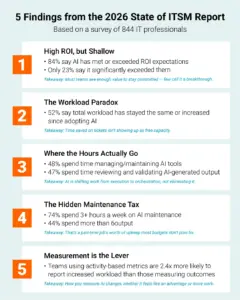
The Paradox of Efficiency: SolarWinds 2026 Report Highlights the Growing Pains of AI Integration in ITSM
The promise of artificial intelligence within the IT Service Management (ITSM) sector...
 Helpdesk & IT Service Management (ITSM)
Anthropic and Akamai Ink Landmark $11.6 Billion Compute Partnership to Fuel Long-Term AI Infrastructure Growth
In a move that underscores the staggering capital requirements of the generative...