

In a landmark update during its most recent earnings call, Microsoft announced that Microsoft 365 Copilot has surpassed 30 million paid seats, marking a pivotal moment in the adoption of generative artificial intelligence within the enterprise. The milestone is underscored by a rapid acceleration in growth, with net seat additions more than doubling on a quarter-over-quarter basis. However, the significance of the announcement extends beyond mere subscription numbers; it signals a fundamental evolution in how the global workforce interacts with technology.
The technology giant’s latest telemetry and customer data suggest that the first phase of enterprise AI—defined primarily by experimentation, seat licensing, and individual time-saving tasks—is giving way to a more profound era of transformation. Across diverse industries, AI is transitioning from a passive assistant that responds to prompts into an active participant in the workplace. This shift is characterized by the rise of AI agents: autonomous or semi-autonomous entities capable of managing complex workflows, executing multi-step projects, and collaborating directly with human employees to achieve outcomes that were previously considered impossible.
A Step Change in Innovation
The technological backbone of this shift lies in a new generation of AI products designed with an "agentic harness." Unlike standard chatbots, these agents are engineered to close their own feedback loops. They do not merely generate text or summarize documents; they plan, execute, test, and correct their own work until a finished result is delivered. This approach was central to the launch of Copilot Cowork, which reached general availability in June. Cowork is designed to handle end-to-end tasks by utilizing a multi-model architecture, allowing the system to scale its capabilities based on the complexity of the work at hand.
Internal testing by Microsoft highlights the efficiency of this model-agnostic approach. Data indicates that Cowork is between 30% and 40% more cost-effective than single-model alternatives. By utilizing various models for different components of a task, the system optimizes both performance and expenditure. Complementing this is Microsoft Scout, an "autopilot" agent that maintains its own identity and permissions within a corporate ecosystem. Scout is designed to operate in the background, ensuring that projects continue to move forward even when a human user’s attention is diverted elsewhere.
Both Cowork and Scout are grounded in what Microsoft calls "Work IQ." This framework allows agents to understand the specific context of an organization, including internal hierarchies, ongoing projects, shifting priorities, and institutional knowledge. This ensures that the AI’s outputs are not just generic responses but are uniquely relevant to the specific business environment in which they operate.
The speed at which these tools are being developed and deployed is also a testament to the power of agentic workflows. The core engineering team for Copilot Cowork began with just three members and grew to only nine by the time the product reached the general market. Despite the small team size, the product moved from inception to being utilized by half of the Fortune 500 within six months. This rapid scaling was made possible by rebuilding the software development process itself around AI agents, allowing a lean team to achieve levels of automation and speed that traditional engineering structures could not support. Omar Shahine, Corporate Vice President of Microsoft Scout, noted that the role of leadership is shifting from coordinating large groups to creating the conditions where expert teams can use agents to experiment safely and capture learning at an unprecedented pace.

Depth and Breadth of Use
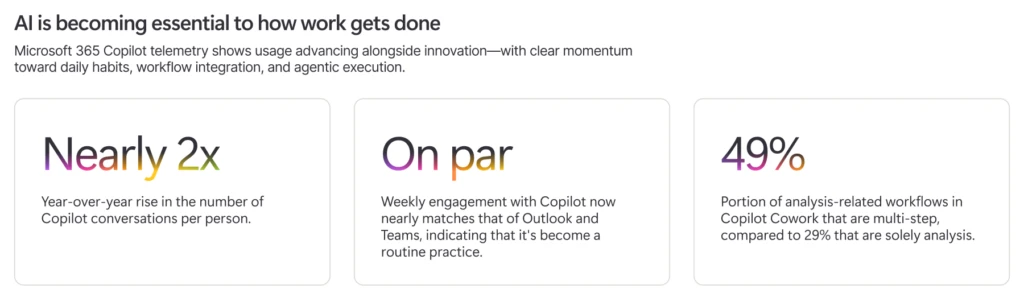
As the technology matures, the way employees interact with AI is becoming both deeper and more frequent. Telemetry data reveals that the number of conversations per user has nearly doubled over the past year. Furthermore, there has been triple-digit growth in the number of users engaging with multiple Copilot features simultaneously. Perhaps most telling is the fact that average weekly engagement with Copilot is now comparable to that of established productivity staples like Microsoft Outlook and Teams.
The nature of the requests being handled by AI is also changing. Users are increasingly moving away from standalone tasks toward multi-step workflows. For instance, a user might ask an agent to analyze a complex dataset and then immediately draft a corresponding executive summary and email. Analysis-related work now accounts for 49% of all tasks when integrated into these multi-step workflows, a significant jump from the 29% observed when analysis is performed as a solitary action. This suggests that AI is no longer just a tool for "quick wins" but is becoming the engine for entire business processes.
While early adopters were concentrated in the banking, manufacturing, and technology sectors, the "agentic" wave is now hitting a broader range of industries. Automotive and healthcare have emerged as some of the fastest-growing sectors for agent adoption. The scale of deployment is also reaching new heights; the number of Microsoft customers with more than 50,000 seats has increased sevenfold year over year. Additionally, the time required for a customer to reach "high usage"—defined as more than 80% monthly active usage across their user base—has plummeted from several months to just a few days.
What AI Makes Possible
The true value of this transformation is found in how organizations are moving beyond simple efficiency toward net-new capabilities. Microsoft’s own Cloud Supply Chain team provides a blueprint for this transition. By adopting a "lean before agents" philosophy, the team first simplified and mapped six end-to-end workflows before deploying over 70 purpose-built agents. This strategic foundation resulted in a 75% reduction in cycle time across fulfillment, logistics, and planning.
Other organizations are using AI to enhance the quality of critical decision-making. At Eaton, an intelligent power management company, an AI-powered quality agent is assisting experts in conducting root cause analysis for manufacturing issues. By reviewing thousands of reports, the agent surfaces trends and supplier insights that might otherwise go unnoticed. This allows Eaton’s human experts to identify risks earlier and take preventative action, keeping the human element at the center of the decision-making process while utilizing AI to handle the data-heavy heavy lifting.
The democratization of agent building is also a major trend. Premera Blue Cross has empowered its employees to build their own AI solutions using Copilot Studio. To date, the health plan provider has seen the creation of over 900 agents. One specific agent designed for intelligent document processing reduced a manual contract review workflow from 45 minutes to just three minutes. This reclaimed time allows staff to focus on member care and complex inquiries rather than administrative backlogs.
In some cases, AI is enabling work that was previously considered impossible to quantify. At Levi Strauss & Co., a finance agent analyzed 1,100 standard operating procedures and cataloged 18,000 individual tasks in a single day. This provided the company with a granular view of its financial operations that human teams could not have produced manually. Similarly, at the global consulting firm EY, an Autonomous Sourcing Agent (ASA) is now handling low-cost, low-risk procurement transactions. The agent can negotiate with multiple suppliers simultaneously on cost and delivery terms, allowing human procurement specialists to focus on high-stakes strategic negotiations.
Specialization at Scale
The most successful organizations are those that have moved away from a "one-size-fits-all" AI deployment. Instead of giving every employee the same general-purpose tool, these firms are tailoring AI to specific roles and personas.
S&P Global, for example, has integrated its commodities research and market insights directly into the flow of work via a specialized Copilot agent in Microsoft Teams. This allows customers to perform data extraction 95% faster and comparative analysis 98% faster than traditional methods. Within Microsoft’s own sales organization, the company has mapped distinct "seller personas" to dedicated agents, including researchers, analysts, and deal agents. By offloading administrative coordination to these agents, sellers have doubled the amount of time they spend in customer-facing activities. This pilot group reported a 9.4% increase in revenue per head and a 20% faster deal closure rate.
In the realm of Human Resources, the marketing data firm Kantar has developed a "people agent" that now resolves 40% of HR queries without human intervention. Employment verification letters, which previously took three days to process, are now delivered in two minutes. Microsoft’s own People Operations team is using a technique called "Frontier Tuning" to scale HR expertise. By capturing the rubrics and standards of human practitioners, they have developed an AI system that delivers a fivefold improvement in successful task completion compared to general-purpose models. This ensures that routine interactions are handled with institutional precision, freeing HR experts to focus on the nuanced, strategic work that requires deep human empathy and judgment.
The Path Forward
As the enterprise landscape continues to shift, the metrics for success are evolving. While seat counts and licenses remain important, the focus is increasingly turning toward the depth of usage, the successful governance of autonomous agents, and the total redesign of workflows.
The organizations currently building a durable competitive advantage are those where technology, operating models, and human agency are evolving in tandem. This convergence is giving rise to what Microsoft describes as the "Frontier Firm"—an organization where AI agents and humans collaborate seamlessly to drive innovation and productivity. As these capabilities move from the laboratory to the core of global industry, the transition from AI as a tool to AI as a teammate appears not only inevitable but already well underway.
 Productivity Software & Office Suites
Microsoft to Headline ESPC 2026 in Amsterdam as the European Tech Community Pivots Toward an Agentic AI Future
As the global landscape of work undergoes its most significant transformation since...
 Productivity Software & Office Suites
Microsoft Announces General Availability of Work IQ APIs, Ushering in the Era of Agentic Software
REDMOND, Wash. — In a move that signals a fundamental transformation in...
 Productivity Software & Office Suites
Microsoft Announces Fifth Annual Power Platform Community Conference in Las Vegas to Address the Future of AI-Driven Business Processes
As modern enterprises continue to navigate an era defined by rapid digital...







