

In some cases, AI is enabling work that was previously considered impossible to quantify. At Levi Strauss & Co., a finance agent analyzed 1,100 standard operating procedures and cataloged 18,000 individual tasks in a single day. This provided the company with a granular view of its financial operations that human teams could not have produced manually. Similarly, at the global consulting firm EY, an Autonomous Sourcing Agent (ASA) is now handling low-cost, low-risk procurement transactions. The agent can negotiate with multiple suppliers simultaneously on cost and delivery terms, allowing human procurement specialists to focus on high-stakes strategic negotiations.
Specialization at Scale
The most successful organizations are those that have moved away from a "one-size-fits-all" AI deployment. Instead of giving every employee the same general-purpose tool, these firms are tailoring AI to specific roles and personas.
S&P Global, for example, has integrated its commodities research and market insights directly into the flow of work via a specialized Copilot agent in Microsoft Teams. This allows customers to perform data extraction 95% faster and comparative analysis 98% faster than traditional methods. Within Microsoft’s own sales organization, the company has mapped distinct "seller personas" to dedicated agents, including researchers, analysts, and deal agents. By offloading administrative coordination to these agents, sellers have doubled the amount of time they spend in customer-facing activities. This pilot group reported a 9.4% increase in revenue per head and a 20% faster deal closure rate.
In the realm of Human Resources, the marketing data firm Kantar has developed a "people agent" that now resolves 40% of HR queries without human intervention. Employment verification letters, which previously took three days to process, are now delivered in two minutes. Microsoft’s own People Operations team is using a technique called "Frontier Tuning" to scale HR expertise. By capturing the rubrics and standards of human practitioners, they have developed an AI system that delivers a fivefold improvement in successful task completion compared to general-purpose models. This ensures that routine interactions are handled with institutional precision, freeing HR experts to focus on the nuanced, strategic work that requires deep human empathy and judgment.
The Path Forward
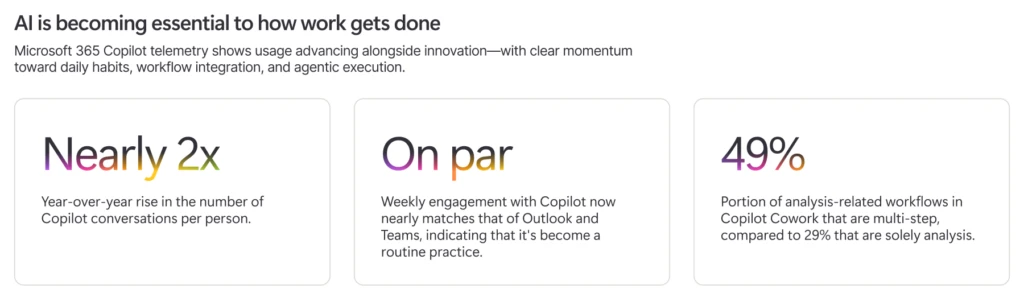
As the enterprise landscape continues to shift, the metrics for success are evolving. While seat counts and licenses remain important, the focus is increasingly turning toward the depth of usage, the successful governance of autonomous agents, and the total redesign of workflows.
The organizations currently building a durable competitive advantage are those where technology, operating models, and human agency are evolving in tandem. This convergence is giving rise to what Microsoft describes as the "Frontier Firm"—an organization where AI agents and humans collaborate seamlessly to drive innovation and productivity. As these capabilities move from the laboratory to the core of global industry, the transition from AI as a tool to AI as a teammate appears not only inevitable but already well underway.
 Productivity Software & Office Suites
Microsoft 365 Copilot Surpasses 30 Million Paid Seats as Enterprise AI Evolves from Assistant to Autonomous Agent
In a landmark update shared during its most recent earnings call, Microsoft...
 Productivity Software & Office Suites
Microsoft Reimagines Copilot as a Proactive AI Ecosystem for the Enterprise
Microsoft has announced a comprehensive overhaul of its Copilot platform, signaling a...
 Productivity Software & Office Suites
Microsoft Unveils Advanced AI Capabilities for Finance Professionals in Excel, Prioritizing Traceability and Real-World Data
The evolution of enterprise technology has historically followed a predictable trajectory. From...







