

This pricing power is a direct result of the supply-demand imbalance. According to Micron’s Chief Financial Officer, Mark Murphy, DRAM bit shipments in the fourth quarter rose by only a single-digit percentage, yet prices increased in the "high teens" percentage range. For flash, bit shipments rose 10 percent, while prices jumped 30 percent. While these are averages across all products, it is widely understood that the price increases for high-end components like HBM and LPDDR were significantly higher, driving the bulk of the profit expansion.
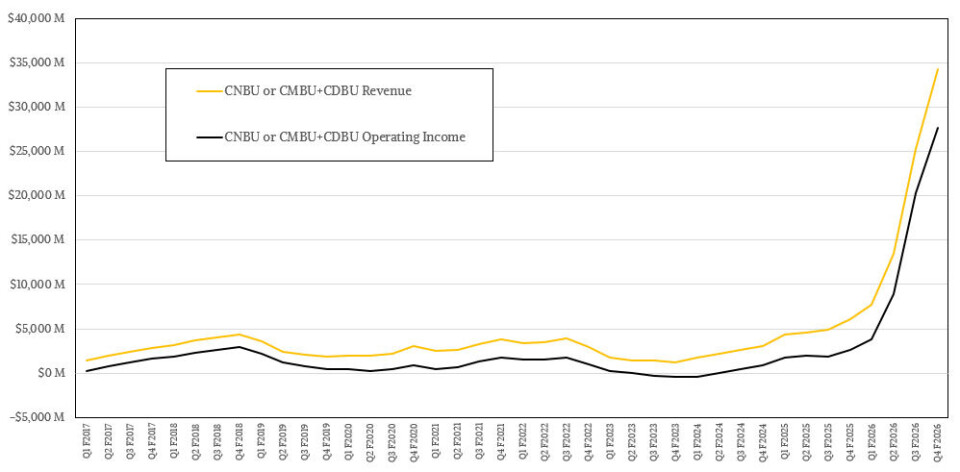
Looking toward the future, Micron is already preparing for the next phase of the AI boom. The company has completed agreements for the majority of its HBM supply through calendar year 2027, with significant year-over-year price increases baked into those deals. This strategy is designed to bring the profit profile of HBM even closer to that of conventional DRAM. The roadmap includes the transition to HBM4 and HBM4E, with Micron specifically highlighting its collaboration with Nvidia on custom HBM4E implementations—branded as NVHBM—which will be integrated into the next generation of GPUs and NVLink Fusion platforms.
However, the path forward is not without technical challenges. As HBM stacks become taller and run at higher speeds, the manufacturing process becomes increasingly difficult. Higher stacks and higher speeds naturally lead to lower yields, as the likelihood of a "dud" stack increases. This manufacturing complexity is one reason why Micron expects memory and flash supply to remain even tighter in 2027 and 2028 than it was in 2026. The company plans to increase its capital expenditures in fiscal 2027 to address these DRAM output constraints, but the physical limits of semiconductor fabrication mean that bit growth will likely remain in the low 20s percentage range.
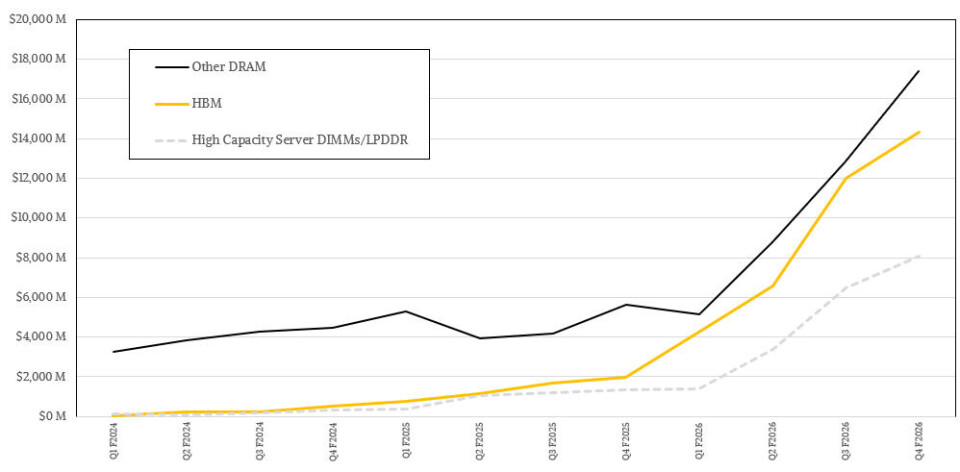
The sheer financial value of these components has reached a level that borders on the surreal. To secure their future needs, customers have already provided Micron with $32 billion in prepayments. The company’s total revenue backlog—fixed-price contracts with committed volumes—now stands at $150 billion, a figure that represents only a portion of its total future sales.
To illustrate the current value of this technology, one can compare HBM to gold. A twelve-high HBM stack weighs approximately a quarter of a gram and carries a market price of $500 to $600. At this rate, a troy ounce of HBM4 would be worth between $62,500 and $75,000. With gold currently trading at roughly $4,176 per troy ounce, a single HBM4 stack is now worth between 15 and 18 times its weight in gold. As the industry looks toward Q1 of fiscal 2027, with projected sales of $61.5 billion, it is clear that Micron and its rivals are operating in a market environment unlike any seen in the history of computing.
 Enterprise Tech & Infrastructure
Cisco Unveils Automated Control Layer to Bridge the Gap Between Isolated Quantum Nodes and Distributed Architectures
In the rapidly evolving landscape of quantum information science, the primary focus...
 Enterprise Tech & Infrastructure
AMD Acquires World Labs for $8.2 Billion to Rival Nvidia in the Frontier of World Models
In a massive strategic move designed to reshape its standing in the...
 Enterprise Tech & Infrastructure
Understanding the Architecture of Modern Storage: Decoding the Relationship Between Flash Technology and Solid-State Drives
In the rapidly evolving landscape of data storage, the terminology used to...







