

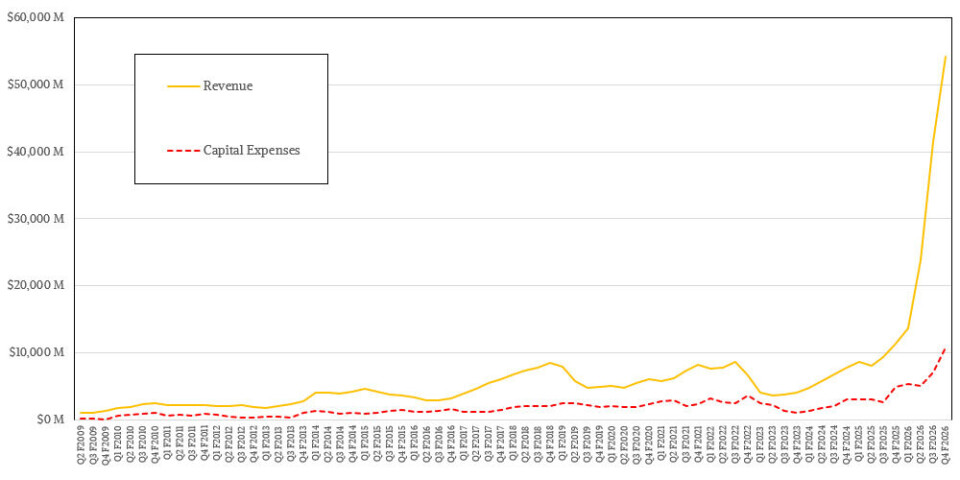
There is a collective understanding among these players that the AI boom is likely to persist through at least 2028, and potentially into 2030. By managing capacity tightly, they are ensuring that unit prices remain high. The industry is currently enjoying a "golden hour" where the objective is to perform the minimum necessary work for the maximum possible revenue at the lowest possible cost.
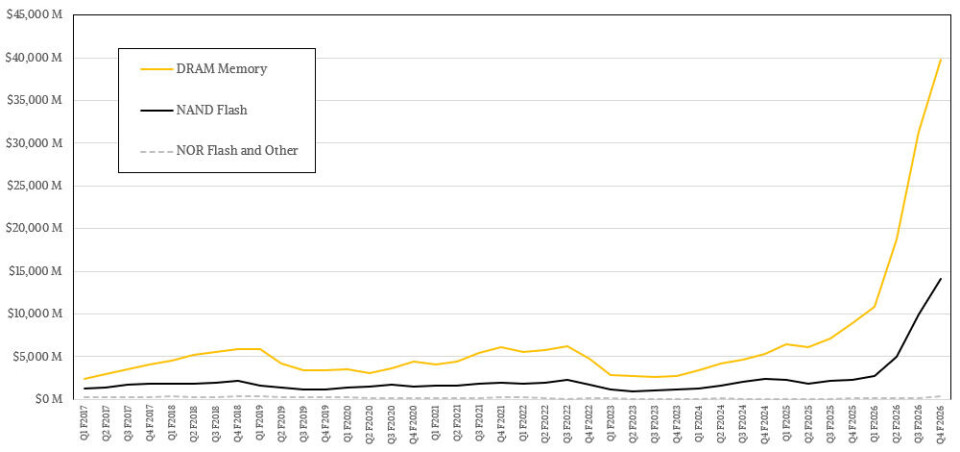
While HBM is the star of the show, the broader DRAM business remains a massive revenue generator. This segment includes low-power LPDDR memory, increasingly vital for edge AI and specific server configurations, as well as high-capacity server memory and standard DRAM for the PC and mobile markets. Micron’s DRAM business grew 4.4-fold to $39.77 billion in the quarter. Interestingly, despite the focus on HBM, it was actually the flash non-volatile storage segment that saw the fastest growth, with sales increasing 6.2-fold to $14.1 billion.
This growth in flash highlights a secondary pillar of the AI infrastructure. While DRAM provides the speed, NAND flash provides the scale required for the massive datasets used in training and inference. While NAND foundries are generally cheaper and faster to bring online than their DRAM counterparts, the complexity of DRAM manufacturing—particularly the clean-room requirements—ensures that DRAM capacity will remain the tighter bottleneck for the foreseeable future.
The Competitive Landscape and the China Factor
As Micron scales its operations, it is keeping a wary eye on international competition, particularly from China. Scott DeBoer, Micron’s Chief Technology Officer, recently noted that the company maintains a two-generation lead over ChangXin Memory Technologies (CXMT), China’s primary indigenous memory manufacturer.
The geopolitical stakes are high. CXMT recently went public on the Shanghai Stock Exchange, raising $8.6 billion—a significant sum, yet a fraction of the profits currently being generated by Micron and its South Korean rivals. China is deeply committed to achieving self-sufficiency in memory production and eventually competing on the global stage. Micron’s strategy is to maintain its technological lead to prevent its customer base from migrating to Chinese alternatives, ensuring that its premium pricing remains protected by a wall of intellectual property and manufacturing sophistication.
The Economics of the Datacenter
The internal structure of Micron’s revenue reveals where the real power lies. The company’s Cloud Memory business unit, which is primarily driven by HBM, is currently seeing extraordinary margins. In fiscal Q4, this unit reported sales of $16.28 billion, up 3.6-fold year-on-year. The gross income for this segment was a remarkable 83 percent of sales, with operating income at 76 percent.
This pricing power is almost unprecedented in the hardware world. According to Micron’s Chief Financial Officer, Mark Murphy, while bit shipments for DRAM rose by only a single-digit percentage, prices increased in the "high teens" range. For flash, bit shipments rose 10 percent, but prices jumped 30 percent. These averages, however, likely mask even more dramatic price hikes for specialized AI components like HBM and high-end server DRAM.
 Enterprise Tech & Infrastructure
Optimizing Amazon S3: How Enterprises Navigate the Hidden Complexities of Cloud Storage Costs
The primary catalyst for overspending on Amazon Simple Storage Service (S3) is...
 Enterprise Tech & Infrastructure
Understanding the Architecture of Modern Storage: Decoding the Relationship Between Flash Technology and Solid-State Drives
In the rapidly evolving landscape of data storage, the terminology used to...
 Enterprise Tech & Infrastructure
From Theory to Engineering: Quantum Computing Reaches a Commercial Tipping Point as Industry Giants Prepare for a Hybrid Future
The long-anticipated transition of quantum computing from a theoretical pursuit of physics...







