

In the sweeping six-decade history of commercial information technology, certain milestones stand out as the ultimate drivers of corporate wealth and industrial transformation. For decades, the benchmark for high-margin, high-impact hardware was the IBM mainframe. In the 1970s, the monolithic systems technology of the System/370 defined the era, followed in the 1980s by the thermal conduction module packaging of the System/3081. These were the engines of the global economy, commanding massive premiums and delivering unprecedented profits.
However, a new contender has emerged that may well eclipse the legendary profitability of the mainframe. High Bandwidth Memory (HBM), specifically stacked DRAM, is currently positioning itself as perhaps the most lucrative product ever conceived in the IT sector. While historical comparisons depend on how one allocates costs and revenues across vastly different eras of computing, the current trajectory of HBM packaging suggests it has surpassed the golden age of Big Blue’s hardware dominance.
The valuation of advanced packaging has never been higher, and its importance has never been more critical. As the generative AI revolution continues to reshape the global economy, the growth of the HBM market—and the subsequent financial performance of its primary architects, Micron Technology, Samsung, and SK Hynix—is skyrocketing at a pace that far outstrips the historical growth of the mainframe. This phenomenon is more than just a financial trend; it is the fundamental infrastructure underpinning the meteoric rise of Nvidia and AMD. Without the high-bandwidth stacked DRAM produced by these three firms, the GenAI revolution would have been a technical impossibility.
A Financial Performance for the Ages
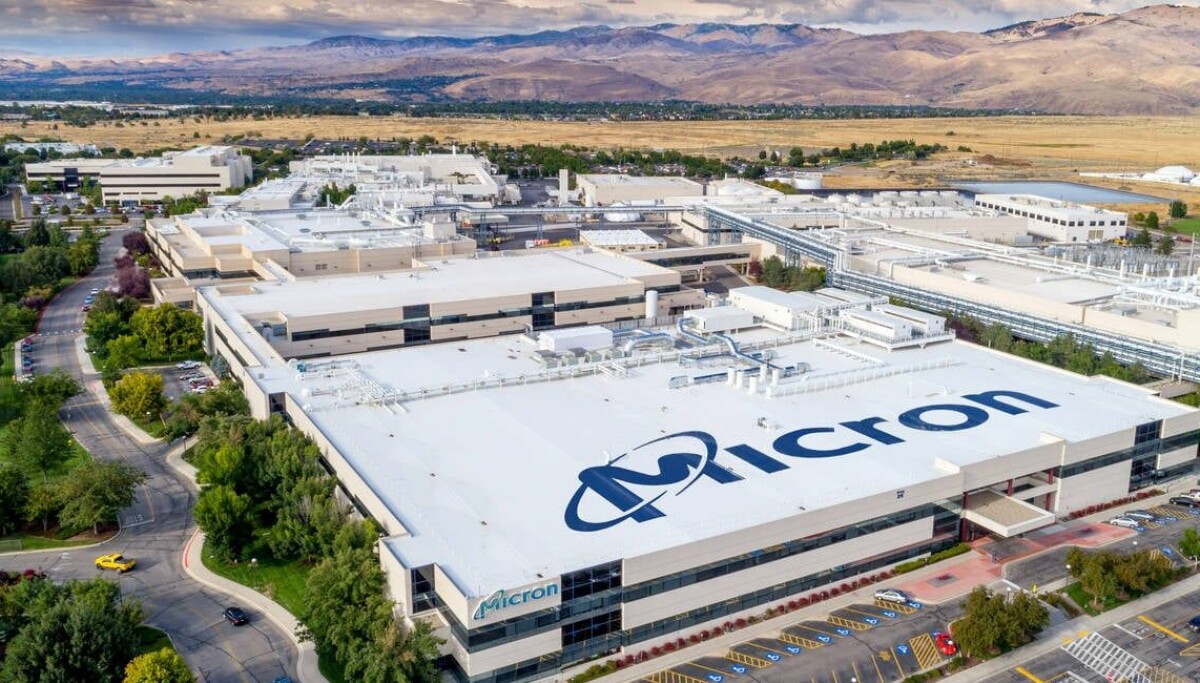
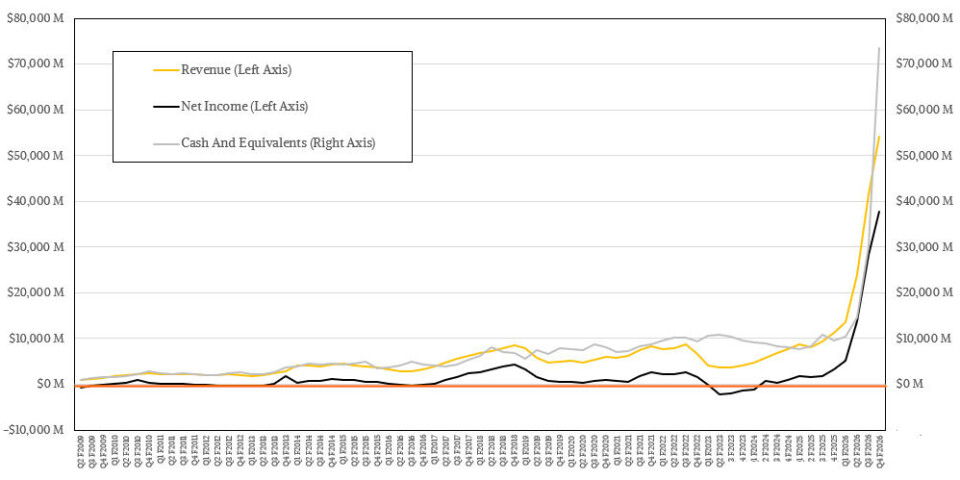
The scale of this boom is best illustrated by the most recent financial results from Micron Technology. For its fiscal 2026, which concluded on September 3, the company reported numbers that can only be described as staggering. Micron’s quarterly revenues surged to $54.23 billion, representing a 4.8-fold increase year-on-year. The profitability metrics were even more aggressive: operating income rose nearly 12-fold compared to the previous year, reaching $43.75 billion, while net income followed a similar 12-fold trajectory to hit $37.7 billion.
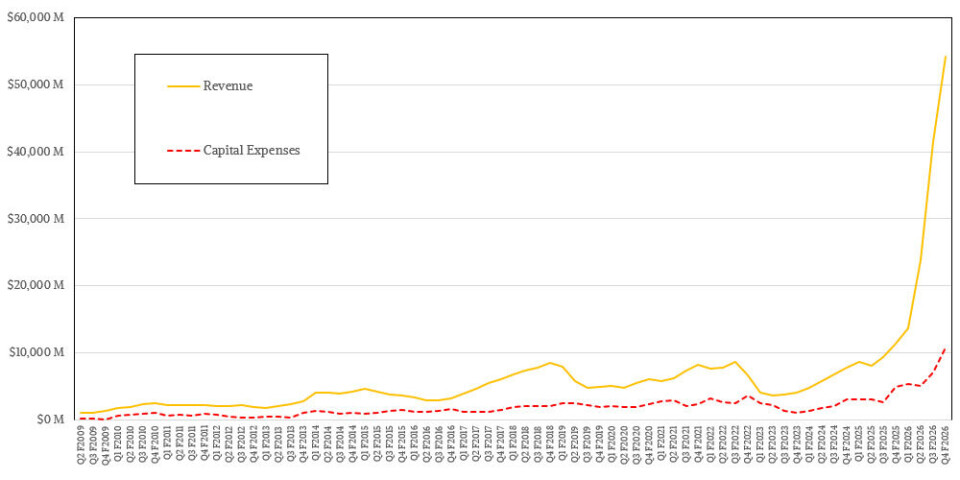
Perhaps most impressively, Micron is currently bringing 69.5 percent of its total revenue directly to the bottom line. Despite this massive influx of capital, the company is maintaining a disciplined approach to expansion. With $73.45 billion in cash on hand—a 7.6-fold increase from the prior year—Micron has the liquidity to build nearly four new fabrication plants (fabs) immediately. Yet, it limited its capital expenditures to $10.77 billion during the period.
This restraint highlights a fundamental reality of semiconductor manufacturing: complexity cannot be bypassed by sheer capital. Building a modern foundry is a serial process that defies parallelization; as the industry saying goes, you cannot have nine women produce a baby in one month. Beyond the physical limitations of construction, Micron and its peers are exercising a level of strategic discipline reminiscent of OPEC’s management of oil supplies.
The End of the Boom-Bust Cycle?
Historically, the memory business has been defined by volatile boom-bust cycles. Manufacturers would traditionally overproduce during periods of high demand, leading to an eventual oversupply that crashed prices and wiped out margins. In the current era, however, the major DRAM and flash vendors appear determined to avoid this pitfall. With demand for AI hardware continuing to outpace supply, Micron, Samsung, and SK Hynix are prioritizing margin preservation and price stability over market share grabs.
There is a collective understanding among these players that the AI boom is likely to persist through at least 2028, and potentially into 2030. By managing capacity tightly, they are ensuring that unit prices remain high. The industry is currently enjoying a "golden hour" where the objective is to perform the minimum necessary work for the maximum possible revenue at the lowest possible cost.
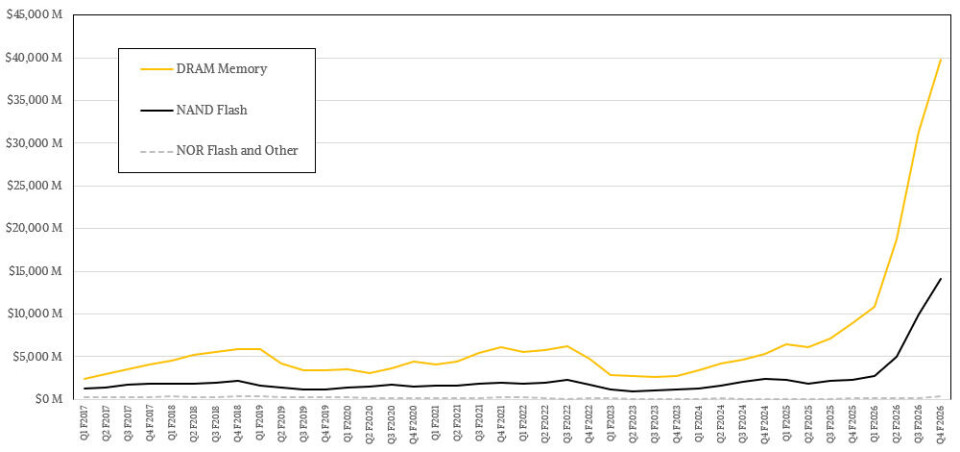
While HBM is the star of the show, the broader DRAM business remains a massive revenue generator. This segment includes low-power LPDDR memory, increasingly vital for edge AI and specific server configurations, as well as high-capacity server memory and standard DRAM for the PC and mobile markets. Micron’s DRAM business grew 4.4-fold to $39.77 billion in the quarter. Interestingly, despite the focus on HBM, it was actually the flash non-volatile storage segment that saw the fastest growth, with sales increasing 6.2-fold to $14.1 billion.
This growth in flash highlights a secondary pillar of the AI infrastructure. While DRAM provides the speed, NAND flash provides the scale required for the massive datasets used in training and inference. While NAND foundries are generally cheaper and faster to bring online than their DRAM counterparts, the complexity of DRAM manufacturing—particularly the clean-room requirements—ensures that DRAM capacity will remain the tighter bottleneck for the foreseeable future.
The Competitive Landscape and the China Factor
As Micron scales its operations, it is keeping a wary eye on international competition, particularly from China. Scott DeBoer, Micron’s Chief Technology Officer, recently noted that the company maintains a two-generation lead over ChangXin Memory Technologies (CXMT), China’s primary indigenous memory manufacturer.
The geopolitical stakes are high. CXMT recently went public on the Shanghai Stock Exchange, raising $8.6 billion—a significant sum, yet a fraction of the profits currently being generated by Micron and its South Korean rivals. China is deeply committed to achieving self-sufficiency in memory production and eventually competing on the global stage. Micron’s strategy is to maintain its technological lead to prevent its customer base from migrating to Chinese alternatives, ensuring that its premium pricing remains protected by a wall of intellectual property and manufacturing sophistication.
The Economics of the Datacenter
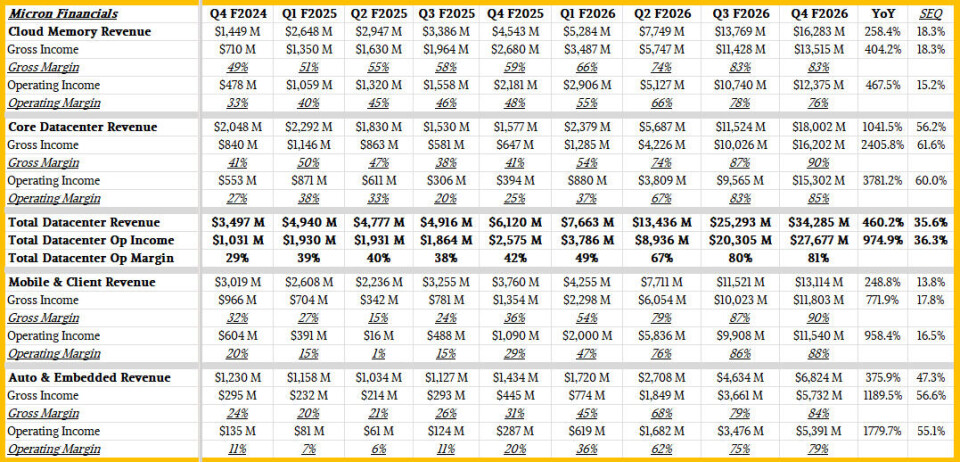
The internal structure of Micron’s revenue reveals where the real power lies. The company’s Cloud Memory business unit, which is primarily driven by HBM, is currently seeing extraordinary margins. In fiscal Q4, this unit reported sales of $16.28 billion, up 3.6-fold year-on-year. The gross income for this segment was a remarkable 83 percent of sales, with operating income at 76 percent.
This pricing power is almost unprecedented in the hardware world. According to Micron’s Chief Financial Officer, Mark Murphy, while bit shipments for DRAM rose by only a single-digit percentage, prices increased in the "high teens" range. For flash, bit shipments rose 10 percent, but prices jumped 30 percent. These averages, however, likely mask even more dramatic price hikes for specialized AI components like HBM and high-end server DRAM.
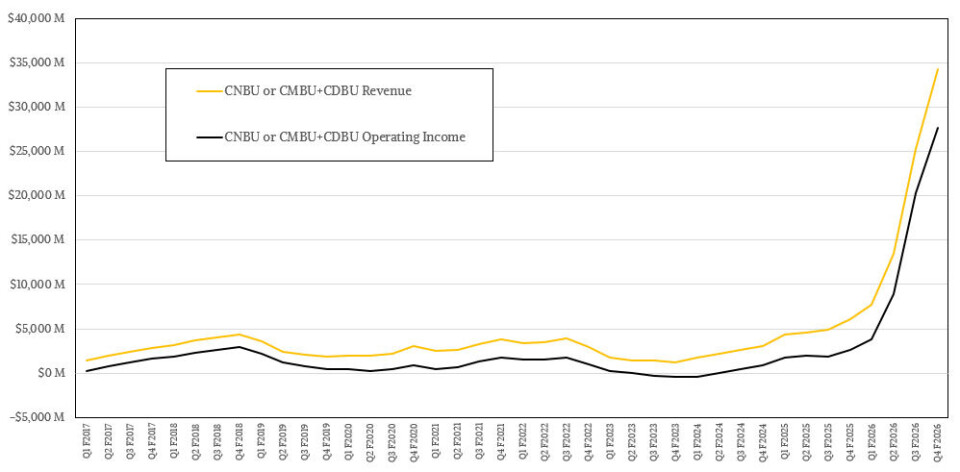
When combining the Cloud Memory unit with the Core Datacenter business—which handles standard DRAM and flash for enterprise use—the total datacenter revenue reached $34.29 billion. This represents a 5.6-fold increase year-on-year. The operating income from these datacenter products accounted for 81 percent of their total revenue, illustrating that the modern server farm has become the most profitable environment in Micron’s history.
Looking Toward HBM4 and the Future of Custom Silicon
The roadmap for the next several years suggests that this trend will only intensify. Micron CEO Sanjay Mehrotra has confirmed that the company has already secured agreements for the majority of its HBM supply through the 2027 calendar year. These deals include significant year-over-year price increases intended to bring the profit profile of HBM even closer to that of conventional DRAM, which currently benefits from more mature manufacturing yields.
The industry is now looking toward the HBM4 and HBM4E cycles. Micron is working closely with Nvidia on the first custom-HBM4E implementation, known as NVHBM. This technology will be integrated into the next generation of Nvidia GPUs and NVLink Fusion platforms, further tightening the bond between the memory providers and the chip designers.
However, the path forward is not without technical hurdles. As HBM stacks grow taller—moving from eight to twelve and eventually sixteen layers—and speeds increase, the manufacturing complexity rises exponentially. Higher stacks are more prone to defects, meaning the "yield" (the percentage of functional units) tends to decrease. This inherent difficulty in manufacturing acts as a natural limit on supply, which in turn supports the high pricing levels. Micron anticipates that DRAM bit growth will slow slightly in 2027 and 2028 as the industry grapples with these technical challenges, while flash capacity will likely expand more rapidly.
Conclusion: A Market Worth More Than Gold
The current state of the memory market is perhaps best summarized by the sheer value of the product being shipped. A twelve-high HBM stack weighs approximately a quarter of a gram. Depending on the contract, one of these stacks can cost between $500 and $600. To put that in perspective, it takes about 125 of these stacks to equal one troy ounce.
At these rates, the cost of HBM4 reaches between $62,500 and $75,000 per troy ounce. With gold currently trading at approximately $4,176 per troy ounce, a single HBM4 stack is worth between 15 and 18 times its weight in gold.
This "strange new world" of semiconductor economics is driven by a desperate need for bandwidth in the age of artificial intelligence. Micron’s customers have already provided $32 billion in prepayments just to secure their place in line, contributing to the company’s massive cash reserves. With a revenue backlog of $150 billion in fixed-price contracts, Micron has effectively locked in its prosperity for the remainder of the decade. While the mainframe era was defined by the size of the machines, the GenAI era is being defined by the incredible value packed into the microscopic layers of stacked DRAM. For now, Micron is not just participating in the AI revolution; it is reaping the rewards of providing the essential, high-priced fuel that makes it possible.
 Enterprise Tech & Infrastructure
The Hidden Architecture of Amazon S3 Costs: Why the Per-Gigabyte Rate is Only the Tip of the Iceberg
For many enterprise IT leaders, the initial appeal of Amazon S3 lies...
 Enterprise Tech & Infrastructure
Navigating the Hidden Complexities of Amazon S3 Cost Management for Enterprise Storage
In the modern enterprise landscape, cloud storage has transitioned from a simple...
 Enterprise Tech & Infrastructure
Decoding the Total Cost of Ownership: A Strategic Approach to Amazon S3 Storage Optimization
For the modern enterprise, the Amazon S3 bill is frequently a source...







