
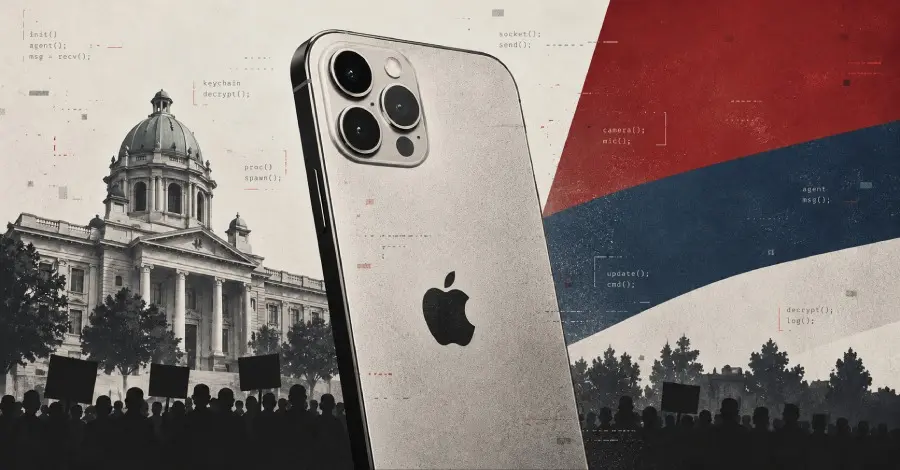
The digital landscape in Serbia has become a front line for political surveillance as new forensic evidence reveals that high-profile members of academia and the judiciary have been targeted by sophisticated mercenary spyware. In a report released on October 19, the Citizen Lab, a renowned research group based at the University of Toronto’s Munk School of Global Affairs & Public Policy, confirmed that the iPhone of Vladan Đokić, the rector of the University of Belgrade, was infected with NSO Group’s Pegasus spyware. The discovery comes at a moment of intense political sensitivity, appearing just six days before Serbia is scheduled to hold a snap parliamentary election on October 25, 2026.
The infection of Rector Đokić’s device is particularly notable due to the method of delivery. According to the Citizen Lab, the attack utilized a "zero-click" exploit. Unlike traditional phishing attempts that require a user to interact with a malicious link or download a compromised file, a zero-click exploit allows the spyware to install itself silently without any action from the victim. This level of sophistication is a hallmark of Pegasus, a tool developed by the Israeli firm NSO Group and marketed exclusively to government agencies for the stated purpose of combating terrorism and serious crime. However, the rector is a prominent figure within Serbia’s academic community and a known supporter of the country’s student protest movement, raising questions about the political motivations behind the surveillance.
While the Citizen Lab expressed high confidence in its findings regarding the infection, the researchers noted that their investigation remains ongoing. The current data confirms that the infection occurred within the year 2026, though a specific date has not yet been pinpointed. Furthermore, the technical analysis does not explicitly identify the entity responsible for deploying the spyware. NSO Group has long maintained that it does not operate the software itself, but rather licenses it to state clients.
The timing of this revelation is inextricably linked to the broader political unrest that has gripped Serbia for nearly two years. The upcoming parliamentary elections were called in September 2026 following a prolonged period of civil dissatisfaction and mass demonstrations. This wave of protests was originally ignited by a tragedy in November 2024, when a concrete canopy at the Novi Sad railway station collapsed, resulting in the deaths of 16 people. The incident became a catalyst for widespread anger over alleged government corruption, poor infrastructure oversight, and a lack of institutional accountability. Rector Đokić’s vocal support for the student activists who emerged as leaders in these protests has placed him at the center of the country’s civic discourse.

The investigation into Đokić’s phone was initiated at his own request and conducted in collaboration with the SHARE Foundation, a leading Serbian digital rights organization. The SHARE Foundation has been at the forefront of documenting digital repression in the region, having previously led an investigation into a separate wave of spyware cases that were made public in September. The emergence of Đokić’s case suggests that the scope of surveillance is broader and more persistent than previously understood.
In addition to the rector, another significant case has surfaced involving Rade Bajić, a senior prosecutorial associate at Serbia’s Public Prosecutor’s Office for Organized Crime. Bajić’s situation came to light through official channels when he received an Apple Threat Notification on August 13, followed by a reminder on August 27. Apple issues these alerts to users when it detects patterns of activity consistent with an attack by mercenary spyware. While these notifications are a strong indicator of targeting, they do not specify the perpetrator. The Citizen Lab views the receipt of such a notification as a high-confidence sign that Bajić’s device was likely targeted for intrusion. Forensic analysis of his phone is currently underway to determine if a successful infection occurred.
The targeting of Bajić is particularly sensitive given his professional history. He was a key figure in the "Generalštab" corruption investigation, a high-stakes case involving the proposed redevelopment of Belgrade’s former army General Staff complex. The site, which remains a scarred landmark from the 1999 NATO bombings, was the subject of a controversial plan to remove its heritage protection status to make way for a luxury development project. This project is backed by a company linked to Jared Kushner, the son-in-law of former U.S. President Donald Trump.
The Generalštab case has already led to significant legal action. In December 2025, Serbian prosecutors charged Culture Minister Nikola Selaković and three other high-ranking officials with abuse of office and the falsification of documents related to the project. Bajić, however, has alleged that his involvement in the case was deliberately curtailed. He stated that he was removed from the investigation in November 2025 without a formal explanation. Following his removal, Bajić took the unusual step for a legal official of speaking publicly at a protest organized by student activists outside Serbia’s Constitutional Court in February, where he detailed the inner workings of the investigation.
The capabilities of Pegasus spyware make these targeting efforts especially alarming to civil rights advocates. Once installed, Pegasus effectively grants the operator the same level of access to the device as the owner. This includes the ability to read private and encrypted messages, harvest photos and location data, and even remotely activate the phone’s microphone and camera to monitor conversations in real-time. The Citizen Lab’s previous analysis of Serbian cases in September highlighted these intrusive capabilities, emphasizing that the spyware turns a personal device into a permanent surveillance tool.

In a formal statement published by the University of Belgrade, Rector Đokić characterized the presence of the spyware on his phone as "another attempt of intimidation." He has called for an immediate and independent investigation into the breach, demanding that the results be made public and that those responsible for installing and operating the spyware be prosecuted. The rector’s concerns regarding state pressure are not unfounded; he previously reported that police raided his university offices on March 31, 2026, seizing computers and servers as part of an unspecified inquiry.
The Serbian government’s civilian security service, the Security Information Agency (BIA), has consistently denied allegations of illegal surveillance. Following the initial reports in September that student activists and opposition politicians had been targeted, the BIA issued a statement dismissing the claims as "purely trivial sensationalism." The agency asserted that it operates strictly within the framework of Serbian law and respects the privacy rights of citizens. Despite these denials, the volume of reported cases continues to grow.
By the Citizen Lab’s current count, at least 16 individuals within Serbian civil society are now known to have been targeted or infected with mercenary spyware this year alone. This includes a diverse group of student activists, an opposition Member of Parliament, and a local councilor. The SHARE Foundation reported that 12 of these individuals received Apple Threat Notifications in August, coinciding with a global alert from Apple that warned users in 110 different countries about potential state-sponsored hacking attempts.
Among those confirmed to have been infected is Jelena Kontić, a student activist whose device was compromised by Pegasus. Other cases identified by researchers involved a different type of surveillance tool known as NoviSpy. Unlike Pegasus, which is often associated with iOS exploits, NoviSpy is an Android-based spyware. Reports from Amnesty International in late 2024 suggested that NoviSpy was configured to transmit stolen data to a server with an IP address belonging to the BIA. Furthermore, Amnesty’s findings indicated that the spyware was sometimes installed manually on the phones of journalists and activists during police questioning, often after the devices were unlocked using forensic tools such as those provided by Cellebrite.
The legal response to these discoveries has been met with significant hurdles. On October 6, lawyers representing Jelena Kontić filed a criminal complaint against unidentified individuals within the BIA and the Serbian police, as well as the management of NSO Group. The SHARE Foundation has noted that because Pegasus is sold exclusively to government entities, the presence of the software strongly implies state involvement. However, previous complaints regarding digital surveillance in Serbia have rarely resulted in transparent investigations or legal accountability.

The technical specifics of the exploit used against Rector Đokić’s phone have not been publicly disclosed, and the Citizen Lab’s note did not specify whether current versions of Apple’s iOS include a patch for the vulnerability. As a result, there is no specific software update that users can install to address this particular threat. Instead, security experts continue to recommend broader protective measures for individuals at high risk of state targeting. These recommendations include the use of Apple’s "Lockdown Mode," which significantly reduces the device’s attack surface by disabling certain features, and ensuring that all software is kept strictly up to date to defend against known vulnerabilities.
As the October 25 election approaches, the revelation of widespread spyware use has added a layer of digital tension to an already volatile political environment. The targeting of a university rector and a corruption prosecutor suggests that the tools of "mercenary" surveillance are being deployed far beyond the traditional boundaries of national security, reaching deep into the institutions of education and law. For Serbia’s civil society, the challenge remains not only to secure their communications but to seek accountability in a system where the lines between security and surveillance appear increasingly blurred.
 Cybersecurity Basics & Security News
MALFEX Campaign Persists as Researchers Uncover Malicious Native Loader in Popular npm Registry
Cybersecurity researchers have identified a sophisticated new entry in the ongoing software...
 Cybersecurity Basics & Security News
GitHub Actions Compromised in ‘Mini Shai-Hulud’ Attack Disabled Again Following Brief Reappearance
The cybersecurity landscape has been reminded once again of the persistent and...
 Cybersecurity Basics & Security News
Google Intelligence Report Warns of Paradigm Shift as Threat Actors Deploy Autonomous Agentic AI Frameworks
In a comprehensive assessment that underscores a fundamental transformation in the digital...







