

The targeting of Bajić is particularly sensitive given his professional history. He was a key figure in the "Generalštab" corruption investigation, a high-stakes case involving the proposed redevelopment of Belgrade’s former army General Staff complex. The site, which remains a scarred landmark from the 1999 NATO bombings, was the subject of a controversial plan to remove its heritage protection status to make way for a luxury development project. This project is backed by a company linked to Jared Kushner, the son-in-law of former U.S. President Donald Trump.
The Generalštab case has already led to significant legal action. In December 2025, Serbian prosecutors charged Culture Minister Nikola Selaković and three other high-ranking officials with abuse of office and the falsification of documents related to the project. Bajić, however, has alleged that his involvement in the case was deliberately curtailed. He stated that he was removed from the investigation in November 2025 without a formal explanation. Following his removal, Bajić took the unusual step for a legal official of speaking publicly at a protest organized by student activists outside Serbia’s Constitutional Court in February, where he detailed the inner workings of the investigation.
The capabilities of Pegasus spyware make these targeting efforts especially alarming to civil rights advocates. Once installed, Pegasus effectively grants the operator the same level of access to the device as the owner. This includes the ability to read private and encrypted messages, harvest photos and location data, and even remotely activate the phone’s microphone and camera to monitor conversations in real-time. The Citizen Lab’s previous analysis of Serbian cases in September highlighted these intrusive capabilities, emphasizing that the spyware turns a personal device into a permanent surveillance tool.

In a formal statement published by the University of Belgrade, Rector Đokić characterized the presence of the spyware on his phone as "another attempt of intimidation." He has called for an immediate and independent investigation into the breach, demanding that the results be made public and that those responsible for installing and operating the spyware be prosecuted. The rector’s concerns regarding state pressure are not unfounded; he previously reported that police raided his university offices on March 31, 2026, seizing computers and servers as part of an unspecified inquiry.
The Serbian government’s civilian security service, the Security Information Agency (BIA), has consistently denied allegations of illegal surveillance. Following the initial reports in September that student activists and opposition politicians had been targeted, the BIA issued a statement dismissing the claims as "purely trivial sensationalism." The agency asserted that it operates strictly within the framework of Serbian law and respects the privacy rights of citizens. Despite these denials, the volume of reported cases continues to grow.
 Cybersecurity Basics & Security News
Critical OpenAI Vulnerability Allowed Attackers to Hijack ChatGPT Sessions via Malicious Shared Links
In a significant discovery for the landscape of artificial intelligence security, researchers...
 Cybersecurity Basics & Security News
The Silent Proliferation: Enterprise Security Grapples with the Rise of Invisible AI Agents
As the enterprise landscape prepares for the full-scale integration of artificial intelligence,...
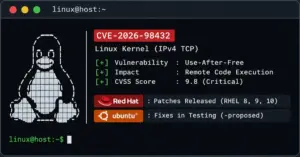 Cybersecurity Basics & Security News
Critical Linux Kernel TCP Vulnerability Triggers Urgent Patching Cycle Across Enterprise Distributions
A severe security flaw residing within the Linux kernel’s networking stack has...







