
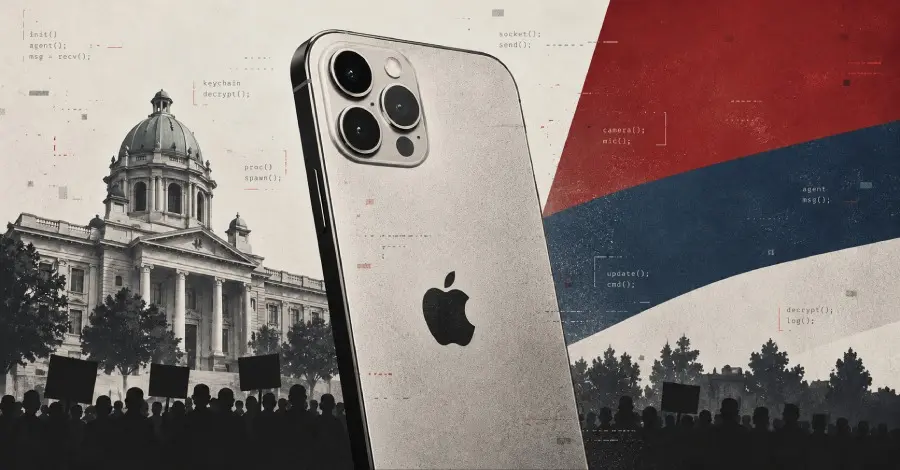
By the Citizen Lab’s current count, at least 16 individuals within Serbian civil society are now known to have been targeted or infected with mercenary spyware this year alone. This includes a diverse group of student activists, an opposition Member of Parliament, and a local councilor. The SHARE Foundation reported that 12 of these individuals received Apple Threat Notifications in August, coinciding with a global alert from Apple that warned users in 110 different countries about potential state-sponsored hacking attempts.
Among those confirmed to have been infected is Jelena Kontić, a student activist whose device was compromised by Pegasus. Other cases identified by researchers involved a different type of surveillance tool known as NoviSpy. Unlike Pegasus, which is often associated with iOS exploits, NoviSpy is an Android-based spyware. Reports from Amnesty International in late 2024 suggested that NoviSpy was configured to transmit stolen data to a server with an IP address belonging to the BIA. Furthermore, Amnesty’s findings indicated that the spyware was sometimes installed manually on the phones of journalists and activists during police questioning, often after the devices were unlocked using forensic tools such as those provided by Cellebrite.
The legal response to these discoveries has been met with significant hurdles. On October 6, lawyers representing Jelena Kontić filed a criminal complaint against unidentified individuals within the BIA and the Serbian police, as well as the management of NSO Group. The SHARE Foundation has noted that because Pegasus is sold exclusively to government entities, the presence of the software strongly implies state involvement. However, previous complaints regarding digital surveillance in Serbia have rarely resulted in transparent investigations or legal accountability.

The technical specifics of the exploit used against Rector Đokić’s phone have not been publicly disclosed, and the Citizen Lab’s note did not specify whether current versions of Apple’s iOS include a patch for the vulnerability. As a result, there is no specific software update that users can install to address this particular threat. Instead, security experts continue to recommend broader protective measures for individuals at high risk of state targeting. These recommendations include the use of Apple’s "Lockdown Mode," which significantly reduces the device’s attack surface by disabling certain features, and ensuring that all software is kept strictly up to date to defend against known vulnerabilities.
As the October 25 election approaches, the revelation of widespread spyware use has added a layer of digital tension to an already volatile political environment. The targeting of a university rector and a corruption prosecutor suggests that the tools of "mercenary" surveillance are being deployed far beyond the traditional boundaries of national security, reaching deep into the institutions of education and law. For Serbia’s civil society, the challenge remains not only to secure their communications but to seek accountability in a system where the lines between security and surveillance appear increasingly blurred.
 Cybersecurity Basics & Security News
Unmasking Lunex: The Rapid Expansion of a Sophisticated Malware-as-a-Service Platform Targeting Ukraine
The cybersecurity landscape is witnessing the emergence of a highly sophisticated Malware-as-a-Service...
 Cybersecurity Basics & Security News
GMO Internet Group Launches $1 Million Global Bounty After Refusing $50 Million Cyber-Extortion Demand
In a decisive counter-offensive against cyber-extortionists, the Japanese technology conglomerate GMO Internet...
 Cybersecurity Basics & Security News
AI vs. AI: How Researchers Used Claude Opus 5 to Breach OpenAI’s Internal Systems
In a sophisticated demonstration of the "double-edged sword" nature of generative artificial...







