
Security and encryption are integrated via host packages, enabling native OpenPGP support. This allows users to read, sign, and encrypt communications securely from within the desktop environment, provided their local system is configured with the necessary cryptographic packages.
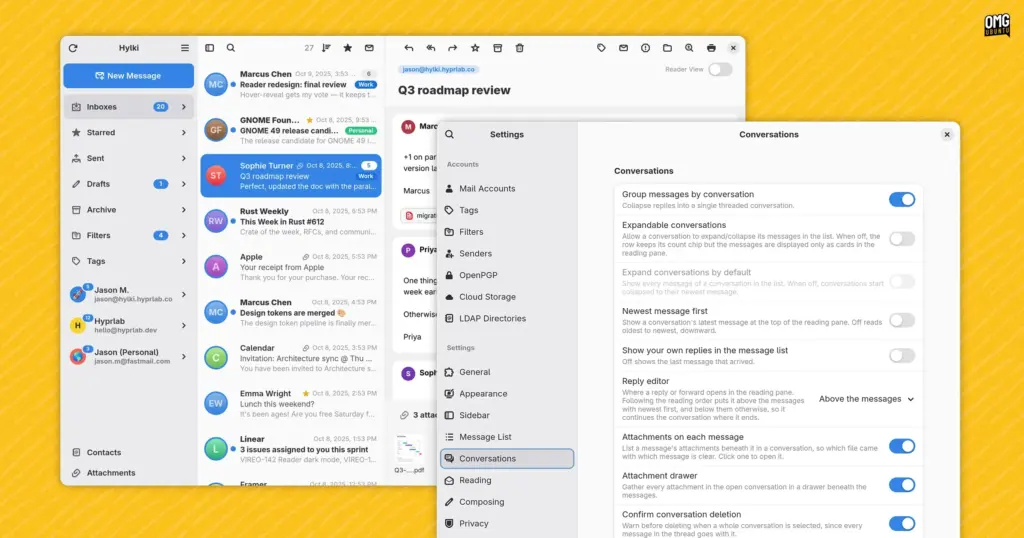
Beyond core mechanics, Hylki incorporates a notable selection of modern reading amenities. A built-in "reader mode" allows users to strip incoming messages of complex marketing templates, nested tracking structures, and visual noise, reducing emails to clean, distraction-free text. For focused writing and reading sessions, a dedicated "focus mode" hides peripheral toolbars, folder sidebars, and administrative interface elements, leaving only the primary reading pane visible.
The application also integrates closely with the broader GNOME ecosystem through native GNOME Contacts compatibility. It accommodates user muscle memory by offering Gmail-style single-key keyboard shortcuts, intuitive gesture controls, and a background application mode that allows the program to monitor incoming mail unobtrusively. Users can choose to run the client in an interface language distinct from the broader operating system’s default locale. Modern convenience features—such as one-click unsubscription links for promotional newsletters and visual thumbnail previews for common file attachments—are built directly into the reading pane.
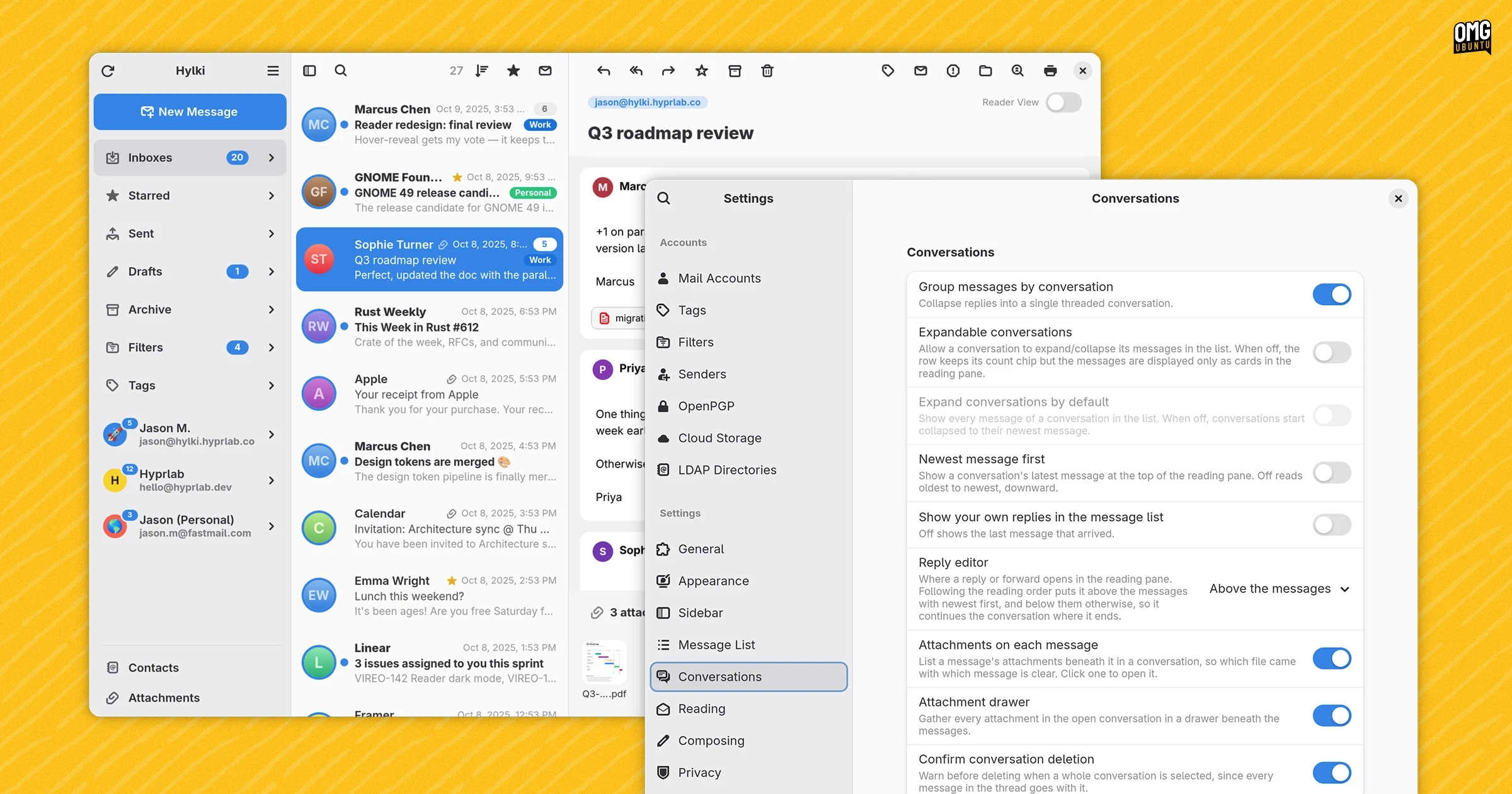
Where Hylki departs most dramatically from typical libadwaita applications is its sheer degree of configurability. Modern GNOME software often adheres to an opinionated philosophy that minimizes user-facing knobs and dials in favor of consistent defaults. Hylki deliberately balances that visual polish with an extensive settings menu. Users can adjust the number of lines visible in inline message previews, customize and rearrange the order of functional buttons across the application toolbar, and define local mail filtering rules to automate organizational triage. The software even bundles an internal collection of alternative themes and distinct application icons, granting users a level of visual agency rarely found in standard GTK4 utilities.
It’s been made by an LLM – with direction
Underneath its polished interface lies a development narrative that will undoubtedly spark debate among open-source developers and software purists. According to the project’s maintainer, the overwhelming majority of Hylki’s Rust codebase was generated using Anthropic’s Claude large language model.
As stated plainly on the project’s official documentation: “The large majority of the Rust code in […] was written with Anthropic’s Claude.”
The developer emphasizes that this process was not an autonomous release of unchecked code. Instead, the artificial intelligence was utilized as a programmatic tool operating under specific human guidance. Every piece of machine-generated output was reviewed, refactored, and tested by a human maintainer who personally evaluates and signs off on every functional release.
Crucially, the client itself does not contain any integrated generative AI features. There are no local neural networks or external cloud-based endpoints analyzing messages, summarizing conversations, or generating automated responses. By omitting client-side AI routines, Hylki sidesteps the serious data privacy and reliability risks that emerge when an LLM operates directly on private communications, preventing scenarios where machine hallucinations might inadvertently mishandle, misread, or misroute sensitive correspondence.
Visual assets within the project have followed a strictly human path. Hylki—a name derived from an Icelandic word meaning "capsule"—features original visual design work, with its primary logo and desktop application icon hand-drawn by designer Yiannis Ioannides.
 Linux & Open Source Solutions
Kagi Halts Development of Orion Browser for Linux and Windows, Plans to Open Source Codebase
Kagi has officially announced that it is ending the internal development of...
 Linux & Open Source Solutions
ONLYOFFICE Desktop Editors 10.0 Released as Fully Rebuilt App With Decoupled AI Tools and Over 1,000 Bug Fixes
The developers behind ONLYOFFICE have officially released version 10.0 of ONLYOFFICE Desktop...
 Linux & Open Source Solutions
Ubuntu 26.10 Introduces Restricted Media Codec Installation to App Center’s Add-Ons Hub
Ubuntu 26.10 has expanded the functionality of its modern App Center by...






