
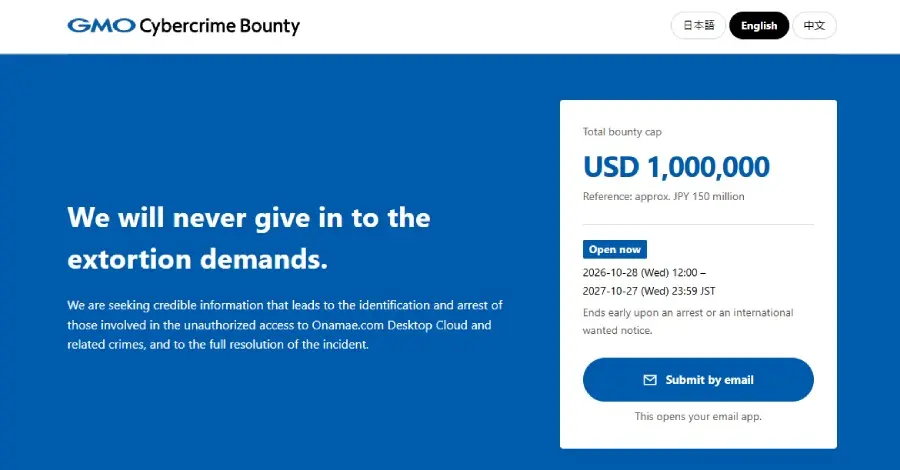
In a decisive counter-offensive against cyber-extortionists, the Japanese technology conglomerate GMO Internet Group has announced a massive financial reward for information leading to the apprehension of those responsible for a recent breach of its Onamae.com Desktop Cloud service. The move comes as a direct response to a staggering $50 million ransom demand, which the company has flatly refused to pay.
The reward program, officially titled the "GMO Cybercrime Bounty," was inaugurated on October 28. Under the terms of the initiative, the group is offering a total of up to $1 million for tips that facilitate the arrest or the issuance of an international wanted notice for the perpetrators. This aggressive stance marks a significant shift in how major Japanese corporations handle high-stakes digital extortion, opting to invest in justice and investigation rather than capitulating to the demands of anonymous attackers.
The breach has specifically targeted the Onamae.com Desktop Cloud, a specialized infrastructure service that provides users with remote Windows desktops. This service is predominantly utilized by foreign exchange (FX) traders who require stable, high-availability environments for automated trading software. The compromise has already had real-world financial consequences, with at least one major broker linking unauthorized trades on customer accounts to credentials exfiltrated from the GMO service.
How the Reward Works
The GMO Cybercrime Bounty is a structured program funded and managed directly by the GMO Internet Group. The company has established a dedicated website to facilitate the secure and, if necessary, anonymous submission of information. To accommodate a global audience of security researchers and whistleblowers, the program accepts tips in three languages: Japanese, English, and Chinese.
The eligibility criteria for the bounty are stringent, designed to ensure that the information provided is of high investigative value. The reward is contingent upon the tip leading directly to a breakthrough in the legal process—specifically, a formal arrest by law enforcement or the issuance of an international wanted notice, such as an Interpol Red Notice. The program is set to remain active until such an arrest occurs, or until October 27, 2027, whichever milestone is reached first.
GMO is actively seeking technical and forensic data that can link specific individuals, servers, or digital assets to the attack. This includes information regarding command-and-control servers, domains, IP addresses, and digital footprints left during the movement of funds, such as cryptocurrency wallet addresses. The company has emphasized that the bounty is intended for actionable intelligence and evidence of criminal methodology; general guesses, unsubstantiated accusations, or the mere reposting of information already available in the public domain will not qualify for payment.
The distribution of the $1 million fund is at the sole discretion of GMO, based on the perceived contribution of the information provided. A single tipster could potentially claim the entire $1 million sum if their information is deemed pivotal, or the total may be divided among multiple contributors. It is a requirement that tipsters prove their identity before any funds are disbursed. Furthermore, the company has clarified that if no submitted tip meets the necessary threshold of utility, no payments will be made.
Strict ethical and legal boundaries have been set for the program. Participation is barred for anyone involved in the original crime, as well as for those who obtained their information through illegal means, such as the purchase of leaked data from the dark web. Employees of the GMO Internet Group are also ineligible. In a stern warning to the public, GMO has instructed potential tipsters not to attempt to breach systems, negotiate with the attackers, or handle stolen credentials and malware in their pursuit of the bounty.

All gathered intelligence is being shared with relevant law enforcement agencies both within Japan and internationally. GMO has already handed over a comprehensive dossier of evidence to the authorities, including detailed communication records from the extortion attempts. To protect participants from phishing, the company has stated it will never request passwords, authentication codes, or administrative fees from tipsters, and all official correspondence will originate from the specific @cybercrimebounty.gmo domain.
The Breach and the Trading Accounts
The timeline of the incident began on October 20, when GMO Internet, the subsidiary responsible for the Desktop Cloud service, detected the presence of malicious programs installed on a subset of customer servers. In an immediate attempt to contain the threat, the company suspended all server plans starting October 21. Initial assessments identified 26,739 servers as being potentially affected by the intrusion.
By October 24, a deeper forensic investigation confirmed the worst-case scenario: a significant security vulnerability had been exploited, leading to unauthorized system access and the exfiltration of sensitive customer data. Because the service involves providing full Windows desktop environments, any data stored by users on those servers was potentially compromised. This includes login credentials for widely used trading platforms such as MetaTrader 4 and MetaTrader 5 (MT4/MT5), which are often saved within the software for convenience.
The fallout was felt almost immediately within the trading community. On October 21, customers began reporting suspicious activity and trades they did not authorize. OANDA Japan, a prominent broker, later confirmed that third parties had successfully logged into several customer accounts using ID and password pairs believed to have been stolen from the GMO servers. OANDA has since moved to restrict trading on at least 500 accounts suspected of being at risk, while clarifying that its own internal systems remained secure.
Similarly, the broker FXTF issued a warning on October 22, noting that the credentials of customers using Virtual Private Servers (VPS) appeared to have been harvested in a broader attack targeting such services. FXTF advised its users who had utilized the GMO Desktop Cloud to immediately change their passwords using devices that had never been connected to the compromised service.
In a formal filing with the stock exchange on October 28, GMO Internet Group admitted that the full scope of the financial impact is still being calculated. The company has yet to confirm the total number of customers eligible for compensation or the full extent of the data that has been leaked.
The Threats and the Leak
The attackers have employed aggressive tactics beyond simple data theft. Following the breach, they issued a series of threats aimed at destabilizing GMO’s relationship with the broader financial sector. The group claimed they would continue to manipulate accounts across more than 70 different securities and FX firms and threatened to deploy ransomware against the individual PCs of GMO’s customers.
Furthermore, the attackers threatened to publish internal technical details of GMO’s infrastructure, a move intended to cause long-term reputational and operational damage. A deadline of noon on October 27 was set for the publication of customer data and the commencement of the ransomware wave. While the large-scale ransomware attack had not materialized by the afternoon of the 27th, the attackers did follow through on their threat to leak information.
ITmedia NEWS reported that on the afternoon of October 27, the attackers posted what they claimed to be the personal information of a GMO customer on their website. GMO has since been working to verify the authenticity of this data. The company has also warned that the attackers’ website was designed to collect information on anyone who visited it, prompting a recommendation for all visitors to perform comprehensive antivirus scans on their devices.

The original site used by the attackers, along with several mirror sites, was successfully taken down on the morning of October 28. However, GMO remains vigilant, promising to take swift action against any new domains the group might establish.
How the Attackers Got In
While a full technical post-mortem is still pending, early indications suggest that the breach may have been preventable. Masatoshi Kumagai, the head of GMO Internet Group, took to his personal blog on October 25 to express his frustration with the internal handling of the situation. He revealed that the group’s own internal team of "white-hat" hackers had previously identified vulnerabilities within the Desktop Cloud service and had warned the management team in charge.
According to Kumagai, the internal response to these warnings was insufficient. The failure to act quickly and thoroughly created a window of opportunity that the attackers were able to exploit. "The response was neither fast nor thorough enough," Kumagai wrote, highlighting a lapse in corporate security protocols.
The attackers themselves have made several claims regarding the service’s architecture. They alleged that a single administrator account was shared across all customer servers and that, by default, the local drives of a customer’s own PC were visible to the remote server upon connection. If true, these configurations would have allowed the attackers to move laterally from the breached cloud environment directly into the private devices of users. While GMO has not confirmed these specific technical claims, the company has been collecting PCs from affected customers for forensic analysis. As of late October, no malware or ransomware has been found on the devices analyzed so far, though the investigation is ongoing.
Remediation and Future Outlook
In an effort to mitigate the damage to its reputation and provide relief to its users, GMO Internet Group has outlined a compensation plan. Every current user of the affected service will receive a baseline payment of ¥5,000. For those whose data is confirmed to have been leaked, additional payments ranging from ¥10,000 to ¥25,000 will be issued, depending on the sensitivity of the information exposed.
Crucially, the company has committed to covering actual trading losses and associated fees for any trades confirmed to be unauthorized results of the breach. This is a significant undertaking given the volatility of the FX market and the potential for large-scale losses.
The Onamae.com Desktop Cloud service in its current form will not be restored. GMO has stated that the breached systems are fundamentally compromised and will not be restarted. Instead, customers who require remote desktop solutions will be offered a transition to a separate, secure service. This move will be provided free of charge for six months, though it requires the explicit consent of the customers.
As the legal and forensic investigations continue, the GMO Cybercrime Bounty stands as a high-profile experiment in corporate-led criminal investigation. By placing a $1 million price tag on the heads of the attackers, GMO is signaling that the cost of targeting its infrastructure now includes the risk of a globally incentivized manhunt.
 Cybersecurity Basics & Security News
Chinese Espionage Group Armory Castle Exploits Critical VMware vCenter Zero-Day in Sophisticated Data Theft Campaign
Cybersecurity researchers have uncovered a high-stakes espionage operation led by a suspected...
 Cybersecurity Basics & Security News
Russia-Aligned Cyber Espionage Group UAC-0099 Deploys New ASHVEIN Malware in Sophisticated Campaign Against Ukraine
The landscape of cyber warfare in Eastern Europe continues to shift as...
 Cybersecurity Basics & Security News
Google Issues Global Warning Over Mass Exploitation of Critical Oracle PeopleSoft Vulnerability
Cybersecurity researchers at Google’s Mandiant division have issued an urgent warning regarding...







