

For more than two decades, Judy Johnston and her 97-year-old mother have shared a digital home. Since 2002, they have relied on a third-level .name domain for their primary email communications, a period spanning nearly the entire history of the modern consumer internet. However, a recent administrative decision by the Internet Corporation for Assigned Names and Numbers (ICANN) and Verisign, the registry operator for the .name top-level domain, has effectively issued them a digital eviction notice. The looming termination of third-level .name domains is not merely a technical sunsetting of an obsolete product; for users like Johnston, it represents a catastrophic disruption of their digital identities and a bureaucratic nightmare that has transformed into a grueling, full-time job.
The plight of the Johnston family came to light through a formal reconsideration request recently published by ICANN. This document serves as a poignant testimony to the unintended consequences of high-level policy changes within the internet’s infrastructure. Johnston’s grievance highlights a growing friction between the technical evolution of the web and the lived experiences of the long-term users who inhabit it. As Verisign moves to streamline its operations by eliminating the complex third-level registration system of the .name registry, users who have spent twenty-five years building their lives around these addresses are being left to pick up the pieces.
To understand the scale of the issue, one must look at the unique structure of the .name top-level domain (TLD). Launched in 2001 as part of ICANN’s initial expansion of the domain name system, .name was designed specifically for individuals. Unlike .com or .org, it offered a unique three-level structure—such as "john.doe.name"—intended to provide a personalized, permanent digital handle. For a generation of early adopters, this was an attractive proposition. It offered a sense of permanence in an era when email providers were often tied to specific internet service providers (ISPs). However, as the industry moved toward second-level domains (such as "doe.name"), the third-level registrations became a legacy feature, eventually viewed by the registry as a technical burden rather than a core service.
For Judy Johnston, the technical "legacy" status of her domain is irrelevant compared to its practical utility. Over twenty-five years, she has integrated this email address into every facet of her administrative life. By her own count, she is now faced with the monumental task of updating at least 211 separate online accounts. This list includes everything from essential utilities and financial institutions to healthcare portals and government services. For a senior citizen managing her own affairs as well as those of her nearly centenarian mother, the sheer volume of this transition is overwhelming.
The process of changing an email address in the modern security environment is no longer a simple matter of clicking "edit profile." In an age of heightened data protection and multi-factor authentication, the email address serves as the foundational "anchor" of a digital identity. When that anchor is pulled, the entire structure of account security can collapse. Johnston notes that she has already encountered significant hurdles. Some service providers, sensing a major change in account credentials, have flagged her attempts as suspicious. She has been required to submit multiple forms of identification and navigate complex data protection protocols just to prove she is authorized to change her own contact information.
"This will be—and already has been—a full-time daily job for weeks," Johnston wrote in her filing. The labor involved is not just digital; it is emotional and cognitive. For seniors, who may already face challenges navigating the increasingly complex user interfaces of modern web platforms, being forced into a high-stakes migration of 211 accounts is a form of systemic exclusion. The "manual recovery" process she fears is a reality for many who miss the window of opportunity to update their settings before a domain goes dark. Once the .name domain is terminated and the mail servers stop functioning, any account that requires a verification code sent to the old address becomes effectively locked, requiring hours of phone calls with customer support and the manual submission of physical documents.
The frustration is compounded by a profound breakdown in communication between the various entities that manage the domain name system. When Johnston first received a notification from her registrar, Network Solutions, regarding the upcoming termination, she did what any responsible consumer would do: she called for clarification. The response she received was a masterclass in institutional confusion. Multiple customer service representatives at Network Solutions reportedly told her that the notification was a scam. They assured her that her domain was "secured" through 2030 and that she should ignore the warnings.
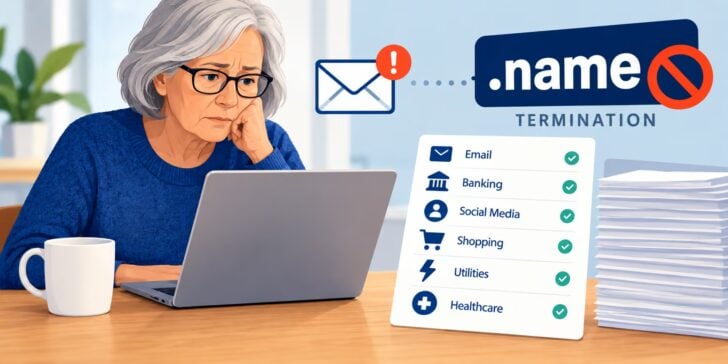
It was only after Johnston insisted that a representative perform a specific search for ".name termination" that the company’s staff realized the notice was legitimate. This gap in knowledge between the registry (Verisign), the regulator (ICANN), and the registrar (Network Solutions) has created a dangerous environment for users. If the very companies tasked with maintaining a user’s digital presence are unaware of the TLD’s impending demise, the average consumer has little hope of navigating the transition successfully. For many users who may not be as diligent as Johnston, the first sign of trouble will be when their email simply stops working, at which point it may be too late to easily recover their linked accounts.
The decision to terminate these domains has sparked a broader debate within the domain industry about the responsibilities of infrastructure providers. Critics argue that ICANN and Verisign should reverse course, or at the very least, provide a more robust and supported transition path. The argument for termination is often rooted in technical simplification—reducing the overhead required to maintain a non-standard registration database. However, from a consumer protection standpoint, the forced obsolescence of a twenty-five-year-old communication tool raises significant ethical questions.
In her reconsideration request, Johnston highlights the specific vulnerability of senior citizens in this transition. For a 97-year-old user, an email address is not just a technical asset; it is a lifeline to family, doctors, and essential services. Changing that address requires a level of digital literacy and physical stamina that is often taken for granted by the younger engineers and policymakers who make these decisions. The requirement to provide "multiple forms of identification" to various websites is particularly taxing for the elderly, for whom mobility or access to updated digital documents may be limited.
The situation also underscores the fragility of the "personal" internet. When the .name TLD was launched, it was marketed as a permanent solution for personal branding. Users like Johnston bought into that vision, paying registration fees for decades under the impression that they were building on stable ground. The sudden removal of that ground suggests that in the current domain ecosystem, the interests of large registry operators and the convenience of technical consolidation often take precedence over the stability of the individual end-user’s digital life.
As the reconsideration process moves through the ICANN bureaucracy, the outcome remains uncertain. ICANN has a formal process for reviewing such requests, but historically, these challenges face a high bar for success. The request filed by Johnston serves as a stark reminder that behind every technical "sunset" or "product retirement" are real people whose lives are being disrupted. For Johnston, the battle is not just about a domain name; it is about the right to maintain a digital identity that she has spent a quarter of a century maintaining.
For now, Johnston remains in the trenches of a digital migration she never asked for. Each day brings a new list of accounts to update, a new set of security questions to answer, and a new round of explanations to customer service agents who may not understand why she is losing her email address. Her story is a cautionary tale for the digital age: in the world of internet infrastructure, nothing is truly permanent, and the cost of "progress" is often paid in the time and labor of the most vulnerable users.
The termination of third-level .name domains may be a small footnote in the overall history of the internet, affecting a relatively small percentage of total domain registrants. But for those affected, the impact is total. As Johnston continues her "full-time job" of changing 211 accounts, the industry is left to grapple with a difficult question: how can the internet evolve without discarding the very people who helped build its foundations? The resolution of the Johnston case and the response from ICANN will provide a significant indicator of whether the future of the web has room for the legacy of its past.
 Web Hosting & Domain Management
Strategic Acquisitions in the European Domain Market: Nameshift Data Reveals Recent End-User Sales Trends
The secondary market for domain names remains a critical indicator of corporate...
 Web Hosting & Domain Management
Corporate Giants and Emerging Startups Secure Strategic Digital Real Estate in Latest Domain Sales Report
The secondary domain name market continues to serve as a reliable barometer...
 Web Hosting & Domain Management
Twente Region Set to Secure Dedicated Digital Identity with Application for .Twente Top-Level Domain
The digital landscape of the Netherlands is poised for a significant expansion...







