
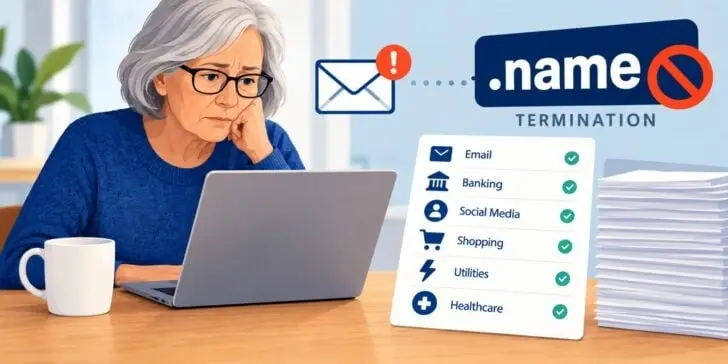
"This will be—and already has been—a full-time daily job for weeks," Johnston wrote in her filing. The labor involved is not just digital; it is emotional and cognitive. For seniors, who may already face challenges navigating the increasingly complex user interfaces of modern web platforms, being forced into a high-stakes migration of 211 accounts is a form of systemic exclusion. The "manual recovery" process she fears is a reality for many who miss the window of opportunity to update their settings before a domain goes dark. Once the .name domain is terminated and the mail servers stop functioning, any account that requires a verification code sent to the old address becomes effectively locked, requiring hours of phone calls with customer support and the manual submission of physical documents.
The frustration is compounded by a profound breakdown in communication between the various entities that manage the domain name system. When Johnston first received a notification from her registrar, Network Solutions, regarding the upcoming termination, she did what any responsible consumer would do: she called for clarification. The response she received was a masterclass in institutional confusion. Multiple customer service representatives at Network Solutions reportedly told her that the notification was a scam. They assured her that her domain was "secured" through 2030 and that she should ignore the warnings.
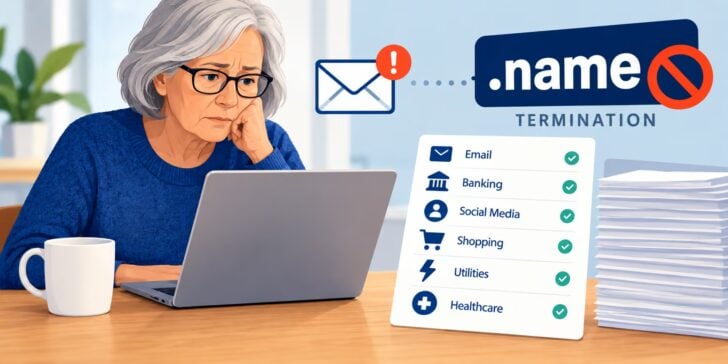
It was only after Johnston insisted that a representative perform a specific search for ".name termination" that the company’s staff realized the notice was legitimate. This gap in knowledge between the registry (Verisign), the regulator (ICANN), and the registrar (Network Solutions) has created a dangerous environment for users. If the very companies tasked with maintaining a user’s digital presence are unaware of the TLD’s impending demise, the average consumer has little hope of navigating the transition successfully. For many users who may not be as diligent as Johnston, the first sign of trouble will be when their email simply stops working, at which point it may be too late to easily recover their linked accounts.
The decision to terminate these domains has sparked a broader debate within the domain industry about the responsibilities of infrastructure providers. Critics argue that ICANN and Verisign should reverse course, or at the very least, provide a more robust and supported transition path. The argument for termination is often rooted in technical simplification—reducing the overhead required to maintain a non-standard registration database. However, from a consumer protection standpoint, the forced obsolescence of a twenty-five-year-old communication tool raises significant ethical questions.
In her reconsideration request, Johnston highlights the specific vulnerability of senior citizens in this transition. For a 97-year-old user, an email address is not just a technical asset; it is a lifeline to family, doctors, and essential services. Changing that address requires a level of digital literacy and physical stamina that is often taken for granted by the younger engineers and policymakers who make these decisions. The requirement to provide "multiple forms of identification" to various websites is particularly taxing for the elderly, for whom mobility or access to updated digital documents may be limited.
 Web Hosting & Domain Management
Public Interest Registry Names TECHO as .Org of the Year at Annual Impact Awards in Washington, D.C.
The Public Interest Registry, the long-standing non-profit organization responsible for managing and...
 Web Hosting & Domain Management
Identity Digital Secures U.S. Government Contract to Manage .us Domain Registry
In a significant shift for the landscape of the American internet infrastructure,...
 Web Hosting & Domain Management
Atom Enhances Domain Seller Experience with Launch of Dedicated Mobile Application
The landscape of the domain name aftermarket is one defined by speed,...







