
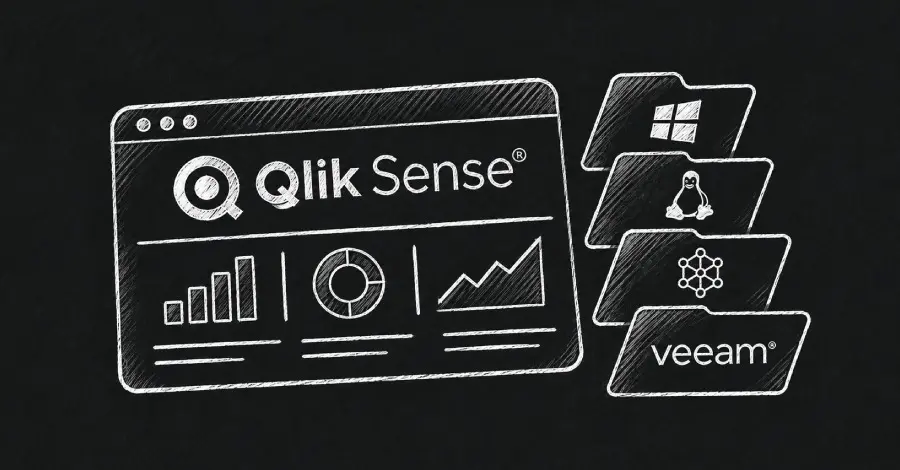
In a significant escalation of activity targeting enterprise data visualization infrastructure, cybersecurity researchers have identified a series of sophisticated intrusion attempts aimed at Qlik Sense servers. These attacks, which occurred throughout October 2026, involve the deployment of PowerShell-based reverse shells and share striking tactical similarities with previous high-profile ransomware campaigns. The discovery, documented by the CyOps and Research teams at Cynet, suggests that threat actors are continuing to refine their methods for gaining initial access to high-value corporate environments through specialized software vulnerabilities.
The recent activity was first detected when security monitors flagged a surge in suspicious commands being executed across multiple environments belonging to European Union-based organizations. According to the research findings, the window of these attacks was remarkably narrow, with several intrusion attempts occurring within a timeframe of just over three minutes. This level of speed and coordination suggests a high degree of automation, where threat actors likely utilize scanning tools to identify vulnerable servers and immediately follow up with automated exploit scripts.
While the specific entry point for this latest wave of attacks is still being analyzed, the methodology bears a clear resemblance to a campaign documented in late 2023. In that earlier instance, researchers at Arctic Wolf linked similar activity to the CACTUS ransomware group. During that period, the CACTUS operators were observed weaponizing a set of critical vulnerabilities in Qlik Sense Enterprise for Windows. These flaws allowed the attackers to bypass authentication and execute code remotely, effectively granting them a foothold within the target’s internal network.
The historical context of these vulnerabilities provides a window into the persistence of the threat. In August and September 2023, Qlik released patches for several critical issues, most notably CVE-2023-41265 and CVE-2023-48365. The latter, often referred to by researchers as "DoubleQlik," was particularly notorious because it represented an incomplete fix for the former. Such scenarios, where a secondary vulnerability emerges because the initial patch did not cover all possible attack vectors, often provide a long-term opportunity for attackers who wait for organizations to fall behind on their patching cycles.

In the 2023 CACTUS campaign, the exploitation of these flaws was merely the first step in a much larger operation. Once initial access was secured, the attackers deployed a suite of legitimate tools to maintain their presence and move laterally through the network. This included the installation of ManageEngine Unified Endpoint Management and Security (UEMS) for broad control, AnyDesk for remote desktop access, and Plink for secure tunneling. By using legitimate administrative tools, the attackers were able to blend in with normal network traffic, making detection significantly more difficult for traditional security systems.
The 2026 activity detected by Cynet follows a similar, albeit updated, playbook. The researchers observed the execution of a PowerShell command containing a one-line reverse shell. This specific script is a variant of a well-known tool from the Nishang framework, a collection of scripts used by both penetration testers and malicious actors for post-exploitation tasks. The script was configured to initiate a connection to a remote IP address—45.115.26[.]23—on port 4455.
A particularly telling detail of this latest campaign is that the malicious commands were executed under the "scheduler.exe" process. This specific execution chain is a direct echo of the 2023 CACTUS Qlik intrusions, reinforcing the theory that the same threat actor or a group utilizing the same "leaked" or shared playbook is responsible for the current wave of activity. Although the security measures in place at the targeted organizations successfully blocked the reverse shell attempts, Cynet’s subsequent analysis in a controlled sandbox environment revealed the full extent of the attackers’ intentions.
Once a reverse shell is successfully established, it serves as an interactive communication channel, allowing the attacker to send commands directly to the compromised server. In this case, the primary objective of the initial shell was to conduct reconnaissance on the local environment and deliver a secondary PowerShell script designed to ensure long-term persistence. This secondary phase involved the deployment of a custom backdoor written in the Go programming language.
Go, or Golang, has become increasingly popular among malware developers due to its ability to be compiled into standalone binaries that are difficult to reverse-engineer and can run across different operating systems with minimal modification. The Go-based backdoor identified by Cynet was designed to connect back to the same command-and-control (C2) infrastructure at 45.115.26[.]23, but on a different port, 4456.

The backdoor’s functionality appears to be multi-faceted, with capabilities tailored for both Windows and Linux environments. On Windows systems, the malware was observed searching for active processes related to Apache ActiveMQ, a popular open-source message broker. This suggests that the attackers were looking for further avenues of exploitation within the network, as ActiveMQ has been the subject of several critical vulnerability disclosures in recent years. On Linux systems, the malware’s behavior was more focused on credential harvesting and system mapping. It attempted to read sensitive system files, specifically "/etc/shadow" and "/etc/passwd," which contain user account information and hashed passwords.
The persistence strategy employed by the attackers did not stop at a single backdoor. A second variant of the PowerShell script was discovered, which attempted a more aggressive approach to maintaining access. This script was designed to install OpenSSH, a suite of secure networking utilities, onto the target system. By installing a legitimate SSH server, the attackers could create a "front door" for themselves that would appear as normal administrative access to many security monitors.
To ensure this access remained active, the script created a Windows scheduled task named "WinUpdCheck." This task was configured to run every five minutes, executing a PowerShell reverse shell stored at "C:ProgramDatasshwinc.ps1." This ensures that even if the initial connection is severed or the server is rebooted, the system will automatically attempt to reconnect to the attacker’s infrastructure.
Cynet’s investigation into the installation process for this SSH backdoor revealed a high degree of resourcefulness. If the standard SSH service (sshd) was not already available on the system, the script would automatically download a legitimate OpenSSH-Win64 zip archive from the attackers’ staging server. It would then extract the files, run a script to install the service, set it to start automatically, and even modify the Windows Firewall to allow inbound traffic on TCP port 22. This automated "IT support" style of malware execution demonstrates how threat actors are increasingly using the system’s own administrative capabilities against it.
Perhaps the most concerning discovery made during the investigation was the contents of the attackers’ staging infrastructure. By analyzing the exposed directory on the server at 45.115.26[.]23:8012, researchers found a veritable toolkit for modern cyber warfare. In addition to the custom Go backdoors and SSH persistence scripts, the directory contained exploit code for CVE-2023-46604, a critical remote code execution vulnerability in Apache ActiveMQ.

Even more significant was the presence of a modified toolchain for exploiting CVE-2024-40711, a critical vulnerability in Veeam Backup & Replication software. Veeam is a cornerstone of data protection for many large enterprises, and vulnerabilities in such software are highly prized by ransomware groups because they allow for the deletion or encryption of backups, leaving the victim with no choice but to pay the ransom. The inclusion of these tools indicates that the targeting of Qlik Sense servers is likely just the initial phase of a broader attack strategy aimed at crippling an organization’s entire data infrastructure.
The discovery of this activity serves as a stark reminder of the "long tail" of software vulnerabilities. Even years after a patch has been released, known flaws in enterprise software like Qlik Sense remain a primary target for sophisticated threat actors. These groups rely on the fact that large organizations often have complex, sprawling IT environments where a few legacy or unpatched servers can remain hidden, providing a perfect entry point for an intrusion.
For organizations utilizing Qlik Sense Enterprise for Windows, the current threat landscape necessitates a proactive approach to security. This includes not only ensuring that all software is patched to the latest version but also monitoring for the specific indicators of compromise (IoCs) identified by researchers. Patterns such as unusual PowerShell execution under "scheduler.exe," the creation of unauthorized scheduled tasks like "WinUpdCheck," and unexpected outbound connections to unfamiliar IP addresses should be treated as high-priority alerts.
As the investigation into this campaign continues, the cybersecurity community remains on high alert. The overlap between the tools used in these attacks and those favored by ransomware operators suggests that the ultimate goal of these intrusions is likely a large-scale data extortion or encryption event. By identifying and blocking these attempts at the initial access stage, security teams can prevent the much more damaging secondary phases of a ransomware attack from ever taking place.
 Cybersecurity Basics & Security News
Bridging the Security Gap: Why Modern Enterprises are Moving Beyond Traditional Vulnerability Management
In the rapidly evolving landscape of cybersecurity, a critical finding can traverse...
 Cybersecurity Basics & Security News
Critical Vulnerability in Elementor Plugin Leaves Two Million WordPress Sites Open to Full Takeover
A high-severity security flaw has been identified in Elementor, the most widely...
 Cybersecurity Basics & Security News
PHP Project Issues Warning Over New Session Vulnerability as PHP2Shell Exploit Attempts Surge Globally
The PHP development team has issued a formal warning regarding a newly...







