
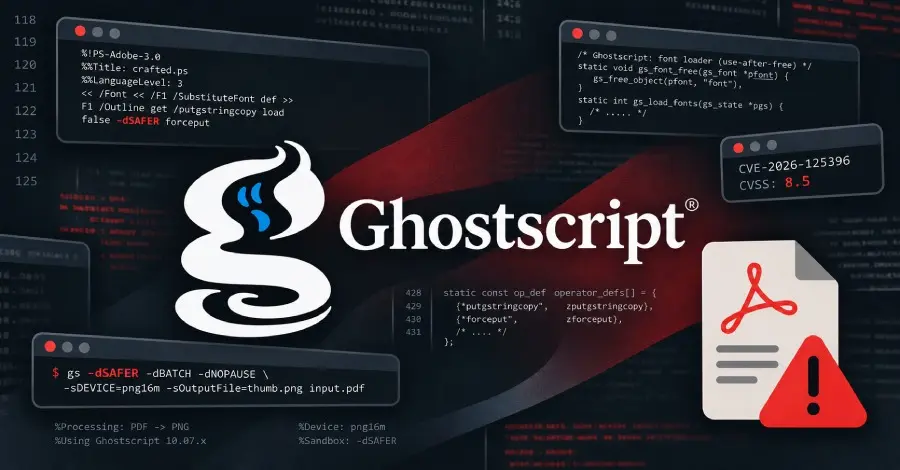
A significant complication is the use of containerization and bundled dependencies. Many modern applications do not rely on the Ghostscript package provided by the host operating system. Instead, they package a specific version of Ghostscript inside a Docker container or an application bundle. In these cases, updating the host OS does nothing to protect the application. System administrators must identify every instance where Ghostscript is bundled and ensure those specific images are rebuilt with the latest version.
Mitigation and Defense-in-Depth
For organizations that cannot immediately update their rendering engines, several mitigation strategies can reduce the risk of exploitation.

The first and most effective step is to limit the types of files that image processing libraries are allowed to handle. By explicitly disabling the processing of PostScript (PS), Encapsulated PostScript (EPS), and PDF files within libraries like ImageMagick, the path to Ghostscript can be severed for most common web uploads.
Furthermore, implementing strict authentication for services like print queues can prevent anonymous attackers from reaching the interpreter. On the system level, security profiles such as AppArmor or SELinux can provide a critical layer of defense. During the pwn.ai testing, an AppArmor profile successfully prevented a compromised Ghostscript process from spawning a shell, effectively neutralizing the most dangerous part of the exploit even though the sandbox itself had been bypassed.
The researchers also noted that their broader investigation into production services led to fixes at major tech companies. Google, for instance, patched an affected path last week following a report from the firm. Other major services, including Dropbox, were also contacted regarding Ghostscript-related issues, though those were noted to be separate from the CVE-2026-125396 vulnerability.
Conclusion
The discovery of CVE-2026-125396 serves as a stark reminder of the hidden dependencies that underpin the modern internet. As a tool that sits several layers deep in the software stack, Ghostscript remains a high-value target for researchers and bad actors alike. While there have been no reports of this specific flaw being exploited in the wild, the ease with which it can be triggered through routine web activities makes it a critical priority for updates.
For now, the advice for administrators is clear: audit your systems for both standalone and bundled versions of Ghostscript, prioritize the update to version 10.08.0, and consider implementing defense-in-depth measures to restrict the interpreter’s reach. In an environment where a simple image upload can lead to a full server compromise, the "ancient code" running in the background can no longer be ignored.
 Cybersecurity Basics & Security News
Italy’s Privacy Regulator Fines Meta €805 Million Over Facebook’s Unauthorized Access to User Photo Galleries
In a landmark decision that highlights the tightening grip of European regulators...
 Cybersecurity Basics & Security News
Critical Check Point Flaw Grants Unauthenticated Root Access to Management Servers
A severe security vulnerability has been identified within Check Point’s Security Management...
 Cybersecurity Basics & Security News
GitHub Actions Compromised in ‘Mini Shai-Hulud’ Attack Disabled Again Following Brief Reappearance
The cybersecurity landscape has been reminded once again of the persistent and...







