
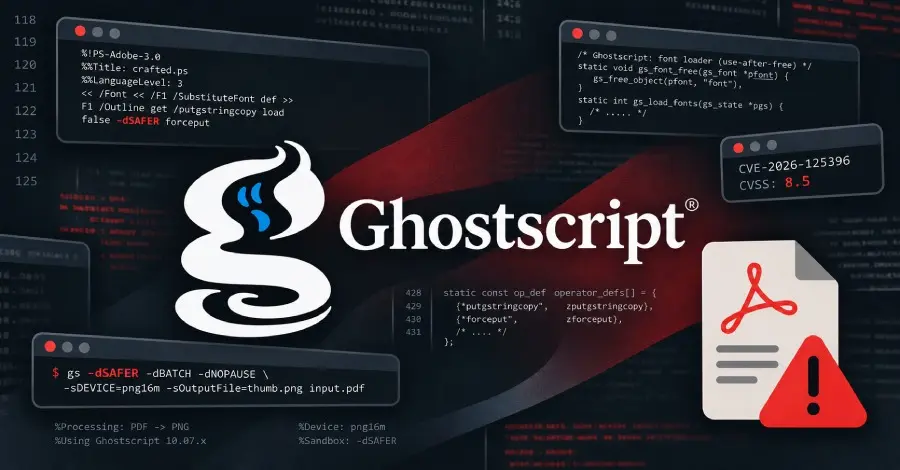
A newly disclosed security vulnerability in Ghostscript, a ubiquitous but often invisible component of the modern Linux ecosystem, is sending ripples through the cybersecurity community. The flaw, which allows a specially crafted file to escape the program’s security sandbox and execute arbitrary commands on a host server, highlights a persistent risk in the way web applications process documents and images.
Tracked as CVE-2026-125396, the vulnerability was brought to light by researchers at the security firm pwn.ai. Their investigation revealed that common server-side tasks—such as generating a thumbnail for an uploaded image, processing an email attachment, or managing a print queue—could be leveraged to gain unauthorized access to a system. While the flaw was officially patched on September 8, the complexity of how Ghostscript is integrated into other software means that many systems may remain vulnerable long after a fix is made available.
The Invisible Engine of Document Processing
Ghostscript serves as an interpreter for PostScript and Portable Document Format (PDF) files. It is the "engine under the hood" for a vast array of Linux-based services. Despite its importance, many system administrators and developers may not realize their applications are utilizing it. This is because Ghostscript is rarely called directly by an end-user application. Instead, it is invoked as a background dependency by popular image and document libraries, including ImageMagick, Pillow, libvips, and various Qt plugins.
The researchers at pwn.ai demonstrated that this indirect relationship creates a significant blind spot. An attacker does not need to upload a file with a .ps or .pdf extension to trigger the vulnerability. Because these libraries often inspect the "magic bytes" or internal structure of a file rather than its extension, a malicious file disguised as a standard .png or .jpg image can be passed to Ghostscript for rendering. Once the interpreter begins processing the file, the exploit is triggered.
This "polyglot" nature of the attack makes it particularly dangerous. A routine feature, such as a website allowing a user to upload a profile picture or a webmail service generating a preview of an attachment, becomes a potential entry point for a remote shell.

Technical Analysis: Breaking the Sandbox
The core of the issue lies in a "use-after-free" memory corruption bug within the portion of Ghostscript responsible for loading fonts. Use-after-free vulnerabilities occur when a program continues to use a pointer after it has been freed, allowing an attacker to manipulate memory and redirect the program’s execution flow.
In the case of CVE-2026-125396, the exploit targets the -dSAFER sandbox. This sandbox is Ghostscript’s primary line of defense, designed specifically to prevent PostScript documents from performing dangerous actions, such as accessing the local file system or running external commands. By exploiting the memory corruption bug during the font-loading process, an attacker can effectively "flip a switch" within the interpreter’s memory, disabling the security restrictions imposed by -dSAFER.
Once the sandbox is bypassed, the document—which is essentially a script—gains the ability to execute commands with the same privileges as the Ghostscript process. In most modern server configurations, this is a low-privilege service account. However, even with restricted permissions, a successful exploit allows an attacker to establish a foothold, probe the internal network, or attempt further privilege escalation.
Wide-Ranging Impact Across Applications
The researchers demonstrated the practical impact of the flaw by testing it against approximately ten common applications and plugins. The results were concerning, showing that the vulnerability could be reached through multiple vectors, some of which required no user authentication.
One of the most immediate risks was identified in the Debian 13 print queue. Researchers showed that an anonymous user could send a print job to a shared queue, triggering the Ghostscript exploit during the rendering process. Similarly, the Roundcube webmail client was found to be vulnerable. In this scenario, an attacker could simply send an email with a malicious attachment; the moment the recipient opened the message to view it, the server would attempt to process the file, leading to command execution.
The WordPress ecosystem, which powers a significant portion of the web, was also a primary focus of the research. While the WordPress Core itself requires a user to have at least "Author" privileges to upload files, several popular plugins were found to have much lower barriers to entry. Public-facing forms in plugins such as Forminator and Essential Addons for Elementor allowed for the exploit to be triggered via public upload forms, requiring no login credentials at all.

Interestingly, the WordPress security team had already moved to address a similar path in August. Tracked as CVE-2026-65640 and released in version 7.0.4, the WordPress fix addressed a specific chain of events leading to Ghostscript. However, experts warn that these are two distinct fixes. While the WordPress update closes a specific door, the Ghostscript update fixes the underlying engine. Both are necessary to ensure comprehensive protection.
The Challenge of Patching Bundled Software
Artifex, the developer behind Ghostscript, responded to the report by releasing version 10.08.0 on September 8. The fix involves moving the vulnerable internal font-loading steps into a more secure memory management framework.
The developer who handled the fix, Ken Sharp, noted in the official bug report that the vulnerability resided in an "ancient piece of code." He described the segment as being well-known to the development team as a potential weak point, yet one that was "difficult to eradicate" due to its deep integration into the legacy codebase. This admission highlights a common challenge in open-source maintenance: the persistence of "technical debt" in software that has been in use for decades.
Despite the availability of a patch, the road to full remediation is long. The security firm’s survey of Linux distributions revealed an uneven landscape. While some distributions moved quickly to integrate the fix, others still listed the status as pending or were shipping vulnerable versions as of last week.
A significant complication is the use of containerization and bundled dependencies. Many modern applications do not rely on the Ghostscript package provided by the host operating system. Instead, they package a specific version of Ghostscript inside a Docker container or an application bundle. In these cases, updating the host OS does nothing to protect the application. System administrators must identify every instance where Ghostscript is bundled and ensure those specific images are rebuilt with the latest version.
Mitigation and Defense-in-Depth
For organizations that cannot immediately update their rendering engines, several mitigation strategies can reduce the risk of exploitation.

The first and most effective step is to limit the types of files that image processing libraries are allowed to handle. By explicitly disabling the processing of PostScript (PS), Encapsulated PostScript (EPS), and PDF files within libraries like ImageMagick, the path to Ghostscript can be severed for most common web uploads.
Furthermore, implementing strict authentication for services like print queues can prevent anonymous attackers from reaching the interpreter. On the system level, security profiles such as AppArmor or SELinux can provide a critical layer of defense. During the pwn.ai testing, an AppArmor profile successfully prevented a compromised Ghostscript process from spawning a shell, effectively neutralizing the most dangerous part of the exploit even though the sandbox itself had been bypassed.
The researchers also noted that their broader investigation into production services led to fixes at major tech companies. Google, for instance, patched an affected path last week following a report from the firm. Other major services, including Dropbox, were also contacted regarding Ghostscript-related issues, though those were noted to be separate from the CVE-2026-125396 vulnerability.
Conclusion
The discovery of CVE-2026-125396 serves as a stark reminder of the hidden dependencies that underpin the modern internet. As a tool that sits several layers deep in the software stack, Ghostscript remains a high-value target for researchers and bad actors alike. While there have been no reports of this specific flaw being exploited in the wild, the ease with which it can be triggered through routine web activities makes it a critical priority for updates.
For now, the advice for administrators is clear: audit your systems for both standalone and bundled versions of Ghostscript, prioritize the update to version 10.08.0, and consider implementing defense-in-depth measures to restrict the interpreter’s reach. In an environment where a simple image upload can lead to a full server compromise, the "ancient code" running in the background can no longer be ignored.
 Cybersecurity Basics & Security News
Critical Cryptographic Flaw in GoBalance Load Balancer Exposes Dark Web Sites to Takeover Attacks
A significant security vulnerability discovered in GoBalance, a specialized load-balancing tool widely...
 Cybersecurity Basics & Security News
Bridging the Security Gap: Why Modern Enterprises are Moving Beyond Traditional Vulnerability Management
In the rapidly evolving landscape of cybersecurity, a critical finding can traverse...
 Cybersecurity Basics & Security News
CISA Expands Known Exploited Vulnerabilities Catalog with Critical Flaws in Cisco BroadWorks and Openwave Messaging
The U.S. Cybersecurity and Infrastructure Security Agency (CISA) has issued a fresh...







