
Wide-Ranging Impact Across Applications
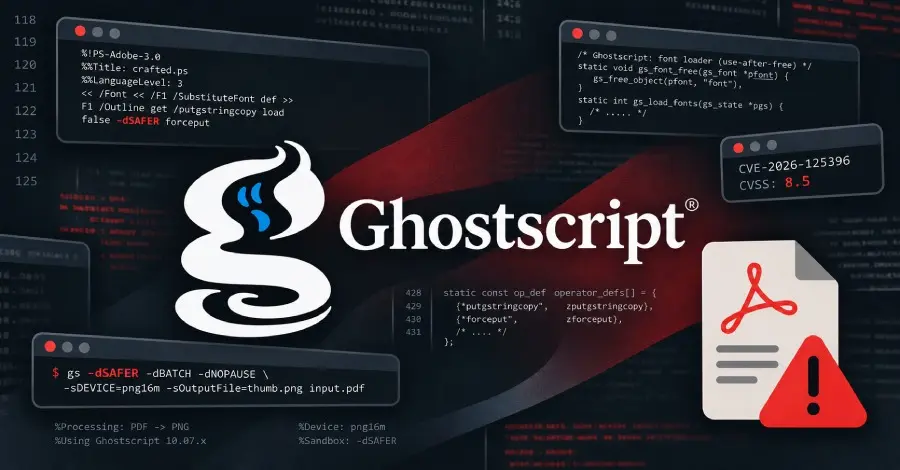
The researchers demonstrated the practical impact of the flaw by testing it against approximately ten common applications and plugins. The results were concerning, showing that the vulnerability could be reached through multiple vectors, some of which required no user authentication.
One of the most immediate risks was identified in the Debian 13 print queue. Researchers showed that an anonymous user could send a print job to a shared queue, triggering the Ghostscript exploit during the rendering process. Similarly, the Roundcube webmail client was found to be vulnerable. In this scenario, an attacker could simply send an email with a malicious attachment; the moment the recipient opened the message to view it, the server would attempt to process the file, leading to command execution.
The WordPress ecosystem, which powers a significant portion of the web, was also a primary focus of the research. While the WordPress Core itself requires a user to have at least "Author" privileges to upload files, several popular plugins were found to have much lower barriers to entry. Public-facing forms in plugins such as Forminator and Essential Addons for Elementor allowed for the exploit to be triggered via public upload forms, requiring no login credentials at all.

Interestingly, the WordPress security team had already moved to address a similar path in August. Tracked as CVE-2026-65640 and released in version 7.0.4, the WordPress fix addressed a specific chain of events leading to Ghostscript. However, experts warn that these are two distinct fixes. While the WordPress update closes a specific door, the Ghostscript update fixes the underlying engine. Both are necessary to ensure comprehensive protection.
The Challenge of Patching Bundled Software
Artifex, the developer behind Ghostscript, responded to the report by releasing version 10.08.0 on September 8. The fix involves moving the vulnerable internal font-loading steps into a more secure memory management framework.
The developer who handled the fix, Ken Sharp, noted in the official bug report that the vulnerability resided in an "ancient piece of code." He described the segment as being well-known to the development team as a potential weak point, yet one that was "difficult to eradicate" due to its deep integration into the legacy codebase. This admission highlights a common challenge in open-source maintenance: the persistence of "technical debt" in software that has been in use for decades.
Despite the availability of a patch, the road to full remediation is long. The security firm’s survey of Linux distributions revealed an uneven landscape. While some distributions moved quickly to integrate the fix, others still listed the status as pending or were shipping vulnerable versions as of last week.
 Cybersecurity Basics & Security News
Bridging the Security Gap: Why Modern Enterprises are Moving Beyond Traditional Vulnerability Management
In the rapidly evolving landscape of cybersecurity, a critical finding can traverse...
 Cybersecurity Basics & Security News
U.S. Authorities Seize Infrastructure Used in Massive North Korean Cryptocurrency Theft Campaigns
In a significant blow to the digital financing of sanctioned regimes, the...
 Cybersecurity Basics & Security News
MALFEX Campaign Persists as Researchers Uncover Malicious Native Loader in Popular npm Registry
Cybersecurity researchers have identified a sophisticated new entry in the ongoing software...







