
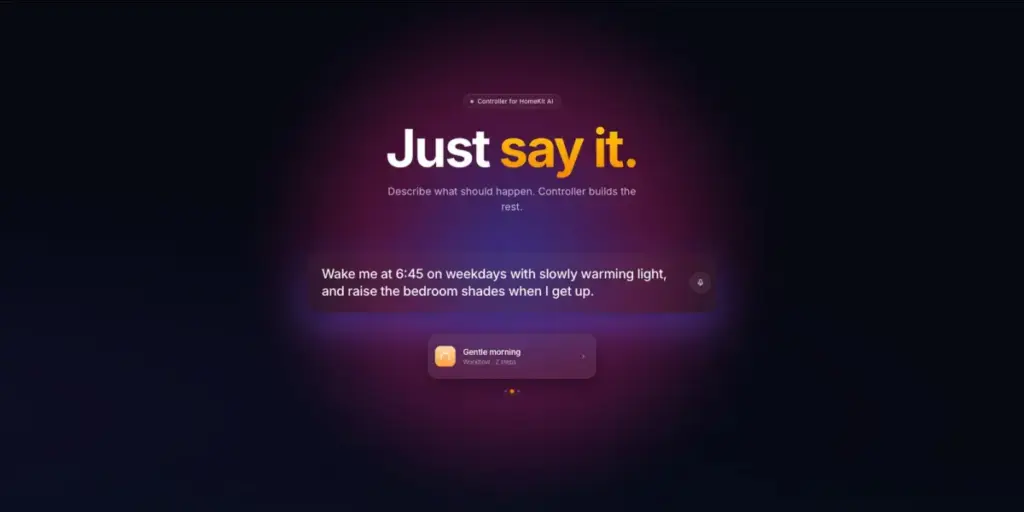
The landscape of smart home management is undergoing a significant transformation as artificial intelligence begins to bridge the gap between complex technical configurations and natural human intent. In a major update to one of the ecosystem’s most powerful tools, the developers of Controller for HomeKit have announced the integration of a sophisticated AI-driven feature designed to simplify the way users interact with their Apple-based smart homes. Marketed under the intuitive tagline "Just say it," the new functionality allows users to describe desired outcomes in plain English, leaving the arduous task of programming scenes and automations to the application’s underlying intelligence.
For years, the HomeKit ecosystem has been praised for its security and privacy, yet it has often been criticized for the steep learning curve associated with creating advanced automations. While Apple’s native Home app provides a user-friendly interface for basic tasks, power users have frequently turned to third-party solutions like Controller for HomeKit to unlock more granular control. With this latest update, the app aims to maintain its professional-grade capabilities while becoming significantly more accessible to those who may find the manual creation of logic-based workflows daunting.
The core premise of the "Just say it" feature is a shift toward intent-based automation. Instead of requiring a user to manually select specific devices, determine their states, set triggers, and define conditions across multiple menus, the AI interprets a natural language prompt and generates the necessary HomeKit architecture automatically. This includes the creation of scenes—which define the state of multiple devices—and automations, which dictate when those scenes should be triggered based on time, location, or sensor data.
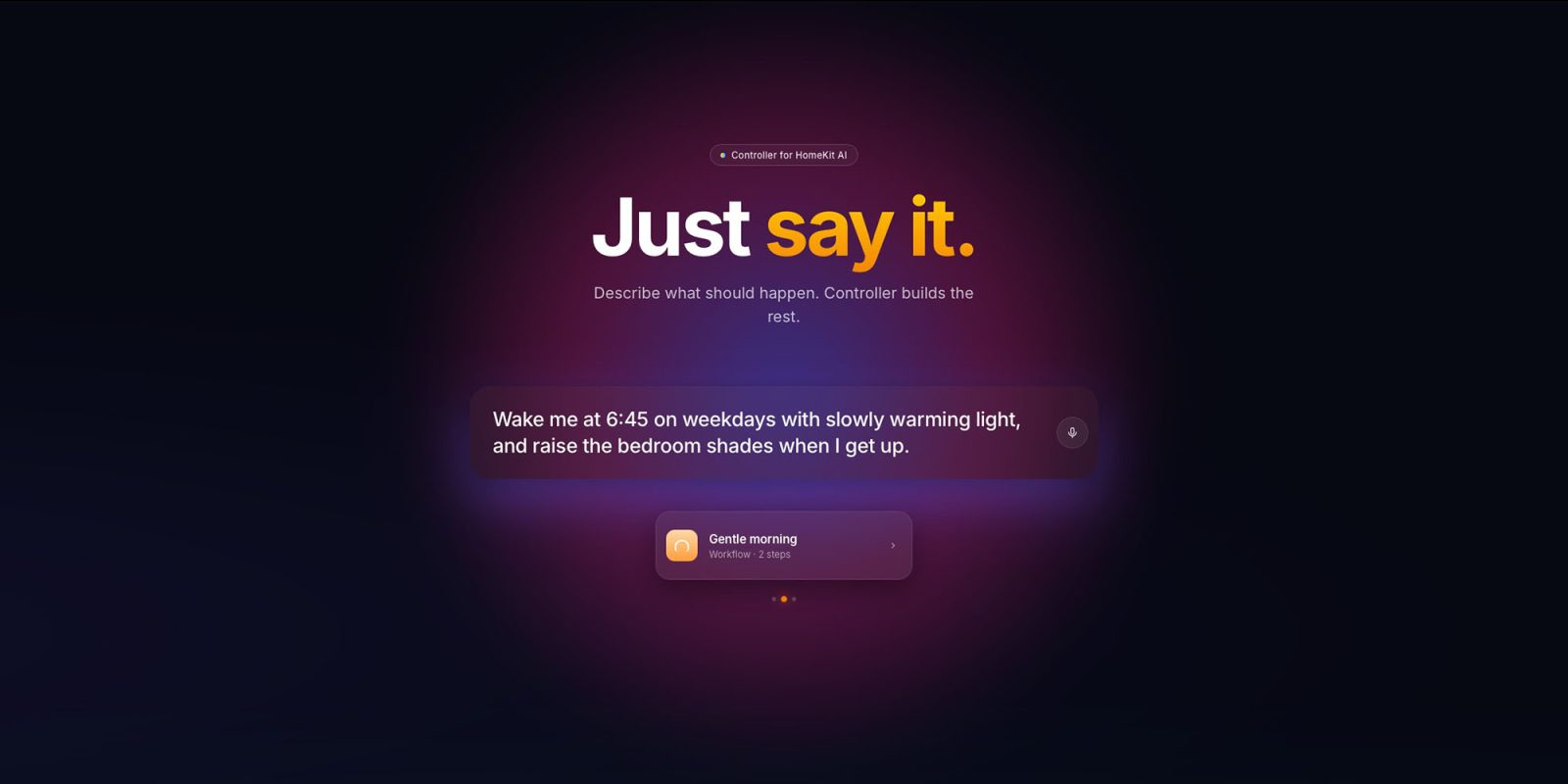
According to the developer’s official documentation and promotional materials, the process is designed to be as frictionless as possible. The website emphasizes that the user only needs to describe what should happen in their home environment, and the app will handle the technical heavy lifting. This approach leverages modern advancements in natural language processing to translate human speech or text into the structured data required by Apple’s HomeKit framework.
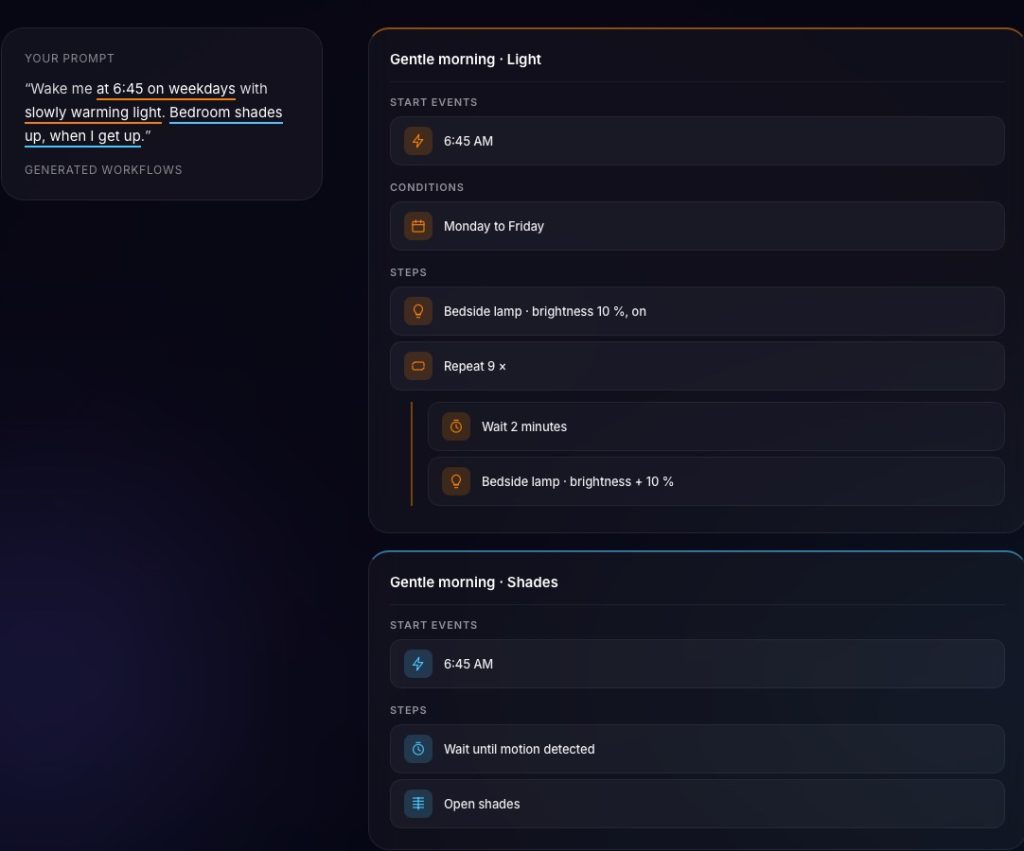
To illustrate the versatility of the new AI engine, the developers have highlighted several practical examples that showcase how the tool handles different levels of complexity. One example focuses on a morning routine: "Wake me at 6:45 on weekdays with slowly warming light, and raise the bedroom shades when I get up." This single sentence involves multiple layers of logic, including a time-based trigger, a recurring schedule (weekdays), a gradual change in device state (warming light), and a secondary action tied to a sensor or user activity (raising shades). For a user to build this manually, they would typically need to navigate several different automation builders and potentially coordinate multiple third-party shortcuts.
Another example provided by the development team is a "Movie night" command, which instructs the system to "dim the living room lights to 20% and close the curtains." This is a classic example of a scene creation, where the AI identifies the relevant devices and assigns them the specified values based on the user’s descriptive language. Finally, the app demonstrates its ability to handle conditional logic with the prompt: "If someone comes home after midnight, turn only the hallway light to 15%." This specific use case requires the AI to understand "after midnight" as a time condition and "comes home" as a location or occupancy trigger, showing a sophisticated understanding of how smart home triggers operate.
Initial testing of the feature suggests that the AI is remarkably capable of interpreting even simple, everyday requests. Despite the inherent complexity of mapping human language to specific hardware IDs and room assignments, the system appears to accurately identify the user’s intent. In one early test, a user asked the app to switch on a bedroom fan whenever the living room lights were turned off. The AI successfully parsed the relationship between the two devices and created a functional automation that linked the power state of the lights to the activation of the fan. This ability to create "if-this-then-that" logic through simple description represents a significant step forward in making smart home technology feel truly "smart."
The timing of this update is particularly noteworthy as the broader technology industry moves toward "agentic" AI—systems that can not only provide information but also perform actions on behalf of the user. While Apple has recently announced its own suite of AI tools under the "Apple Intelligence" banner, third-party developers like those behind Controller for HomeKit are often able to iterate faster and provide more specialized features for enthusiasts. By integrating AI directly into the automation creation process, Controller for HomeKit is positioning itself as an essential bridge for users who want the complexity of a professional setup without the manual labor typically associated with it.
However, the implementation of such features is not without its challenges. The success of natural language automation depends heavily on how well a user has named their devices and organized their rooms within the Home app. If a user has multiple "hallway lights" or ambiguously named "smart plugs," the AI must be intelligent enough to ask for clarification or make an educated guess based on the context of the home’s layout. Controller for HomeKit’s implementation appears to handle these nuances by presenting the generated automation to the user for review before it is finalized, ensuring that the AI’s interpretation matches the user’s actual needs.
The transition to AI-assisted configuration also highlights the ongoing shift in the software industry’s business models. Controller for HomeKit is offered as a subscription-based service, which is becoming increasingly common for apps that rely on cloud-based AI processing and continuous development. The app is structured into two main tiers: Essentials and Plus. The Essentials tier is priced at $40 per year, providing access to the fundamental tools required for advanced HomeKit management. The Plus tier, which includes the most advanced features and presumably the full breadth of the new AI capabilities, is priced at $80 per year. To allow users to experience the "Just say it" feature firsthand before committing to a subscription, the developer offers a seven-day free trial.
For many users, the cost of the subscription may be justified by the time saved in configuring a complex home. As smart homes grow from a handful of bulbs to dozens of sensors, switches, and appliances, the management of these devices can become a part-time job. A tool that allows a user to simply state their desired outcome and have the system configure itself reduces the "friction of ownership" that often leads to smart home devices being underutilized.

As the smart home market continues to mature, the focus is shifting away from the hardware itself and toward the software layer that orchestrates it. The "Just say it" update to Controller for HomeKit is a clear indication that the future of the smart home lies in natural, conversational interfaces. By removing the need for users to understand the underlying logic of triggers and conditions, the app is making it possible for anyone to create a highly customized and responsive living environment.
While the feature is still in its early stages of rollout, the potential for expansion is significant. Future iterations could potentially handle even more complex scenarios, such as energy-saving automations based on real-time electricity pricing or security routines that adapt to the time of year and sunset patterns. For now, the ability to simply describe a scene and see it come to life in the HomeKit ecosystem is a compelling proposition for both new users and seasoned smart home veterans.
The developer has encouraged the community to provide feedback on the AI’s performance, noting that the system will continue to refine its understanding of various phrasing and device combinations as more users interact with it. As more people integrate smart technology into their daily lives, the demand for intuitive, AI-powered management tools is only expected to grow. Controller for HomeKit’s latest update serves as a blueprint for how professional-grade software can evolve to meet this demand, combining power with simplicity through the use of modern artificial intelligence.
 Smart Home & IoT Solutions
Apple and LG’s Upcoming Smart Home Accessories to Feature Exclusive Dynamic Island Proximity Controls
As Apple prepares for its highly anticipated "Welcome home" special event scheduled...
 Smart Home & IoT Solutions
Apple’s Smart Home Ambitions Expand with LG Partnership and Exclusive ‘Proximity Control’ Features
As the technology industry looks toward Apple’s upcoming "Welcome Home" special event...
 Smart Home & IoT Solutions
Apple Prepares for Major Smart Home Expansion as Siri AI Sets the Stage for New Hardware
For the better part of the last decade, Apple’s presence in the...






