

The landscape of smart home management is undergoing a significant transformation as artificial intelligence begins to bridge the gap between complex technical configurations and natural human intent. In a major update to one of the ecosystem’s most powerful tools, the developers of Controller for HomeKit have announced the integration of a sophisticated AI-driven feature designed to simplify the way users interact with their Apple-based smart homes. Marketed under the intuitive tagline "Just say it," the new functionality allows users to describe desired outcomes in plain English, leaving the arduous task of programming scenes and automations to the application’s underlying intelligence.
For years, the HomeKit ecosystem has been praised for its security and privacy, yet it has often been criticized for the steep learning curve associated with creating advanced automations. While Apple’s native Home app provides a user-friendly interface for basic tasks, power users have frequently turned to third-party solutions like Controller for HomeKit to unlock more granular control. With this latest update, the app aims to maintain its professional-grade capabilities while becoming significantly more accessible to those who may find the manual creation of logic-based workflows daunting.
The core premise of the "Just say it" feature is a shift toward intent-based automation. Instead of requiring a user to manually select specific devices, determine their states, set triggers, and define conditions across multiple menus, the AI interprets a natural language prompt and generates the necessary HomeKit architecture automatically. This includes the creation of scenes—which define the state of multiple devices—and automations, which dictate when those scenes should be triggered based on time, location, or sensor data.
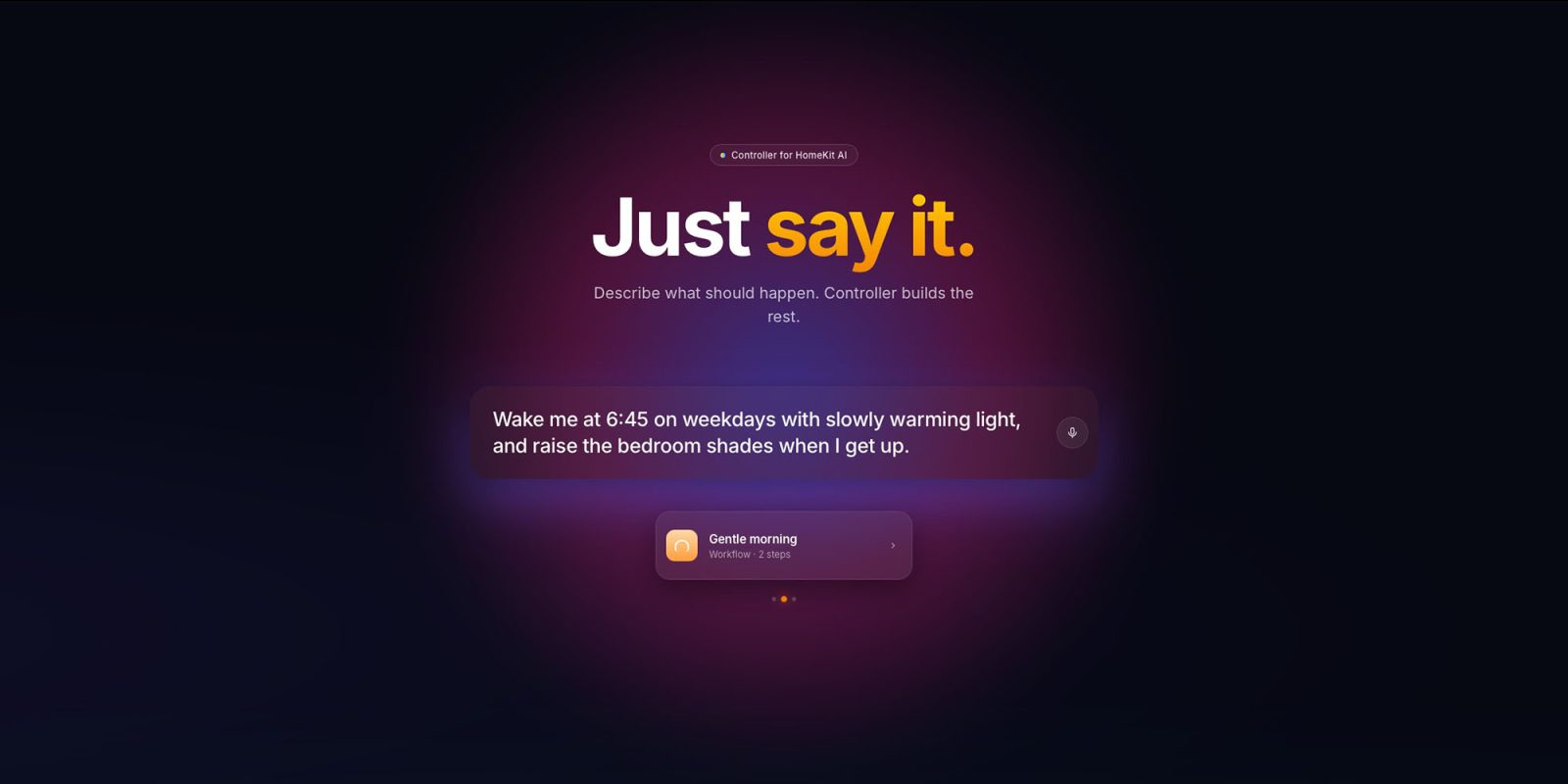
According to the developer’s official documentation and promotional materials, the process is designed to be as frictionless as possible. The website emphasizes that the user only needs to describe what should happen in their home environment, and the app will handle the technical heavy lifting. This approach leverages modern advancements in natural language processing to translate human speech or text into the structured data required by Apple’s HomeKit framework.
To illustrate the versatility of the new AI engine, the developers have highlighted several practical examples that showcase how the tool handles different levels of complexity. One example focuses on a morning routine: "Wake me at 6:45 on weekdays with slowly warming light, and raise the bedroom shades when I get up." This single sentence involves multiple layers of logic, including a time-based trigger, a recurring schedule (weekdays), a gradual change in device state (warming light), and a secondary action tied to a sensor or user activity (raising shades). For a user to build this manually, they would typically need to navigate several different automation builders and potentially coordinate multiple third-party shortcuts.
 Smart Home & IoT Solutions
Abode Expands Apple Home Ecosystem with New Ruggedized Garage and Outdoor Security Sensors
The landscape of DIY home security continues to evolve as homeowners move...
 Smart Home & IoT Solutions
Abode Expands Smart Home Ecosystem with New Apple Home-Compatible Outdoor and Garage Sensors
The landscape of DIY home security continues to evolve as homeowners seek...
 Smart Home & IoT Solutions
Apple Signals Major Smart Home Pivot with Rumored 2027 Security Service and AI-Driven Hardware
For years, Apple’s presence in the smart home market has been characterized...







