
Market Momentum and Practical Applications
The quantum networking sector is no longer a purely academic pursuit. Market estimates now value the industry at approximately $2 billion, with a growing roster of specialized players including Nu Quantum, Aliro Technologies, and QphoX. Cisco has also been active in forming strategic partnerships, notably with Qunnect. Earlier this year, the two companies demonstrated scalable quantum entanglement swapping over 17.6 kilometers of existing commercial fiber-optic cable in New York City—a significant milestone proving that quantum signals can coexist with standard telecommunications infrastructure.
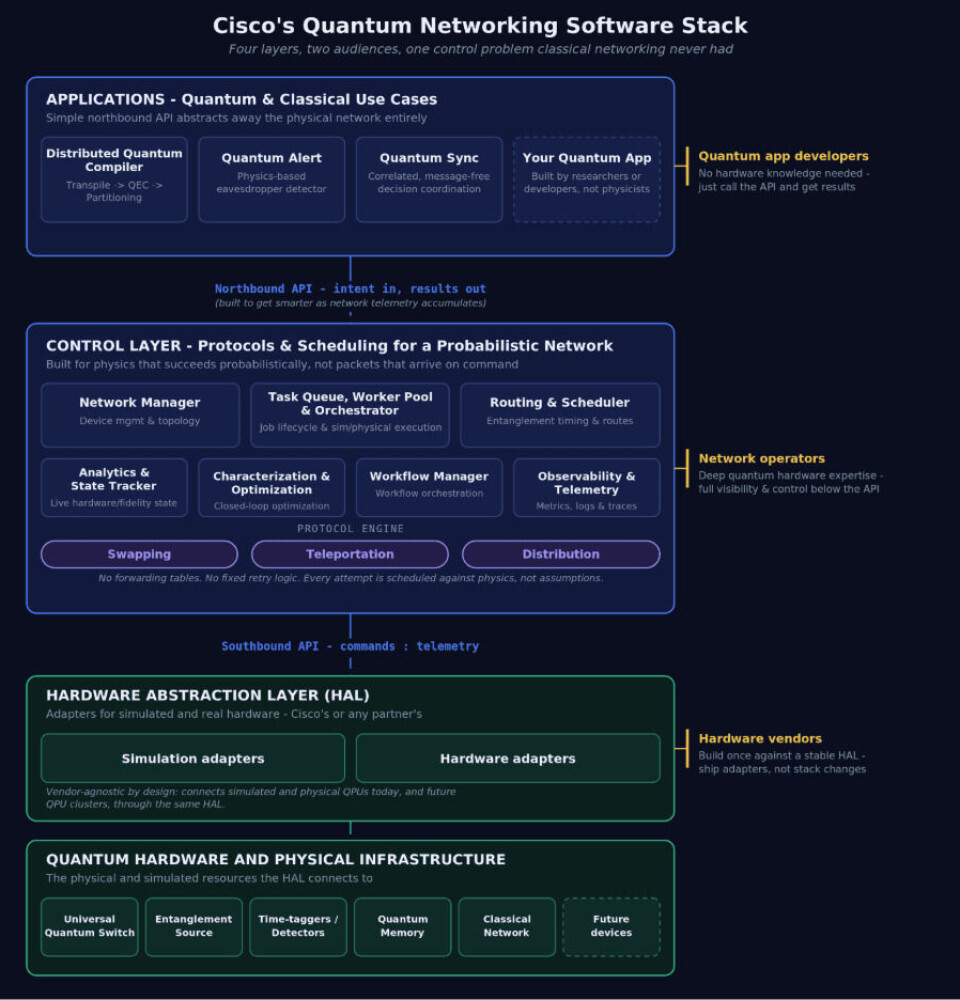
While the ultimate goal is a global quantum internet, Cisco is also identifying "near-term" use cases where quantum networking can benefit classical applications. One such example is in the financial sector, where "Quantum Sync" can be used for decision coordination in high-speed trading. By using quantum signals for instant communication between geographically separated nodes, firms can achieve a level of synchronization impossible with classical signals alone.
Another immediate application is in the realm of cybersecurity. Quantum eavesdropper detection utilizes the fragility of entangled photons. By mixing quantum signals with classical data on a fiber-optic line, any attempt by a third party to intercept the data would inevitably disturb the entanglement. This disturbance is immediately detectable, providing a "tamper-evident" seal on sensitive communications.
The Road Ahead: Transduction and Memory
Despite the rapid progress, several formidable hurdles remain before interconnected quantum systems become a daily reality. Kompella estimates that we are likely three to five years away from seeing functional, interconnected quantum systems at scale.
One major technical bottleneck is "transduction"—the process of converting quantum information from one physical form to another. For example, the qubits used for computation (such as those in a superconducting refrigerator) often operate at different frequencies than the "communication qubits" (photons) used to transmit data over fiber-optic lines. Converting between these two states while preserving entanglement is a monumental engineering challenge.
Furthermore, the industry still lacks robust "quantum memory." Because qubits are so fragile, they cannot yet be stored for long periods. Efficient quantum memory would allow the network to "buffer" entangled pairs, greatly increasing the reliability and timing coordination of the entire system.
"Quantum memories are actually extremely helpful in increasing your fidelities and timing," Kompella noted, adding that this remains a nascent area where further breakthroughs are essential.
As Cisco continues to refine its controller and compiler, the company is positioning itself not just as a hardware provider, but as the essential architect of the quantum control plane. By focusing on the automation of the network, Cisco aims to ensure that when the "quantum age" truly arrives, the infrastructure will be ready to handle it at machine speed.
 Enterprise Tech & Infrastructure
Upscale AI Challenges Nvidia’s Dominance with SkyHammer Scale-Up Fabric
For decades, the architecture of high-performance computing has been defined by a...
 Enterprise Tech & Infrastructure
Navigating the Shift to Software-Defined Storage: Expert Strategies for Enterprise Success
The modern enterprise data center is undergoing a fundamental transformation, driven by...
 Enterprise Tech & Infrastructure
From Theory to Engineering: Quantum Computing Reaches a Commercial Tipping Point as Industry Giants Prepare for a Hybrid Future
The long-anticipated transition of quantum computing from a theoretical pursuit of physics...







