
In the rapidly evolving landscape of quantum information science, the primary focus for much of the last decade has been a race toward "scaling up"—the pursuit of packing more qubits into a single, increasingly complex refrigerated unit. However, Cisco Systems, through its specialized research and development incubator, Outshift, is championing a different philosophy. The networking giant contends that the true path to a "Quantum Internet" and functional large-scale quantum computing lies not just in the size of individual processors, but in the ability to "scale out" through sophisticated, automated networking.
For several years, Outshift has been methodically assembling the architectural components required to transform quantum computing from a series of isolated experiments into a distributed, cloud-like infrastructure. This vision mirrors the historical evolution of classical computing, which transitioned from massive, standalone mainframes to the hyper-connected global networks that define the modern digital era. Cisco’s latest breakthroughs, centered on a new Quantum Network Controller and a Network-Aware Quantum Compiler, aim to provide the critical software and control layers needed to manage the inherent volatility of quantum states at machine speed.
The Shift Toward Distributed Quantum Power
The fundamental premise driving Cisco’s investment is that the massive number of qubits required for commercially viable applications—such as drug discovery, materials science, or complex financial modeling—may be too difficult to house within a single physical system. Environmental noise, thermal fluctuations, and the sheer physical footprint of dilution refrigerators create diminishing returns for single-machine scaling.
To solve this, Cisco envisions a future where multiple quantum computers are linked via a quantum network, allowing them to share entanglement and work in concert. This "scaling out" approach requires a quantum networking stack that can handle the unique properties of quantum mechanics. Unlike classical networking, which transmits bits as pulses of light representing zeros and ones, quantum networking relies on entanglement—a phenomenon where particles become inextricably linked, such that the state of one instantly influences the state of another, regardless of the distance between them.
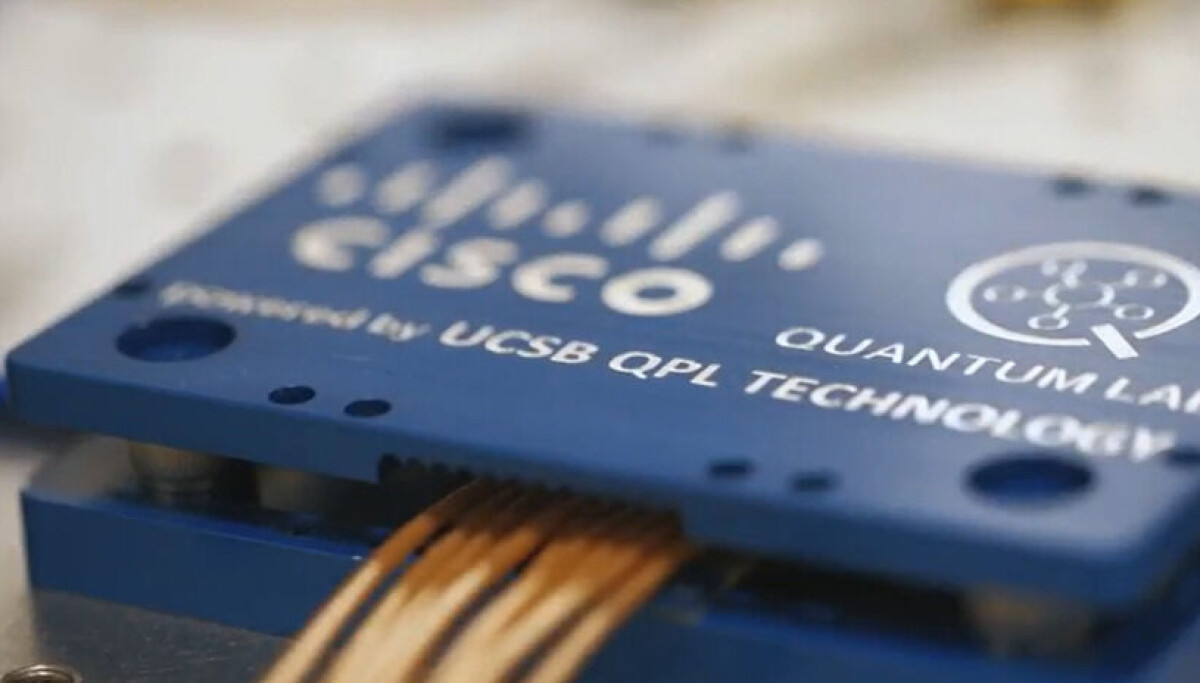
Early in 2024, the Outshift group was tasked with the ambitious goal of building this quantum networking stack. This effort led to the unveiling of a prototype quantum network entangling chip. This hardware is designed to generate entangled pairs of photons and distribute them over significant distances, providing the raw "fuel" for quantum communication. Because this process is fundamentally different from classical data transmission, it requires entirely new hardware and protocols to ensure that the delicate quantum states are not lost to environmental decoherence.
Interoperability and the Universal Quantum Switch
One of the most significant challenges in the current quantum ecosystem is the lack of a standardized hardware modality. Leading firms and research institutions are currently pursuing a variety of different methods to create and control qubits. IBM and Google have leaned heavily into superconducting circuits; others, like IonQ, utilize trapped ions; QuEra focuses on neutral atoms; and companies like QuiX are pushing the boundaries of photonics.
In April, Cisco addressed this fragmentation with the introduction of its Universal Quantum Switch. The prototype is designed to be modality-agnostic, meaning it can connect quantum sensors and computers regardless of the underlying technology used by the vendor. By facilitating connections between, for example, a superconducting system and a trapped-ion system, Cisco is positioning itself as the neutral fabric of the quantum era—much as it did for the classical internet.
However, hardware alone is insufficient. As the number of connected nodes grows, the complexity of managing those connections increases exponentially. This realization led to the most recent announcement at Cisco’s Quantum Summit: the Quantum Network Controller.
Automation at Machine Speed
The current state of quantum networking is largely characterized by manual configuration. Researchers and engineers must "hand-stitch" point-to-point connections, a process that is slow, prone to error, and entirely unscalable. Ramana Kompella, the head of Cisco Research, highlights that while manual configuration might work for a laboratory setup with two or three nodes, it collapses under the weight of a true network.
“Connecting 1,000 quantum nodes point to point takes close to 500,000 dedicated links,” noted Vijoy Pandey, Senior Vice President of Outshift. Managing such a web of connections manually is a mathematical and operational impossibility.
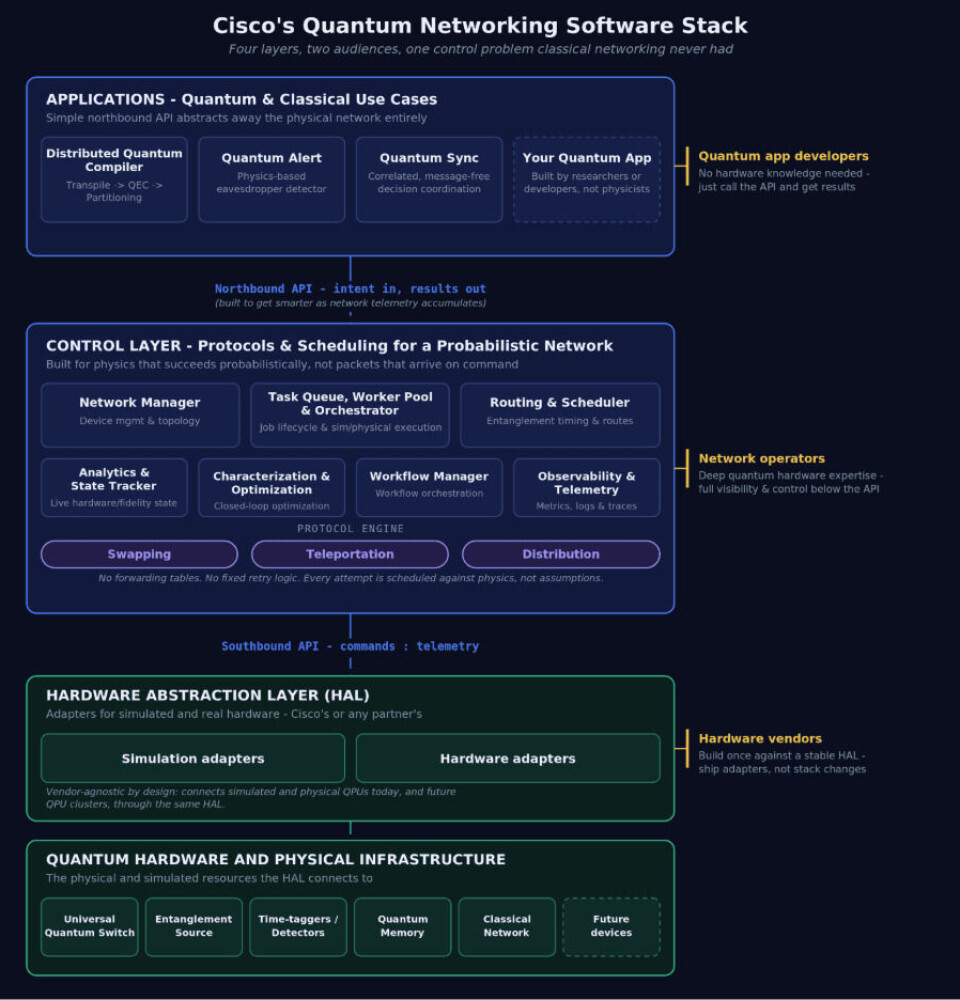
Kompella explained to The Next Platform that the power of a network lies in "any-to-any" connectivity. When an application requires entanglement between two specific nodes, that request must be fulfilled instantly. If requests are coming in at machine speeds, a human operator cannot possibly reconfigure the fabric fast enough to keep up. The Quantum Network Controller acts as the "brain" of the network, providing a control plane that automates these connections, ensuring that the fabric can scale alongside the demand for quantum resources.
Entanglement-as-a-Service
A key distinction between classical and quantum networking lies in the nature of the operations. Classical systems are deterministic; when a controller schedules a task, the timing and execution are predictable. Quantum systems, conversely, are probabilistic. Qubits have incredibly short "coherence times," meaning they only maintain their quantum state for fractions of a second before being disrupted by their environment.
Reza Nejabati, who leads Cisco’s Quantum Labs, points out that factors such as signal loss, fidelity, and synchronization timing determine the success of a quantum operation. To shield application developers from this overwhelming complexity, Cisco’s controller employs an "Entanglement-as-a-Service" (EaaS) model.
Through a standardized API, an application can simply request a connection by specifying the required endpoints, the necessary fidelity (the "purity" of the quantum state), and the timing. The controller then takes over, scheduling the connection, ensuring the quality of the link, and using predefined tuning to optimize performance. If a connection fails or the fidelity drops below the required threshold, the controller automatically retries or reinitializes the job. This abstraction layer is intended to allow developers to focus on writing quantum algorithms without needing to understand the minutiae of photonics or fiber-optic synchronization.
Integrating the Software Stack: The Quantum Compiler
The final piece of Cisco’s current puzzle is the Network-Aware Quantum Compiler. For distributed quantum computing to work, a large, complex quantum circuit must be broken down into smaller sub-circuits that can be executed on different physical processors.
According to Kompella, the compiler and the controller work in tandem. The compiler analyzes the computational task, determines how to partition it, and identifies exactly when and where entanglement is needed to move a "partially computed state" from one processor to another. It then communicates these requirements to the controller, which prepares the network to provide those entanglements at the precise millisecond they are required.
This synergy is what Cisco believes will finally enable "distributed quantum computing," where the collective power of many small quantum devices exceeds what any single device could achieve alone.
Market Momentum and Practical Applications
The quantum networking sector is no longer a purely academic pursuit. Market estimates now value the industry at approximately $2 billion, with a growing roster of specialized players including Nu Quantum, Aliro Technologies, and QphoX. Cisco has also been active in forming strategic partnerships, notably with Qunnect. Earlier this year, the two companies demonstrated scalable quantum entanglement swapping over 17.6 kilometers of existing commercial fiber-optic cable in New York City—a significant milestone proving that quantum signals can coexist with standard telecommunications infrastructure.
While the ultimate goal is a global quantum internet, Cisco is also identifying "near-term" use cases where quantum networking can benefit classical applications. One such example is in the financial sector, where "Quantum Sync" can be used for decision coordination in high-speed trading. By using quantum signals for instant communication between geographically separated nodes, firms can achieve a level of synchronization impossible with classical signals alone.
Another immediate application is in the realm of cybersecurity. Quantum eavesdropper detection utilizes the fragility of entangled photons. By mixing quantum signals with classical data on a fiber-optic line, any attempt by a third party to intercept the data would inevitably disturb the entanglement. This disturbance is immediately detectable, providing a "tamper-evident" seal on sensitive communications.
The Road Ahead: Transduction and Memory
Despite the rapid progress, several formidable hurdles remain before interconnected quantum systems become a daily reality. Kompella estimates that we are likely three to five years away from seeing functional, interconnected quantum systems at scale.
One major technical bottleneck is "transduction"—the process of converting quantum information from one physical form to another. For example, the qubits used for computation (such as those in a superconducting refrigerator) often operate at different frequencies than the "communication qubits" (photons) used to transmit data over fiber-optic lines. Converting between these two states while preserving entanglement is a monumental engineering challenge.
Furthermore, the industry still lacks robust "quantum memory." Because qubits are so fragile, they cannot yet be stored for long periods. Efficient quantum memory would allow the network to "buffer" entangled pairs, greatly increasing the reliability and timing coordination of the entire system.
"Quantum memories are actually extremely helpful in increasing your fidelities and timing," Kompella noted, adding that this remains a nascent area where further breakthroughs are essential.
As Cisco continues to refine its controller and compiler, the company is positioning itself not just as a hardware provider, but as the essential architect of the quantum control plane. By focusing on the automation of the network, Cisco aims to ensure that when the "quantum age" truly arrives, the infrastructure will be ready to handle it at machine speed.
 Enterprise Tech & Infrastructure
Seagate, Western Digital, and Toshiba Lead 2023 Rankings for Enterprise-Grade Storage Solutions
In the rapidly evolving landscape of corporate data infrastructure, the demand for...
 Enterprise Tech & Infrastructure
From Theory to Engineering: Quantum Computing Reaches a Commercial Tipping Point as Industry Giants Prepare for a Hybrid Future
The long-anticipated transition of quantum computing from a theoretical pursuit of physics...
 Enterprise Tech & Infrastructure
Quantum Elements Bridges the Hardware-Software Gap in Quest for Fault-Tolerant Computing
The journey toward a practical, large-scale quantum computer has long been defined...







