
“Connecting 1,000 quantum nodes point to point takes close to 500,000 dedicated links,” noted Vijoy Pandey, Senior Vice President of Outshift. Managing such a web of connections manually is a mathematical and operational impossibility.
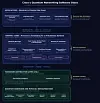
Kompella explained to The Next Platform that the power of a network lies in "any-to-any" connectivity. When an application requires entanglement between two specific nodes, that request must be fulfilled instantly. If requests are coming in at machine speeds, a human operator cannot possibly reconfigure the fabric fast enough to keep up. The Quantum Network Controller acts as the "brain" of the network, providing a control plane that automates these connections, ensuring that the fabric can scale alongside the demand for quantum resources.
Entanglement-as-a-Service
A key distinction between classical and quantum networking lies in the nature of the operations. Classical systems are deterministic; when a controller schedules a task, the timing and execution are predictable. Quantum systems, conversely, are probabilistic. Qubits have incredibly short "coherence times," meaning they only maintain their quantum state for fractions of a second before being disrupted by their environment.
Reza Nejabati, who leads Cisco’s Quantum Labs, points out that factors such as signal loss, fidelity, and synchronization timing determine the success of a quantum operation. To shield application developers from this overwhelming complexity, Cisco’s controller employs an "Entanglement-as-a-Service" (EaaS) model.
Through a standardized API, an application can simply request a connection by specifying the required endpoints, the necessary fidelity (the "purity" of the quantum state), and the timing. The controller then takes over, scheduling the connection, ensuring the quality of the link, and using predefined tuning to optimize performance. If a connection fails or the fidelity drops below the required threshold, the controller automatically retries or reinitializes the job. This abstraction layer is intended to allow developers to focus on writing quantum algorithms without needing to understand the minutiae of photonics or fiber-optic synchronization.
Integrating the Software Stack: The Quantum Compiler
The final piece of Cisco’s current puzzle is the Network-Aware Quantum Compiler. For distributed quantum computing to work, a large, complex quantum circuit must be broken down into smaller sub-circuits that can be executed on different physical processors.
According to Kompella, the compiler and the controller work in tandem. The compiler analyzes the computational task, determines how to partition it, and identifies exactly when and where entanglement is needed to move a "partially computed state" from one processor to another. It then communicates these requirements to the controller, which prepares the network to provide those entanglements at the precise millisecond they are required.
This synergy is what Cisco believes will finally enable "distributed quantum computing," where the collective power of many small quantum devices exceeds what any single device could achieve alone.
 Enterprise Tech & Infrastructure
AMD Acquires World Labs for $8.2 Billion to Rival Nvidia in the Frontier of World Models
In a massive strategic move designed to reshape its standing in the...
 Enterprise Tech & Infrastructure
Bridging the Gap in Data Center Convergence: The Evolving Role of Fibre Channel over Ethernet
As data centers face unprecedented pressure to handle massive workloads driven by...
 Enterprise Tech & Infrastructure
Quantum Elements Bridges the Hardware-Software Gap in Quest for Fault-Tolerant Computing
The journey toward a practical, large-scale quantum computer has long been defined...







