
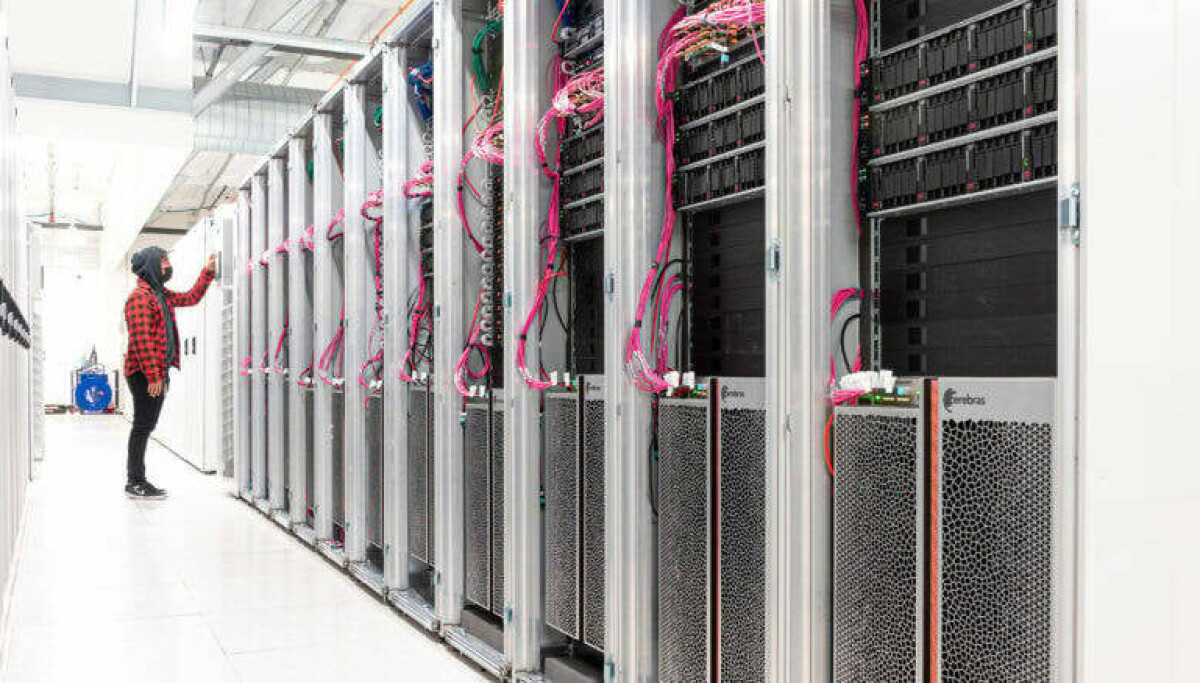
Throughout 2026, Cerebras Systems, the innovator behind the world’s largest AI processors, has remained steadfast in its strategic narrative: this is the year of infrastructure and manufacturing. The company has spent the better part of the year aggressively building out its cloud services and scaling its manufacturing footprint to meet the staggering demands of its burgeoning contract list. While the company has successfully inked agreements with industry titans such as Amazon Web Services (AWS), Oracle Cloud, and Microsoft Azure, its immediate financial trajectory is currently being defined by a transformative partnership with OpenAI. This deal, which is finally moving into its primary ramp-up phase, accounts for the vast majority of Cerebras’ current revenue backlog and nearly all of its recent incremental growth.
The broader AI landscape is approaching a critical juncture as the industry looks toward 2027. Market analysts suggest that next year could be a banner period for AI hardware providers, though a shadow of uncertainty remains. There is a distinct, non-zero possibility that 2027 could represent the peak of the current Generative AI spending boom. Predicting the longevity of this investment cycle is a challenge even for the most advanced AI systems. In the complex supply chain of the technology sector, organizations often operate based on the immediate forecasts of their customers, creating a cycle where demand signals can sometimes be amplified beyond reality. However, the consistent high-volume purchasing observed over the past four years suggests that, despite persistent fears of a market correction, the appetite for high-performance AI systems remains robust.
The underlying reality is that Generative AI has moved beyond mere hype to become a foundational shift in computing. The primary driver of this evolution is the rapidly decreasing cost of "token chewing"—the process of generating and processing AI outputs. As these costs fall, AI integration is becoming pervasive, embedding itself either directly within the world’s software applications or forming a critical layer around them. While some industry enthusiasts believe AI will eventually replace traditional applications entirely, this view often overlooks the inherent risk aversion of the global corporate sector. In many of the world’s most critical banking and insurance systems, mainframe code dating back several decades remains operational. Much like a granite mountain, this legacy infrastructure has survived wave after wave of technological evolution. While AI will undoubtedly augment and surround these systems, the core of corporate computing is built on a foundation that resists total displacement.
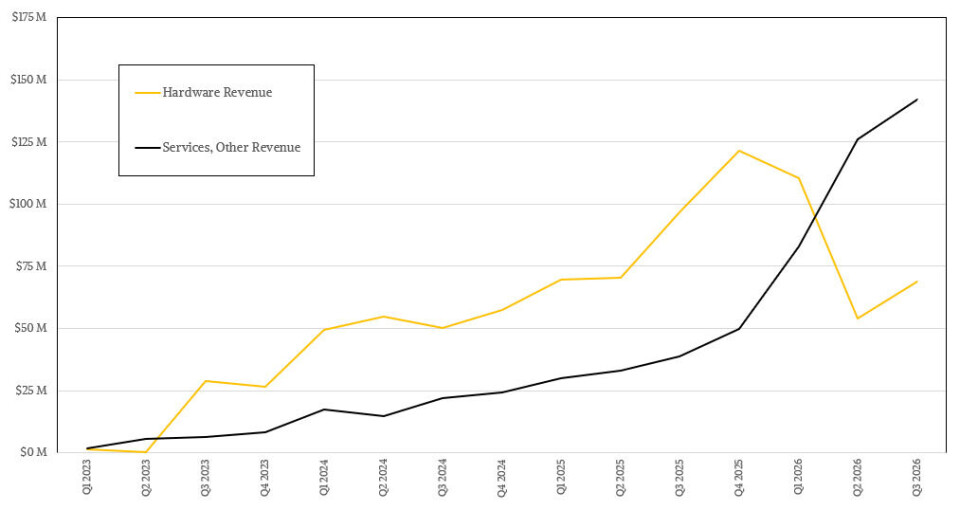
Financial results for the third quarter of 2026 reflect this transitional period for Cerebras. The company reported a dip in sales for its CS-3 and CS-4 hardware compared to previous quarters. This decline, however, was not a sign of waning interest but rather a tactical redirection of resources. Cerebras has been prioritizing the build-out of its own cloud services infrastructure to support the massive $10 billion inference deal it secured with OpenAI in January 2026. This agreement, which involves providing 750 megawatts of computing capacity for fast inference tasks, has the potential to expand significantly. Revised estimates suggest the deal could be worth between $20 billion and $30 billion through 2032, provided OpenAI exercises options to add another 1.25 gigawatts of capacity by 2030. For OpenAI, the economics of this deal are compelling. Utilizing Cerebras’ waferscale engines for inference prefill and decode operations offers a cost-effective alternative to traditional Nvidia GPU clusters, particularly as Cerebras integrates AMD GPUs for prefill tasks within its cloud environment.
On the balance sheet, Cerebras’ third-quarter hardware revenue fell by 28.8 percent to $68.9 million. Gross margins were notably thin, sitting at just 11 percent—a far cry from the company’s long-term target of 60 percent. During a conference call with Wall Street analysts, Andrew Feldman, co-founder and CEO of Cerebras, explained that these margins were impacted by two primary factors: the ongoing costs of ramping up a new production level at the company’s manufacturing facilities and the fulfillment of legacy contracts. Specifically, machines currently being installed were sold under aggressive pricing terms negotiated years ago with early customers, likely including the cloud provider G42.
Addressing rumors regarding production difficulties, Feldman was quick to dismiss claims that the company was suffering from yield issues on its massive chips. The current generation WSE-3, used in CS-3 systems, and the WSE-3 Turbo, found in CS-4 systems, are manufactured using Taiwan Semiconductor Manufacturing Co’s (TSMC) 5-nanometer process. This node is considered highly mature and stable, unlike the cutting-edge 2-nanometer processes currently being explored for next-generation CPUs like AMD’s "Venice" Epyc 9006 series. The WSE-3 Turbo was introduced in August as a high-performance bridge to the future, utilizing double-clocking techniques to boost inference throughput.
Looking ahead, the company’s roadmap centers on the Wafer Scale Engine 5 (WSE-5), skipping the "4" designation entirely. The WSE-5 will power the upcoming CS-5 systems, which are designed to compete directly with the latest offerings from Nvidia and AMD, as well as specialized hardware from Grok, SambaNova, and the internal silicon projects of major hyperscalers. Feldman reported that the WSE-5 reached its tape-out milestone on June 15 and is already undergoing rigorous testing. The transition from tape-out to functional system testing in under five months is a significant engineering feat. The CS-5 is expected to double the performance of the CS-4 and is slated for full production in the early summer of 2027. By remaining on TSMC’s 5-nanometer node for this generation, Cerebras avoids the intense competition and high costs associated with more advanced nodes while still delivering substantial performance gains.
The technical specifications of the WSE-5 remain a subject of industry speculation, but the engine likely incorporates several advanced technologies to maintain its competitive edge. Potential features include silicon photonics for high-speed optical interconnects between wafers and memory servers, as well as SRAM stacking. Cerebras has already confirmed the use of 3D stacked DRAM with its wafers, a move necessitated by the extreme bandwidth requirements of modern AI models. Furthermore, the trend of "double-clocking" wafers is expected to continue. In the current phase of the AI market, the primary economic metric is the cost per million tokens rather than traditional energy efficiency metrics like performance per watt. While electricity availability is becoming a constraint for data center operators, the immediate demand for raw inference speed means that performance currently trumps power consumption.
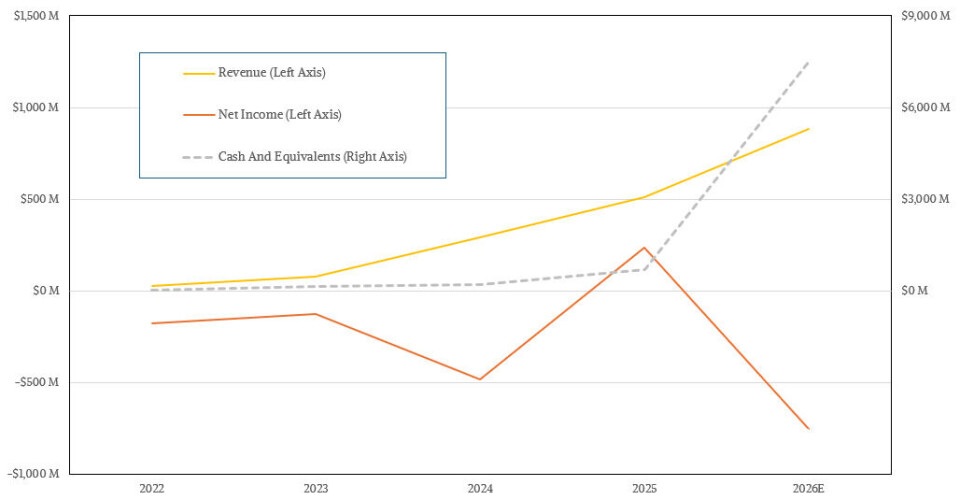
Because hardware sales in the supercomputing sector are notoriously "lumpy"—characterized by large, infrequent shipments—Cerebras’ financial health is best viewed through an annual lens. On a GAAP basis, the company is projected to finish 2026 with approximately $885 million in revenue, representing a 73.4 percent increase over 2025. While current net income has been pressured by a significant spike in research and development spending and stock-based compensation, the long-term outlook remains aggressive. Feldman indicated that the company aims to triple its sales in 2027. As manufacturing efficiencies improve through partnerships with contract manufacturers like Flex and Sanmina, gross profits are expected to recover toward historical targets.
Cerebras concluded the third quarter with a formidable cash position of $7.36 billion. More importantly, its revenue backlog has swelled to $26.1 billion, almost entirely anchored by the OpenAI commitment. While the recent deals with AWS, Oracle, and Microsoft have not yet contributed to the formal backlog or recognized revenue, they represent a significant validation of the company’s technology. The world’s largest cloud providers are increasingly looking to integrate waferscale hardware into their inference pipelines to handle the "decode" phase of model execution more efficiently.
As the industry prepares for the 2027 hardware cycle, Cerebras is positioning itself not just as a chip maker, but as a critical infrastructure partner for the world’s leading AI researchers. The move to a cloud-first delivery model allows the company to capture a larger share of the AI value chain while insulating itself from some of the volatility of direct hardware sales. With the WSE-5 testing already underway and a massive backlog of orders to fulfill, the company’s trajectory appears set on a path of rapid expansion, provided the global appetite for AI tokens continues its current upward trend. The coming summer will serve as the ultimate proving ground for whether Cerebras can translate its ambitious engineering roadmap into sustained market leadership.
 Enterprise Tech & Infrastructure
The Long Road to Open Silicon: How OpenTitan and the Rise of Secure Roots of Trust are Reshaping the Semiconductor Industry
The 2018 Hot Chips conference served as a pivotal moment for the...
 Enterprise Tech & Infrastructure
Understanding RAID 10: The Strategic Balance of Speed, Redundancy, and the High Cost of Capacity
In the complex ecosystem of data storage, few configurations spark as much...
 Enterprise Tech & Infrastructure
Navigating the Shift to Software-Defined Storage: Essential Strategies for Modern Enterprise Data Management
The landscape of enterprise data management is undergoing a fundamental transformation as...