

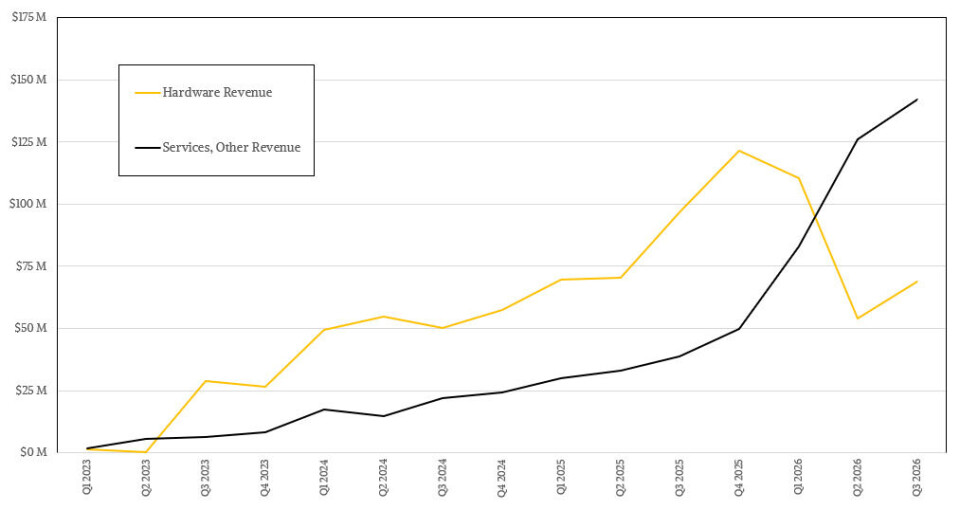
On the balance sheet, Cerebras’ third-quarter hardware revenue fell by 28.8 percent to $68.9 million. Gross margins were notably thin, sitting at just 11 percent—a far cry from the company’s long-term target of 60 percent. During a conference call with Wall Street analysts, Andrew Feldman, co-founder and CEO of Cerebras, explained that these margins were impacted by two primary factors: the ongoing costs of ramping up a new production level at the company’s manufacturing facilities and the fulfillment of legacy contracts. Specifically, machines currently being installed were sold under aggressive pricing terms negotiated years ago with early customers, likely including the cloud provider G42.
Addressing rumors regarding production difficulties, Feldman was quick to dismiss claims that the company was suffering from yield issues on its massive chips. The current generation WSE-3, used in CS-3 systems, and the WSE-3 Turbo, found in CS-4 systems, are manufactured using Taiwan Semiconductor Manufacturing Co’s (TSMC) 5-nanometer process. This node is considered highly mature and stable, unlike the cutting-edge 2-nanometer processes currently being explored for next-generation CPUs like AMD’s "Venice" Epyc 9006 series. The WSE-3 Turbo was introduced in August as a high-performance bridge to the future, utilizing double-clocking techniques to boost inference throughput.
Looking ahead, the company’s roadmap centers on the Wafer Scale Engine 5 (WSE-5), skipping the "4" designation entirely. The WSE-5 will power the upcoming CS-5 systems, which are designed to compete directly with the latest offerings from Nvidia and AMD, as well as specialized hardware from Grok, SambaNova, and the internal silicon projects of major hyperscalers. Feldman reported that the WSE-5 reached its tape-out milestone on June 15 and is already undergoing rigorous testing. The transition from tape-out to functional system testing in under five months is a significant engineering feat. The CS-5 is expected to double the performance of the CS-4 and is slated for full production in the early summer of 2027. By remaining on TSMC’s 5-nanometer node for this generation, Cerebras avoids the intense competition and high costs associated with more advanced nodes while still delivering substantial performance gains.
The technical specifications of the WSE-5 remain a subject of industry speculation, but the engine likely incorporates several advanced technologies to maintain its competitive edge. Potential features include silicon photonics for high-speed optical interconnects between wafers and memory servers, as well as SRAM stacking. Cerebras has already confirmed the use of 3D stacked DRAM with its wafers, a move necessitated by the extreme bandwidth requirements of modern AI models. Furthermore, the trend of "double-clocking" wafers is expected to continue. In the current phase of the AI market, the primary economic metric is the cost per million tokens rather than traditional energy efficiency metrics like performance per watt. While electricity availability is becoming a constraint for data center operators, the immediate demand for raw inference speed means that performance currently trumps power consumption.
 Enterprise Tech & Infrastructure
The Security Architecture of Enterprise Storage: Evaluating the Vulnerabilities of DAS and NAS Systems
In the modern enterprise landscape, data is frequently characterized as the lifeblood...
 Enterprise Tech & Infrastructure
The Architecture of Data: Understanding the Critical Hierarchy of Computer Memory Systems
In the modern digital landscape, the term "computer memory" serves as a...
 Enterprise Tech & Infrastructure
IonQ Breakthrough Demonstrates Real-Time Quantum Error Correction Using Standard CPU Architecture
The global pursuit of fault-tolerant, scalable quantum computing has long been defined...







