The rapid pace of software evolution has long presented a unique challenge for the burgeoning field of artificial intelligence, particularly for Large Language Models that serve as daily companions for software engineers. As Microsoft officially rolls out .NET 11, the developer community faces a familiar hurdle: the "knowledge cutoff" inherent in even the most advanced AI models. While these models are capable of generating complex code and architectural suggestions, their training data is static, often trailing months or even years behind the latest stable releases of major frameworks. This disconnect often leads to AI agents suggesting deprecated methods, missing out on performance optimizations, or failing to implement the most recent syntax improvements. To address this specific friction point, a new open-source project titled Playbook has been released, offering a specialized Model Context Protocol (MCP) designed to synchronize AI behavior with the cutting-edge standards of .NET 11.
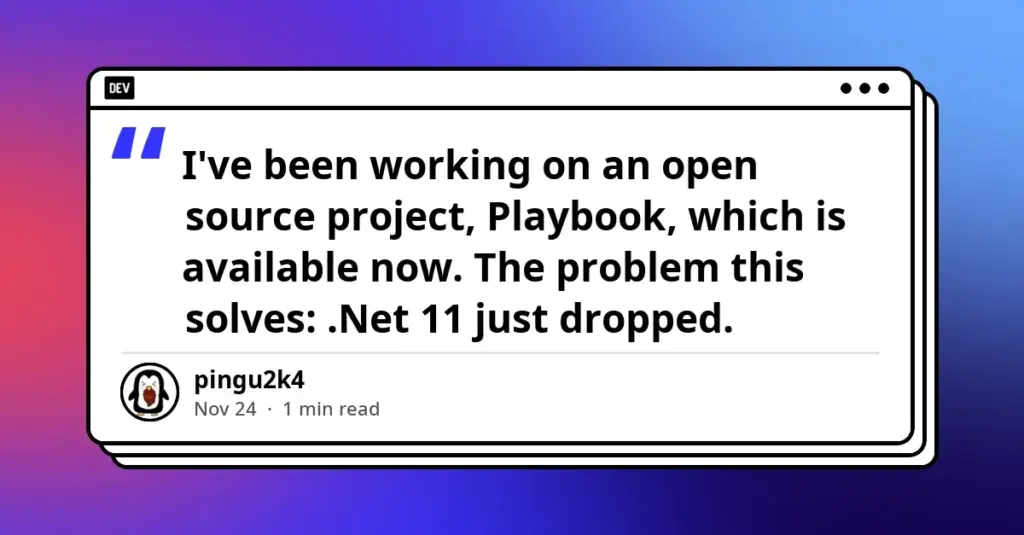
The developer behind the project, known as pingu2k4, recently announced the launch of Playbook as a direct solution to the lag between framework releases and AI model updates. The core of the problem lies in the timing of model training cycles. By the time a major framework like .NET 11 reaches general availability, the foundational training of current flagship models—such as those powering Claude, GPT-4, or various specialized coding assistants—has already concluded. While some models may have been exposed to early Release Candidate (RC) documentation during their training phases, it is highly unlikely that any current AI possesses a comprehensive, nuanced understanding of the finalized .NET 11 ecosystem. This often results in a "hallucination" of sorts, where the AI attempts to apply .NET 8 or .NET 9 logic to a .NET 11 environment, missing out on the specific advancements Microsoft has introduced to streamline development.
Playbook functions as an MCP, a standardized framework that allows AI agents to interact with external data sources and tools in a structured manner. By acting as a bridge, Playbook provides AI agents with an extensive library of information that covers 491 specific coding recipes. These recipes are meticulously organized across 24 distinct categories, ensuring that the agent has access to granular, verified implementation details rather than relying on outdated internal training data. Among these categories, the project places a significant emphasis on Blazor, with 70 recipes specifically tagged for the web framework. This focus is particularly relevant given the rapid evolution of Blazor’s rendering modes and component models, which have undergone substantial changes in recent iterations of the .NET ecosystem.
The technical implementation of Playbook allows an AI agent to search through these recipes dynamically to understand how specific tasks should be performed within the user’s current target framework. One of the most significant features of this MCP is its contextual awareness. When a developer is working within a specific environment, the agent can specify which framework it is interested in. In response, the MCP filters the available data to return only the information relevant to the current goals and working environment of the developer. This prevents the "information overload" that can occur when an AI attempts to synthesize too many conflicting versions of a library, ensuring that the code generated is not only functional but also adheres to the latest best practices and architectural standards.
The impact of this contextual grounding is not merely theoretical. According to the project’s creator, initial testing has demonstrated a quantifiable improvement in the quality of AI-generated code. When tasked with creating a .NET 11 application, models utilizing the Playbook MCP showed a "noticeable improvement" in following the new standards and methodologies introduced in the latest version of the framework compared to those operating without the tool. This suggests that providing a high-quality, curated context window can effectively bypass the limitations of a model’s original training data, allowing developers to leverage the full power of .NET 11 immediately upon its release.

Beyond the technical accuracy of the code, the user experience of Playbook is designed for seamless integration into existing workflows. One of the primary barriers to adopting new AI tools is often the need to learn complex prompting strategies or to constantly remind the agent which tools it should be using. Playbook aims to eliminate this friction. Once the MCP is installed, it functions as a background capability for the AI agent. The developer does not need to change their prompting style or explicitly instruct the agent to consult the Playbook database. Instead, the agent is designed to autonomously recognize when its internal knowledge may be insufficient or when a more specific .NET 11 recipe is available, opting to use the MCP at the correct moments to ensure the highest quality output.
This project arrives at a time when the software industry is increasingly looking for ways to make AI more reliable and context-aware. The Model Context Protocol itself is gaining traction as a vital standard for connecting LLMs to the real-world data they need to be effective in professional settings. By applying this protocol specifically to the .NET ecosystem, Playbook addresses a major pain point for enterprise developers who rely on Microsoft’s stack. The transition to new versions of .NET is often a complex process involving the adoption of new APIs and the phasing out of older patterns. Having an AI assistant that is fully "aware" of these transitions can significantly reduce the cognitive load on developers and minimize the introduction of legacy patterns into new codebases.
The breadth of the Playbook library—nearly 500 recipes—indicates a significant effort to map out the common challenges and patterns faced by .NET developers. By categorizing these into 24 areas, the project covers a wide swathe of the framework, from core logic and data access to the intricacies of front-end development with Blazor. This structured approach to "recipes" mirrors how many developers actually learn and implement new features: by looking for verified, idiomatic examples of how to solve specific problems. By feeding these idiomatic examples directly into the AI’s reasoning process, Playbook ensures that the "creative" side of the AI is tempered by the "authoritative" side of the latest documentation and community standards.
The open-source nature of Playbook, which is currently hosted on GitHub under the PinguApps organization, allows for community contribution and transparency. As .NET 11 continues to mature and as the community discovers new optimal patterns, the recipe library can be updated and expanded. This community-driven model is essential for keeping pace with the "evergreen" nature of modern software development. The developer, pingu2k4, has encouraged users to engage with the project, offering to answer questions and provide support for those looking to integrate the MCP into their development environments.
For developers looking to maintain their velocity while transitioning to .NET 11, tools like Playbook represent a new frontier in AI-assisted engineering. Rather than waiting for the next generation of LLMs to be trained on current data, developers can now provide their existing agents with the "textbooks" they need to understand the present. This shift from relying on a model’s "memory" to providing it with "real-time reference material" is a significant step toward making AI a more dependable partner in high-stakes software development.
Installation instructions and the full source code for Playbook are available on the project’s GitHub repository. As the .NET ecosystem continues to expand and as AI agents become more deeply embedded in the IDE, the role of specialized context providers like Playbook is likely to grow. For now, it offers a practical, immediate solution to one of the most persistent problems in AI-assisted coding: staying current in a world that moves faster than a model can learn. By focusing on the specific needs of .NET 11 and Blazor developers, Playbook provides a blueprint for how framework-specific knowledge can be effectively bridged to the next generation of AI tools.
 Software Development & Scripting for IT
AI-Driven Development Reaches New Milestone as Formal Verification and Statecharts Detect Elusive Edge Cases
In the rapidly evolving landscape of software engineering, the integration of artificial...
 Software Development & Scripting for IT
The Efficiency Era: Compressed Models Dominate as VIDraft and LG Lead the 2026 Korean AI Download Charts
As the global landscape for artificial intelligence continues to shift toward practical...
 Software Development & Scripting for IT
The Technical Divide: How Design Control and Risk Management Distinguish ISO 13485 from ISO 9001 in Medical Manufacturing
In the complex world of medical device procurement and engineering, the presentation...