
SAN FRANCISCO — At its annual BoxWorks 2026 conference on Thursday, cloud content management giant Box announced a significant evolution of its enterprise AI strategy, unveiling a suite of tools designed to transform how businesses interact with their internal data. The company introduced Box Architect, a natural-language-driven tool for building autonomous workflows, alongside a high-performance content retrieval engine developed in collaboration with Nvidia. These advancements signal a shift for the company, moving beyond simple generative AI chatbots toward "agentic" systems that can independently execute complex business processes.
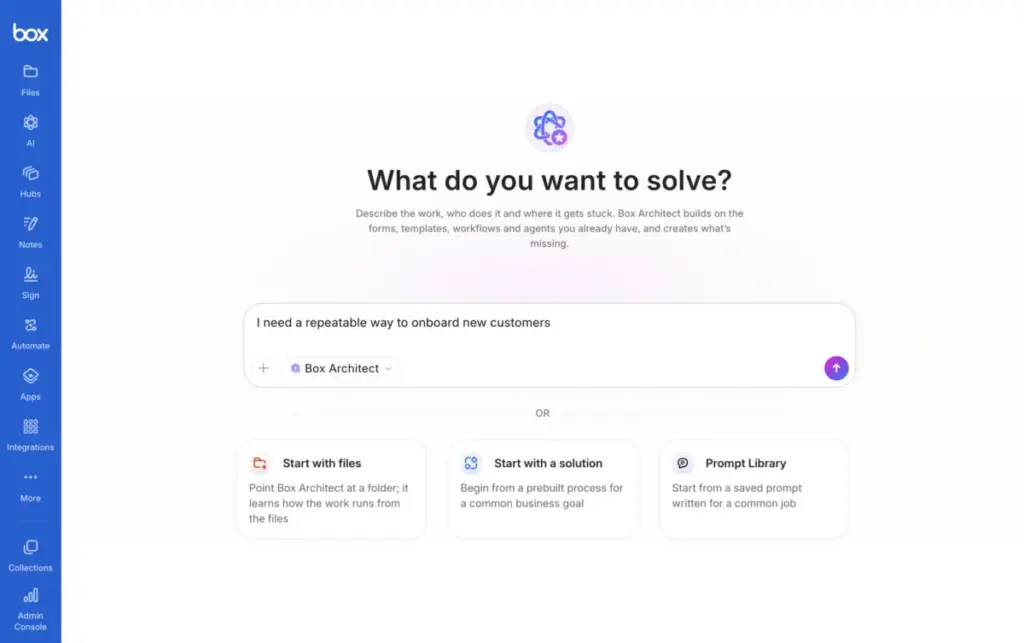
The centerpiece of the announcement, Box Architect, represents a fundamental change in how enterprise workflows are designed and deployed. Rather than requiring specialized technical knowledge or manual coding to map out business logic, the tool allows users to describe their goals in plain language. According to Box CEO Aaron Levie, Architect serves as an "agentic operator" of the platform’s core capabilities, effectively bridging the gap between a user’s intent and the execution of sophisticated content-related tasks.
The Rise of Agentic Workflow Automation
In the current enterprise landscape, automation has often been limited to rigid, pre-defined sequences. Box Architect aims to disrupt this by introducing flexibility and intelligence into the design phase. When a user provides a natural-language description of a process—such as "set up a system to process incoming vendor invoices and ensure they match our procurement policies"—Architect interprets the request and defines the necessary stages, decision points, and logic required to fulfill the goal.
Crucially, this automation does not bypass the stringent security and compliance frameworks that enterprise customers rely on. Box emphasized that Architect is built to automatically apply existing permissions, classifications, and retention policies to any workflow it generates. This ensures that even as AI takes a more active role in moving and processing documents, the underlying governance structures remain intact, preventing unauthorized access or data mishandling.
The lifecycle of a workflow in Architect includes several layers of validation. Before a workflow is published, users are given the opportunity to test the logic in a sandbox environment. This phase allows for the insertion of human-in-the-loop requirements, such as specific stages where a human manager must review or approve a document before the AI agent proceeds to the next step. Furthermore, the system is designed to be self-optimizing; once a workflow is deployed, Architect monitors the outputs and performance, offering recommendations for improvements based on real-world usage patterns.
Integrating the Box Ecosystem
The utility of Box Architect is largely derived from its ability to orchestrate various existing tools within the Box platform. By acting as a central coordinator, it can link disparate services into a cohesive, automated pipeline. The company illustrated this with the example of a financial institution managing client onboarding. In such a scenario, Architect could be used to design a workflow that initiates when a client submits data via Box Forms. From there, the system could trigger Box Extract to pull relevant data from identification documents, use Box Sign to facilitate the execution of legal agreements, and finally leverage Box Automate to trigger the final account setup in external systems.
This integration strategy moves Box further away from being a mere repository for files and closer to being an active operating system for business content. By streamlining the connection between data capture, extraction, and legal execution, Box aims to reduce the "friction" often associated with manual document handling.
Jason Andersen, vice president and principal analyst at Moor Insights & Strategy, noted that Architect’s primary value lies in its ability to harness collective organizational intelligence. While many initial AI tools focused on individual productivity—such as summarizing a single document—Architect is designed to scale those capabilities across a team or an entire business. It allows organizations to codify their collective knowledge into repeatable, automated agents.
However, Andersen also cautioned that the transition to agentic AI requires a disciplined approach. He suggested that while the AI can handle the heavy lifting of design, human oversight remains a critical component of development. Organizations must use observability tools to monitor these agents, ensuring they operate within the specific risk and cost management parameters required by the business.
Enhancing Performance with Nvidia-Powered Context Retrieval
In addition to the workflow automation tools, Box unveiled a new Context Retrieval engine, a technical breakthrough aimed at making AI agents faster, more accurate, and more cost-effective. Built on Nvidia’s Nemotron Retriever open-weight models, the engine is specifically designed to solve one of the most persistent challenges in enterprise AI: finding the right information within a massive, unstructured data set to provide to a large language model (LLM).
Box CTO Ben Kus explained that the Context Retrieval engine is engineered to deliver highly relevant enterprise context to AI agents with significantly lower latency than previous methods. The engine utilizes multimodal indexing, which allows it to scan and understand not just text-based documents, but also images, audio, and video files. This is a critical development for modern enterprises that increasingly store diverse media formats in the cloud.
The engine employs a sophisticated combination of keyword and semantic search. This dual approach ensures that if a user asks a question using terms that do not exactly match the text in a document, the AI can still find the relevant information by understanding the underlying meaning and context. As with Architect, the retrieval engine is bound by Box’s existing permission structures, ensuring that AI agents can only access and retrieve information that the specific user is authorized to see.
The performance metrics shared by Box suggest a significant leap forward in efficiency. Internal testing of the Context Retrieval engine showed a 20% improvement in search accuracy and a fourfold increase in the speed of question-answering tasks. Perhaps most importantly for the bottom line of enterprise customers, the engine resulted in up to 90% fewer tokens being sent to downstream models. Because most LLM providers charge based on token usage, this reduction represents a substantial decrease in the operational cost of running AI at scale.
Strategic Implications and Availability
The partnership with Nvidia and the use of the Nemotron open-weight model are seen as strategic moves to provide more value and flexibility to customers. Jason Andersen pointed out that context retrieval systems are becoming essential for improving the accuracy of AI outputs, which in turn leads to higher user satisfaction. He noted that the use of open models further strengthens Box’s value proposition, though he reiterated that the maximum benefit of such systems can only be realized if customers implement robust design principles and governance.
The rollout of these features will follow a phased approach. Box Architect is scheduled to enter beta testing in the fourth quarter of 2026. It will be available to customers on the Enterprise Advanced tier, which is currently the company’s highest service level. While specific pricing for the Architect tool has not been disclosed, the Enterprise Advanced tier already includes an allocation of 20,000 "AI Units," which Box uses to track and manage the consumption of its various AI-powered features.
The Context Retrieval engine is expected to reach general availability for Enterprise Advanced customers earlier in the year, providing the infrastructure necessary for the next generation of Box AI agents to function effectively.
As Box prepares for these launches, the company is positioning itself as a leader in the transition from "assistant-based" AI to "agentic" AI. By combining natural-language workflow design with high-speed, cost-efficient data retrieval, Box is attempting to provide a comprehensive platform where the AI doesn’t just help users find their work, but actively helps them complete it. The success of these tools will likely depend on how well enterprises can integrate these autonomous agents into their existing cultures of compliance and oversight.
 Small Business IT & Cloud Computing
Anthropic Advances Software Engineering Capabilities with Launch of Claude Fable 5.2 and Mythos 5.2
Anthropic has announced the release of its latest artificial intelligence models, Claude...
 Small Business IT & Cloud Computing
Apple Redefines the Professional Laptop with Touch-Integrated MacBook Pro and PROLED XDR Display
In a move that signals one of the most significant architectural and...
 Small Business IT & Cloud Computing
Meta Partners with NEC and Sumitomo to Build Petal, the World’s Highest-Capacity Undersea Cable Connecting the US and France
In a significant move to bolster the backbone of the global internet,...







