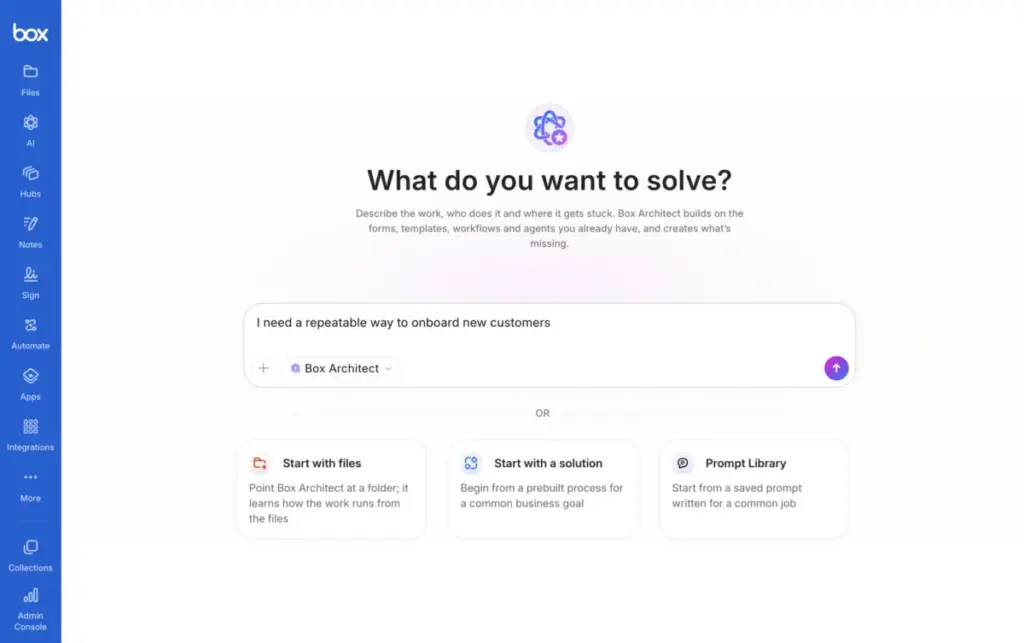
SAN FRANCISCO — At its annual BoxWorks 2026 conference on Thursday, cloud content management giant Box announced a significant evolution of its enterprise AI strategy, unveiling a suite of tools designed to transform how businesses interact with their internal data. The company introduced Box Architect, a natural-language-driven tool for building autonomous workflows, alongside a high-performance content retrieval engine developed in collaboration with Nvidia. These advancements signal a shift for the company, moving beyond simple generative AI chatbots toward "agentic" systems that can independently execute complex business processes.
The centerpiece of the announcement, Box Architect, represents a fundamental change in how enterprise workflows are designed and deployed. Rather than requiring specialized technical knowledge or manual coding to map out business logic, the tool allows users to describe their goals in plain language. According to Box CEO Aaron Levie, Architect serves as an "agentic operator" of the platform’s core capabilities, effectively bridging the gap between a user’s intent and the execution of sophisticated content-related tasks.
The Rise of Agentic Workflow Automation
In the current enterprise landscape, automation has often been limited to rigid, pre-defined sequences. Box Architect aims to disrupt this by introducing flexibility and intelligence into the design phase. When a user provides a natural-language description of a process—such as "set up a system to process incoming vendor invoices and ensure they match our procurement policies"—Architect interprets the request and defines the necessary stages, decision points, and logic required to fulfill the goal.
Crucially, this automation does not bypass the stringent security and compliance frameworks that enterprise customers rely on. Box emphasized that Architect is built to automatically apply existing permissions, classifications, and retention policies to any workflow it generates. This ensures that even as AI takes a more active role in moving and processing documents, the underlying governance structures remain intact, preventing unauthorized access or data mishandling.
The lifecycle of a workflow in Architect includes several layers of validation. Before a workflow is published, users are given the opportunity to test the logic in a sandbox environment. This phase allows for the insertion of human-in-the-loop requirements, such as specific stages where a human manager must review or approve a document before the AI agent proceeds to the next step. Furthermore, the system is designed to be self-optimizing; once a workflow is deployed, Architect monitors the outputs and performance, offering recommendations for improvements based on real-world usage patterns.
Integrating the Box Ecosystem
The utility of Box Architect is largely derived from its ability to orchestrate various existing tools within the Box platform. By acting as a central coordinator, it can link disparate services into a cohesive, automated pipeline. The company illustrated this with the example of a financial institution managing client onboarding. In such a scenario, Architect could be used to design a workflow that initiates when a client submits data via Box Forms. From there, the system could trigger Box Extract to pull relevant data from identification documents, use Box Sign to facilitate the execution of legal agreements, and finally leverage Box Automate to trigger the final account setup in external systems.
 Small Business IT & Cloud Computing
Meta Partners with NEC and Sumitomo to Build Petal, the World’s Highest-Capacity Undersea Cable Connecting the US and France
In a significant move to bolster the backbone of the global internet,...
 Small Business IT & Cloud Computing
Microsoft Issues Record-Breaking 1,408 Security Updates in October, While SharePoint Flaw Faces Active Attacks
The cybersecurity landscape shifted dramatically this month as Microsoft released its October...
 Small Business IT & Cloud Computing
Security Researchers Detect Residential Proxy Activity Within White House Network Environment
In an era where the digital perimeter of government institutions is under...