
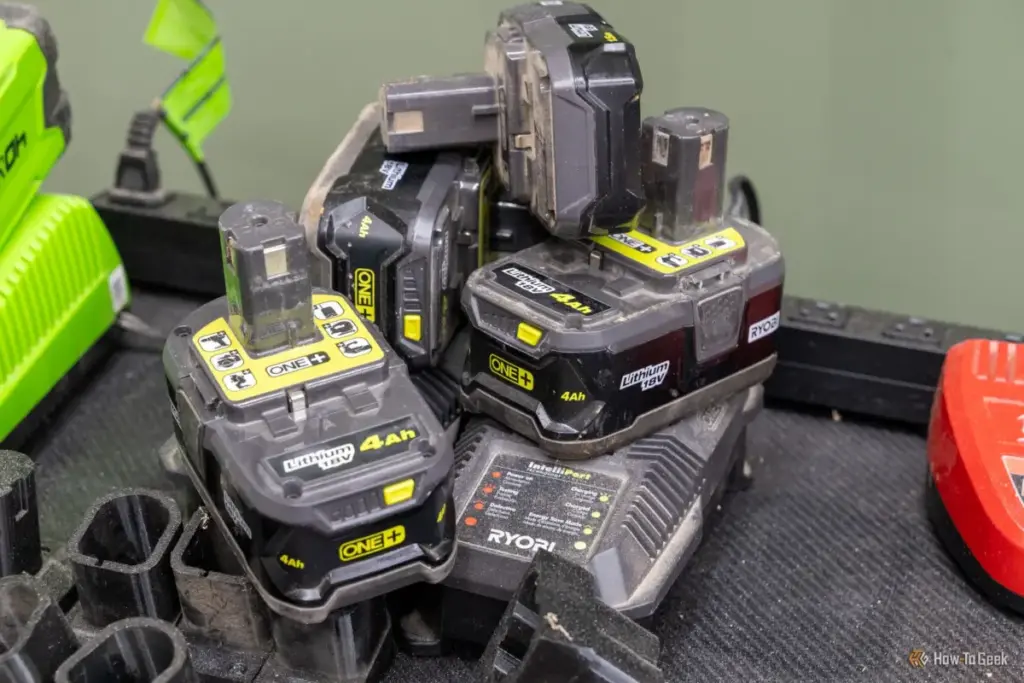
And a few of them can never be unlocked by you
The first line of defense is often the most overlooked: environmental stabilization. If a battery has been pushed to its limit in a high-demand tool like a circular saw or a lawnmower, it may simply be too hot for the BMS to allow a charge. In these instances, allowing the battery to rest in a climate-controlled area for several hours can sometimes clear the fault. Similarly, cleaning the terminal contacts with isopropyl alcohol can ensure that the charger is receiving an accurate voltage reading from the pack. If these steps fail, and a different charger produces the same result, the issue likely resides deep within the battery’s internal logic.
For those willing to venture into "battery surgery," a more advanced option exists: the J1 jumper reset. This process involves opening the battery casing to access the BMS board and manually resetting the logic controller. This is often referred to as a "soft lockout" fix. By bridging specific points on the board—typically labeled as J1—users can sometimes trick the BMS into clearing its error log and attempting to balance the cells again.
However, this path is fraught with risks. Opening a battery pack almost certainly voids any remaining manufacturer warranty and requires a steady hand. Lithium-ion cells carry significant energy; a single slip of a screwdriver that punctures a cell or shorts a circuit could lead to a thermal runaway event. Furthermore, while a J1 reset might fix a temporary glitch, it does not address the underlying cause of a cell imbalance, meaning the error may soon return.
Even more challenging is the "permanent lockout." In recent years, technical communities on platforms like Reddit have identified a deeper level of software restriction in certain Ryobi battery models. In these cases, a simple hardware reset is insufficient because the fault has been written into the battery’s firmware at a specific memory address.
One notable discovery by a community member involved bypassing this permanent lockout on a PBP005 board by dumping the battery’s firmware and manually editing the memory. By resetting the value at memory address 0x7E90 back to zero and reflashing the firmware onto the controller, the user was able to revive a battery that the official charger had deemed "dead." This level of repair requires specialized equipment, including a Tag-Connect cable and a SEGGER J-Link debugger, placing it well beyond the reach of the typical homeowner. It highlights a growing trend in the industry: the transition from mechanical failures that can be repaired to software "kill switches" that require computer engineering skills to circumvent.
I get why Ryobi does it, but a permanent kill switch feels like overkill
The implementation of these permanent lockouts raises significant questions about the balance between consumer safety and product longevity. From a corporate perspective, Ryobi’s parent company, Techtronic Industries (TTI), has a clear incentive to prioritize safety. Lithium-ion technology is inherently volatile if mismanaged. If a BMS allows a severely imbalanced or damaged pack to charge, the risk of a fire is real. By implementing a strict, non-reversible lockout, the manufacturer protects itself from liability and ensures that consumers are not using potentially dangerous equipment.
 Tech Tutorials & How-To Guides
Streaming Giants and Broadcast Legends: The Top Five Shows to Watch This Weekend
As the final weekend of October 2026 approaches, the digital landscape of...
 Tech Tutorials & How-To Guides
The Best Documentaries and Docuseries to Stream: September 2026’s Top Picks
The landscape of streaming television continues to be heavily influenced by the...
 Tech Tutorials & How-To Guides
Essential Roadside Resilience: Why Modern Drivers are Turning to Portable Battery-Powered Solutions
The modern driving experience is often defined by a sense of seamless...







