
As Apple continues to integrate its sophisticated "Apple Intelligence" suite across its ecosystem, the latest developer previews are shedding light on how these advanced features will be monetized and tiered for consumers. Within the technical documentation and release notes for the macOS 27 beta 3, a significant detail has emerged regarding the future of the Apple Home app: users wishing to utilize the next generation of AI-driven security camera features will be required to maintain a high-tier 2TB iCloud+ subscription.
This discovery marks a pivotal shift in how Apple manages its smart home platform, HomeKit Secure Video. While the company has long used iCloud+ as a prerequisite for camera storage, the move to lock specific software-based "intelligence" features behind its $9.99-per-month plan has sparked a conversation regarding the rising cost of the modern smart home and the creeping expansion of subscription-based ecosystems.
Intelligent Home App Notifications and Video Summaries
The features in question were first teased during Apple’s Worldwide Developers Conference (WWDC) earlier this year, where the company showcased a more intuitive and less intrusive way for homeowners to monitor their property. Currently, many smart home users suffer from "notification fatigue"—a phenomenon where a single event, such as a family member returning from work, triggers a relentless barrage of individual alerts.
Under the current system, a user might receive a notification when motion is detected in the driveway, another when the garage door opens, a third when it closes, a fourth when the front door detects a person, and a fifth when the smart lock is engaged. This sequence can be disruptive and often leads to users ignoring alerts altogether.
In the upcoming iOS 27 and macOS 27 updates, Apple Intelligence aims to solve this by synthesizing these disparate data points into a single, cohesive narrative. Instead of six separate pings, the Home app will provide a single, intelligent summary stating that a specific family member has arrived home. This level of contextual awareness requires the system to understand the relationship between different devices and the chronological flow of events, a task perfectly suited for the large language models and processing power behind Apple Intelligence.
Beyond notification management, the update introduces a significant hardware-adjacent upgrade: the transition of HomeKit Secure Video from 1080p to 4K resolution. This has been a long-standing request from the enthusiast community, as competitors in the security space have offered Ultra-HD resolutions for years. However, the most transformative changes are found in how the software interacts with that high-resolution footage.
Apple highlighted three primary intelligent capabilities designed to save time and increase security:
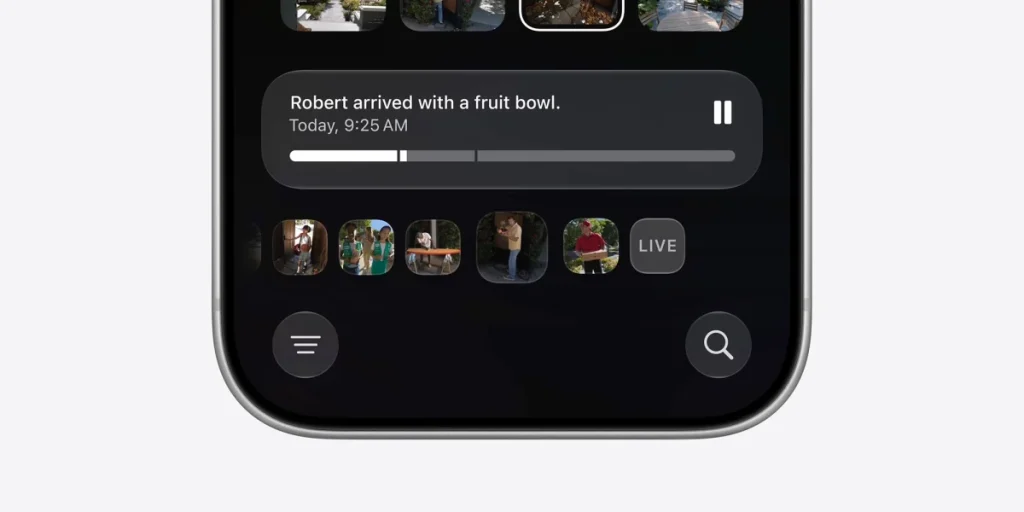
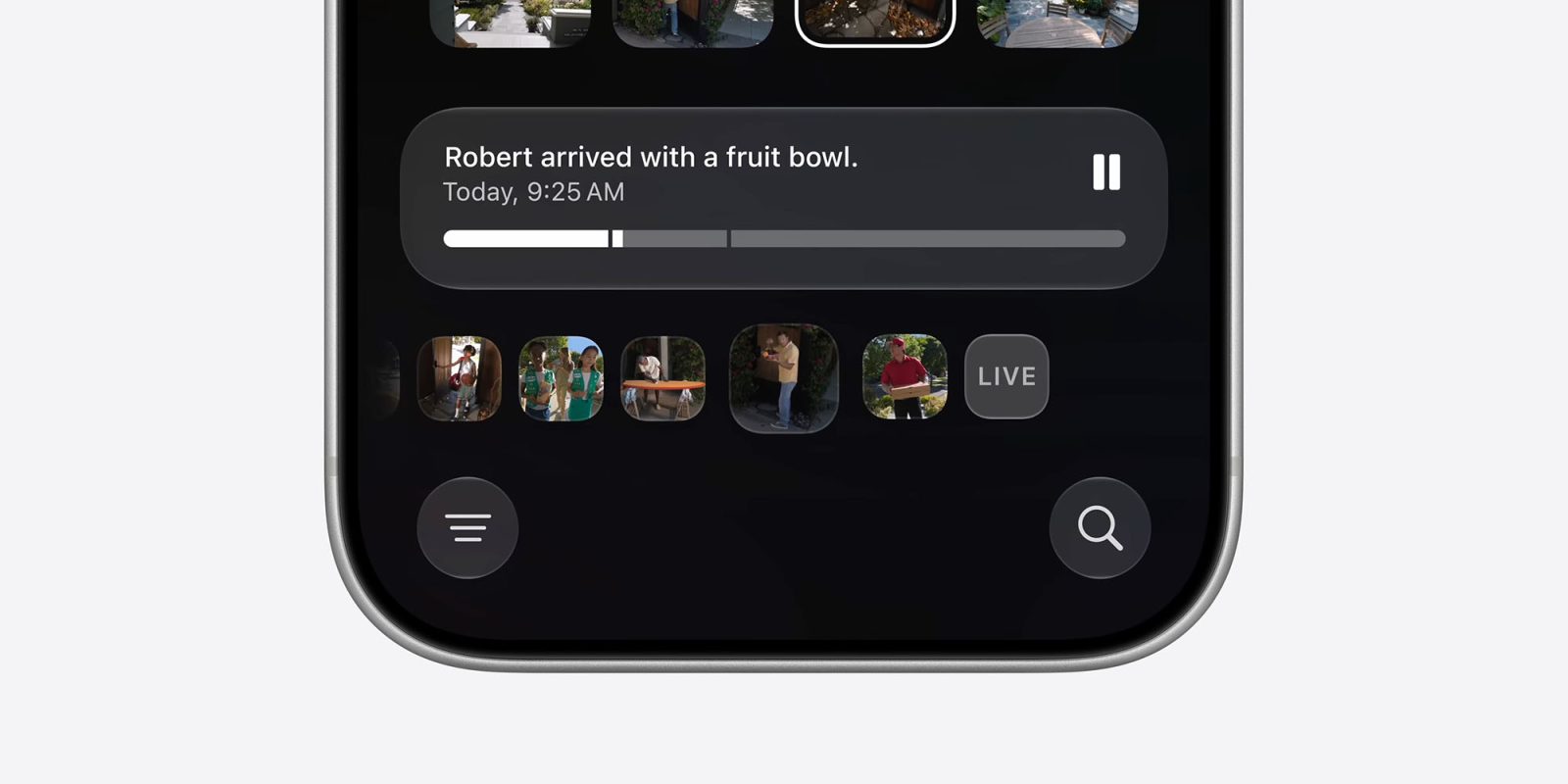
- Generated Video Descriptions: The Home app will use generative AI to create text-based summaries of video clips. This allows users to understand exactly what occurred in a recording—such as "a neighbor walked the dog past the gate"—without needing to manually scrub through the footage.
- Advanced Natural Language Search: Users will be able to search through their recorded history using specific queries. Instead of looking through a timeline of "Motion Detected" events, a user could search for "when was the UPS package delivered?" or "find clips of a person in a red jacket."
- Noteworthy Clip Highlights: At the top of the Search interface, the Home app will automatically elevate clips it deems important, such as unrecognized visitors or specific deliveries, ensuring that critical moments are not buried under routine activity.
To illustrate these capabilities, Apple showcased demonstrations involving complex interactions, such as a friend arriving to drop off a fruit bowl. The AI was able to identify the individual, the object they were carrying, and the nature of the interaction, presenting it to the user as a concise, searchable event.
The Cost of Intelligence: The 2TB Requirement
While the technical prowess of these features is evident, the "fine print" discovered in the latest developer beta has clarified the price of admission. According to reports first highlighted by Macworld, the release notes for macOS 27 beta 3 explicitly state that enabling Apple Intelligence features within the Home app requires a 2TB iCloud+ subscription.
While the note appeared in the macOS developer documentation, the requirement is universal across the Apple ecosystem, meaning users on iPhone and iPad will also need to be on the 2TB plan to access these AI enhancements. In the United States, the 2TB iCloud+ plan is priced at $9.99 per month, positioning these "intelligent" features as a premium add-on rather than a standard update for all HomeKit users.
For many, this news is a frustrating development. While Apple Intelligence was marketed as a core part of the upcoming operating system updates, it is becoming clear that the "Private Cloud Compute" and the storage requirements for 4K video analysis carry a cost that Apple is passing directly to the consumer.
A Disappointing Trend in Smart Home Subscriptions
The decision to mandate the 2TB tier is, in some ways, a logical extension of Apple’s existing HomeKit Secure Video (HSV) structure, though it represents a narrowing of options for the average user. Historically, HSV tiers were based on the number of cameras a user owned. A 50GB iCloud+ plan supported a single camera, the 200GB plan supported up to five, and the 2TB plan offered support for an unlimited number of cameras.
As the 2TB plan already kicks in for anyone with six or more cameras, those with extensive security setups may not see a change in their monthly bill. However, for the "light" user—someone with perhaps a single smart doorbell or one indoor camera—the jump from a 50GB or 200GB plan to the 2TB tier is a significant price hike. A user who was paying $2.99 a month for the 200GB plan just to keep their three cameras running will now find themselves forced to more than triple their monthly investment to $9.99 if they want the notification summaries and AI search features.

This move contributes to an increasingly common sentiment among tech consumers: subscription fatigue. In the early days of the smart home, one of the primary draws of the Apple Home ecosystem and HomeKit Secure Video was the ability to bypass the predatory subscription models of third-party camera manufacturers. Companies like Ring, Nest, and Arlo have long locked their best features—such as person detection and cloud storage—behind monthly fees.
By integrating these features into iCloud, Apple initially offered a value proposition that felt like a "perk" of being in the Apple ecosystem. Now, by moving the goalposts and requiring the most expensive consumer storage tier for AI features, Apple is mirroring the very industry trends it once seemed to provide an alternative to.
The disappointment felt by many in the community stems from the fact that these AI features are largely software-driven. While 4K video certainly requires more storage space, the "summarization" of notifications is a processing task. For users with modern iPhones, iPads, or Macs containing M-series or A17 Pro chips, much of this processing is handled on-device. The requirement for a 2TB cloud plan feels, to some critics, less like a technical necessity and more like a strategic lever to move users into higher-margin subscription brackets.
The Path Forward for HomeKit Users
As the beta cycle for macOS 27 and iOS 27 continues, it remains to be seen if Apple will face enough pushback to adjust these requirements before the final public release. There is a precedent for Apple fine-tuning its service tiers, but given the heavy investment the company has made in the infrastructure required for Private Cloud Compute—the back-end servers that handle Apple Intelligence tasks too complex for local devices—it seems unlikely they will lower the barrier to entry significantly.
For the dedicated smart home enthusiast, the 2TB requirement may be a pill worth swallowing. The addition of 4K support alone brings Apple’s offering back into competition with high-end security brands, and the AI-generated summaries solve a genuine utility problem. The ability to search through weeks of footage for a specific event using natural language is a powerful tool that transforms a passive recording device into an active assistant.
However, for the casual user who simply wants a smarter doorbell, the $120-per-year commitment for iCloud+ may make the Home app a less attractive hub. As the smart home market matures, the divide between "standard" features and "AI-powered" premium features is becoming the new frontline of consumer technology. Apple’s latest move confirms that in the era of artificial intelligence, the "smart" in smart home will increasingly come with a recurring monthly price tag.
 Smart Home & IoT Solutions
Philips Hue Enhances Smart Home Ecosystem with Launch of SpatialAware and New Video Doorbell Features
The landscape of smart home lighting has undergone a significant transformation today...
 Smart Home & IoT Solutions
SwitchBot Unveils Lock Vision Series Featuring Matter Integration and Advanced 3D Biometric Recognition
In a significant expansion of its smart home security portfolio, SwitchBot has...
 Smart Home & IoT Solutions
Apple and LG Collaborate on Major Smart Home Expansion to Reboot the HomeKit Ecosystem
In a significant strategic shift aimed at revitalizing its presence in the...







