
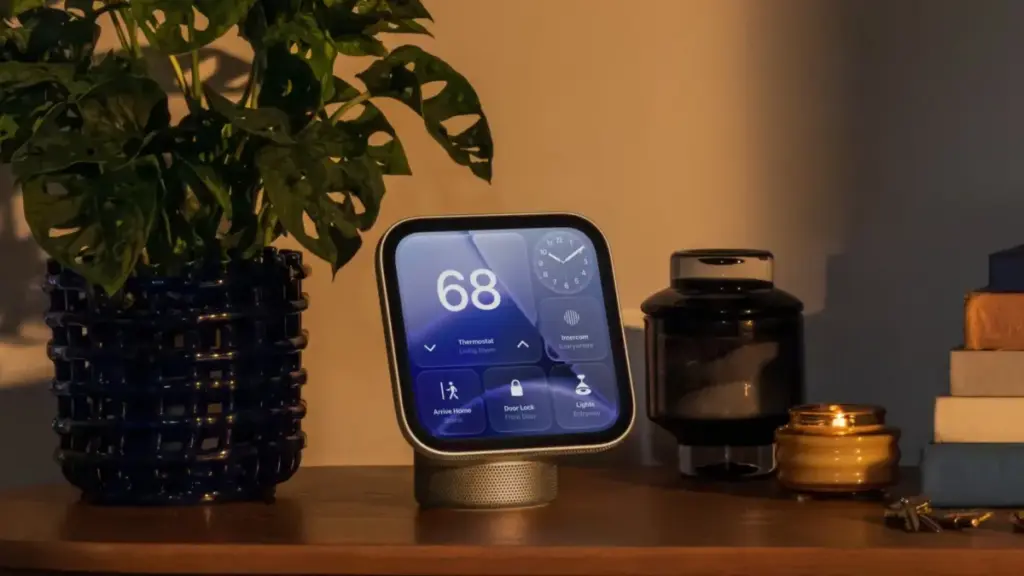
Users will receive real-time alerts for incoming telecommunication calls routed through their linked Apple devices, alongside alerts generated by smart accessories, such as door locks, cameras, and environmental sensors. The settings panel includes a master toggle to enable or disable critical alerts for urgent home safety events. Beyond these specific categories, Apple has omitted all standard application notifications, banners, and app-level alert configurations, keeping the screen clear of social media, email, or message clutter.
App and Website Authentication
Navigating digital sign-ins on a hub display without a traditional physical keyboard presents usability challenges. To solve this, Apple has adapted the seamless authentication system originally developed for the Apple TV platform into the HomeView experience.
When a user encounters a sign-in prompt for an app, third-party media channel, or web service on the HomeView, the display prompts nearby paired devices. Users can authorize sign-in requests, autofill account credentials, and approve passkey prompts directly from an iPhone. This eliminates the need to manually enter complex passwords or usernames on the smart hub screen itself, leveraging the secure enclave and stored credentials of the mobile device.
Media Management and Sleep Timers
In addition to home control and monitoring features, the HomeView functions as a central audio and video playback node within the living space. To facilitate bedtime routine management or scheduled media shutdown, the device includes a built-in media sleep timer.
Users can configure a sleep timer directly through the playback interface or main control menus. Once the timer reaches zero, the HomeView automatically pauses any active media streams, including music, podcasts, or video playback. This functionality mirror traditional audio equipment management, preventing media from streaming indefinitely overnight or when a room is left unoccupied.
Software Development and Ecosystem Context
The commercial arrival of the HomeView follows months of public speculation, developer analysis, and preliminary software tours. Prior to the official public release, details regarding the software environment were showcased by independent developers and tech analysts. Broadcasts app developer Steve Troughton-Smith notably shared a comprehensive video tour of the HomeView software architecture, running the operating system within a virtualized environment engineered by developer Guilherme Rambo.
Those early software builds provided the public with an early glimpse into the core layout, menu structures, widget systems, and interactive apps that make up the finished consumer experience. Apple also conducted restricted previews with select technology journalists and content creators ahead of the November 13 launch to demonstrate how the hub manages real-world home automation hardware.
The arrival of the HomeView and the fourth-generation Apple TV 4K caps an exceptionally dense autumn launch window for Apple. Previous reports from Bloomberg’s Mark Gurman correctly pointed toward an aggressive late-fall launch schedule that encompassed major refreshes across Apple’s primary hardware lines. Over the preceding weeks, Apple introduced MacBook Pro models featuring OLED display panels, updated 14-inch MacBook Pro laptops and desktop iMacs powered by the M6 chip family, alongside the eighth-generation iPad mini featuring an OLED display screen.
With the HomeView now officially available in retail channels and arriving on customer doorsteps, Apple completes its major hardware pipeline for the calendar year, placing its new smart home hub at the center of its broader connected hardware portfolio.
 macOS & Apple IT Support
New ‘Backglow’ App Brings Granular Control to the Revived Illuminated Apple Logo on MacBook Pro
Following Apple’s official release of its redesigned 14-inch and 16-inch MacBook Pro...
 macOS & Apple IT Support
Apple Releases watchOS 27: A Comprehensive Look at New AI Features, Interface Changes, and Health Updates Across Apple Watch Generations
Apple officially launched watchOS 27 on September 14, introducing a sweeping array...
 macOS & Apple IT Support
Apple Seeds iOS 27.3 Beta 2: Face Unlock for iPhone Duo, Siri AI Web Awareness, Tiered Usage Limits, and System Refinements
Apple has officially seeded the second beta of iOS 27.3 to developers...







