
For nearly thirty years, the official online message boards maintained by Apple served as an indispensable digital town square for millions of device owners around the globe. Whether a user was attempting to resolve a stubborn system kernel panic, diagnose a hardware fault, or master a subtle interface setting in macOS or iOS, the platform stood as a massive public library of troubleshooting knowledge. However, that long-standing era came to a sudden and unexpected halt when Apple abruptly placed the Apple Support Community into a permanent read-only state. Without prior warning to the public or to the dedicated volunteers who spent decades curating its content, Apple announced that the entirety of the discussion forums will be permanently closed on Friday, November 20, 2026.
The sudden decision effectively froze the entire platform overnight. Long-time contributors, many of whom had devoted countless hours each week to answering complex technical queries for over twenty years, logged on to discover that their posting privileges had been immediately revoked. The platform’s input forms were locked, leaving community members completely unable to post farewell messages, exchange alternative contact information, or archive personal threads before the servers are taken down for good.
The abruptness of the shutdown ignited immediate debate across the technology landscape. To its detractors, the Apple Support Community had gradually suffered from the pitfalls common to large gamified forums, where some users churned out generic or low-effort answers in a bid to accumulate system points, raise their community ranks, and earn recognition badges. Yet for the vast network of unpaid volunteers who provided genuine expertise, the unceremonious closure felt like a dismissive end to decades of public service. While some online commentators greeted the forum’s sunsetting with a sense of detachment, the human core of the community—the people who built and sustained it—deserved a meaningful acknowledgment of their contributions.
The history of the platform stretches back to the late 1990s, when it operated under the banner of Apple Discussions long before adopting its modern name and infrastructure. Over the course of twenty-six years, the forums evolved alongside Apple’s own meteoric growth from a niche computer maker into a global technology juggernaut. Jeff Donald, a resident of Florida, joined the original Apple Discussions in November 2000. For over a quarter of a century, Donald spent his free time guiding users through software migration issues and system configurations. His long-standing devotion was formally recognized by Apple when the company invited him to join the Apple Community+ program—an exclusive tier introduced in 2022 to grant top-tier contributors specialized perks, direct feedback channels, and unique brand experiences.
For other veteran members, the announcement brought a mixture of shock and quiet resignation. Leroy Douglas, who had been actively assisting users on the boards since July 2009, recalled feeling stunned when he first read the banner announcing the forum’s impending demise. Even though he acknowledged having seen the writing on the wall as modern technical support increasingly shifted toward automated tools, direct messaging, and corporate support channels, the sudden execution of the decision offered no space for a proper transition.
Beyond its core English-language base, the Apple Support Community was a truly international ecosystem. As German contributor Tobias Steen highlighted, the platform operated dedicated localized communities spanning multiple languages, including Chinese, French, German, Japanese, Korean, Portuguese, and Spanish. These localized portals catered to non-English speaking users who relied on regional experts to translate technical jargon into accessible, native-language advice. In an unusual discrepancy during the initial announcement, the French and German versions of the platform did not immediately display explicit closure banners alongside the English site, though contributors in those regions were eventually informed that their forums faced the exact same fate on November 20.
The demographic diversity of the forums was equally vast, bringing together individuals across generations, professions, and geographic boundaries. The user base ranged from teenagers eager to learn system architecture, such as 16-year-old Evan Bato Rousseau in France, to distinguished academics and public figures. Among its regular visitors was 83-year-old British Nobel Prize winner Sir Tim Hunt, who actively utilized the platform to troubleshoot his own setup. Sir Hunt noted that despite the occasional presence of wonky or off-target answers from eager points-seekers, the board consistently served as an invaluable, practical resource for solving real-world computing problems.
For power users and software developers, the platform was more than just a place to ask basic questions; it was an advanced technical laboratory and diagnostic hub. John Daniel, a Canadian software developer best known for creating the popular macOS diagnostic utility EtreCheck, maintained an active presence on the support forums for over two decades under his online handle. In the forum’s structured gamification system, members who earned substantial reputation points through verified solutions reached "Level 6" or higher. This milestone unlocked access to "The Lounge"—a restricted, private forum category where high-level volunteers could interact directly with one another and occasionally engage with Apple’s internal engineering and support staff.
Prior to the global disruptions of 2020, Apple actively cultivated these high-tier relationships by hosting exclusive, in-person meetups for top Support Community members. These events included special invitation-only visits to Apple Park in Cupertino, where corporate executives and community managers personally thanked volunteers for reducing the load on Apple’s official customer service infrastructure.
Reflecting on the closure, Daniel strongly disputed recent public criticisms dismissing the community as outdated or useless. He emphasized that high-level volunteers regularly diagnosed complex operating system issues, isolated critical bugs within Apple software updates, traced hardware anomalies, and devised workarounds long before official software patches were deployed. The collaborative environment allowed developers and power users to continuously learn from one another while performing a vital public service for non-technical users. For veteran contributors like Daniel, the loss of that collaborative troubleshooting space represents a significant blow to the broader Mac and iOS enthusiast community.
The emotional resonance of the forum’s closure was felt deeply by international contributors as well. Elías Rojano Núñez, an active participant from Chile who contributed extensively to the Spanish-language boards, expressed profound sadness over the unannounced shutdown. For Rojano Núñez, helping everyday users navigate technical hurdles provided a deep sense of personal fulfillment. While expressing disappointment at the lack of advance notice from Apple, he remained grateful for the lasting relationships he cultivated with fellow volunteers around the world over many years.
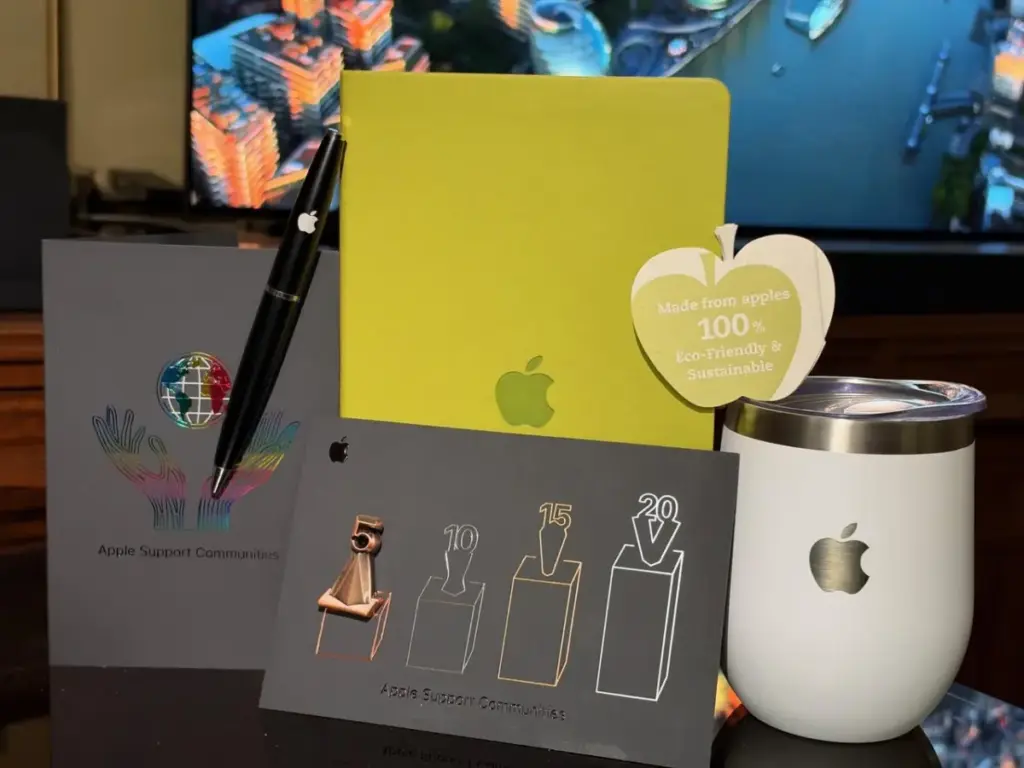
To mark their service, Apple regularly dispatched tangible tokens of appreciation to its top community members. Over the years, dedicated volunteers received physical anniversary pins marking 5, 10, 15, and 20 years of active participation, alongside specialized Apple-branded merchandise such as custom apparel, hats, tote bags, and umbrellas. These physical artifacts served as symbols of a shared identity and mutual effort, reinforcing the reality that behind the digital threads was a real human community.
The decision to sunset the Apple Support Community arrives at a moment of broader transformation for Apple’s customer support and product ecosystem. As the company prepares for major hardware releases—such as the new Apple HomeView smart display powered by Apple Intelligence and Siri AI, alongside the fourth-generation Apple TV 4K—its overall support strategy has pivoted increasingly toward automated systems, direct app-based support, and internal AI development. Concurrently, internal reports indicate that Apple has been refining its software development pipelines for future operating system iterations, including iOS 28 and macOS 28, altering how bug testing and user feedback are gathered internally.
Yet, despite the rise of automated diagnostics and corporate help channels, no modern support portal fully replicates the organic, peer-to-peer knowledge sharing that defined the Apple Support Community for nearly thirty years. Whatever its functional shortcomings or structural flaws, the platform was far more than a simple database of troubleshooting steps. For thousands of volunteers and millions of everyday users, it was a reliable digital neighborhood and a place of true community belonging. As November 20 approaches and the servers prepare to go dark permanently, the global community of volunteers leaves behind a profound legacy of public service—deserving of a respectful, heartfelt thank you rather than a silent dismissal.
 macOS & Apple IT Support
Apple Explores Major Siri Overhaul to Build Autonomous AI Agent Rivaling Competitors
Apple’s virtual assistant ecosystem may be approaching its most fundamental architectural shift...
 macOS & Apple IT Support
Amazon Cuts $200 Off M5 MacBook Air Models, Matching All-Time Low Prices Across 13-Inch and 15-Inch Lineups
Amazon has launched a major weekend promotion on Apple’s M5 MacBook Air,...
 macOS & Apple IT Support
Amazon Launches First Discounts on Apple Watch Ultra 4 and Series 12 Following Official Release
Following the official market arrival of Apple’s newest wearable lineup, retail channels...







