
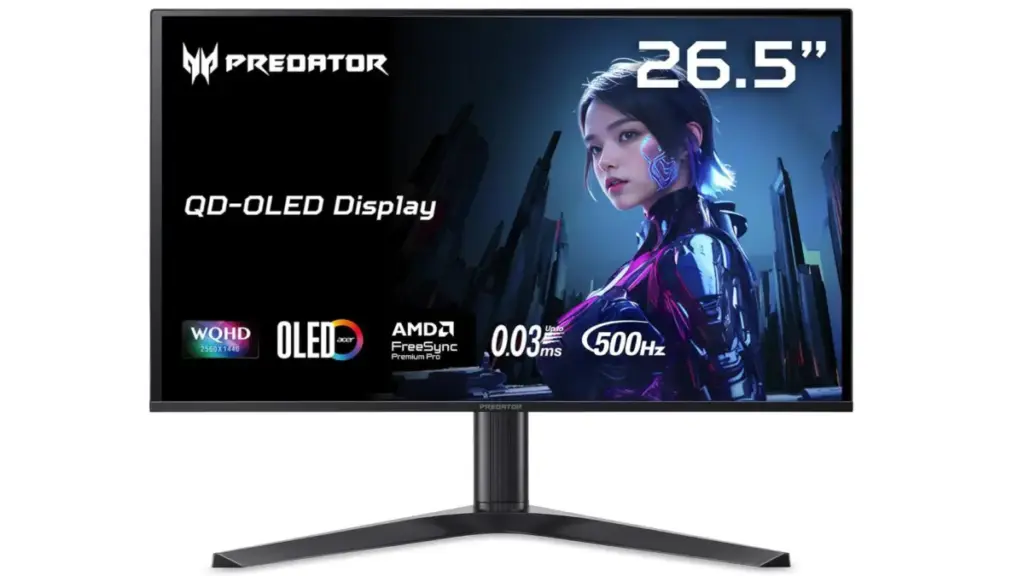
The latest development in this space comes from a significant price adjustment on one of the most technologically advanced gaming monitors currently available. The Acer Predator X27U—a model more formally, if less catchily, designated by the manufacturer as the F5bmiippruzx—has seen a substantial discount that positions it as a highly competitive option for those looking to upgrade their visual experience. Currently listed at Newegg for $509.99, this display represents a notable shift in the accessibility of premium panel technologies. For a price point that was once reserved for mid-range IPS displays with standard refresh rates, consumers can now acquire a monitor that sits at the bleeding edge of current display engineering, combining the superior contrast of organic light-emitting diodes with the extreme speed required by professional-grade competitive gaming.
The centerpiece of the Acer Predator X27U is its 27-inch QD-OLED panel, a technology that has rapidly become the gold standard for both media consumption and high-fidelity gaming. To understand the significance of this deal, one must consider the technical leap that QD-OLED represents over traditional liquid crystal displays. Unlike standard LCDs that rely on a dedicated backlight to illuminate pixels—often leading to "blooming" or "gray" blacks where light bleeds into dark areas—OLED technology utilizes self-emissive pixels. Each individual pixel generates its own light and can be turned off completely, resulting in an infinite contrast ratio and true, perfect blacks. The "QD" in QD-OLED signifies the addition of a Quantum Dot layer, which enhances the panel’s ability to produce vibrant, highly accurate colors and improved peak brightness compared to first-generation W-OLED panels. By integrating this technology into the Predator X27U, Acer provides a visual experience where shadows are deep and inky, and highlights pop with a level of clarity that traditional monitors simply cannot replicate.
Further elevating its status in the market is the monitor’s 1440p resolution. While the industry has seen a push toward 4K, the 2560 x 1440 (QHD) resolution remains the widely recognized "sweet spot" for 27-inch displays. At this size, the pixel density is high enough to provide sharp text and fine detail in gaming environments without the massive graphical overhead required to drive a 4K panel at high frame rates. For many gamers, 1440p offers the ideal balance, allowing mid-to-high-end graphics cards to maintain high performance while still delivering a significantly crisper image than standard 1080p. In the context of the Predator X27U, this resolution serves as the foundation for its most headline-grabbing feature: a staggering 500 Hz refresh rate.
The jump to a 500 Hz refresh rate is a development that targets the most demanding segment of the gaming community. While 144 Hz and 240 Hz have become standard for enthusiasts, and 360 Hz has begun to find its way into the homes of competitive players, 500 Hz pushes the boundaries of what is humanly perceptible. This extreme refresh rate means the monitor updates the image every two milliseconds, providing a level of motion clarity and input responsiveness that is virtually unmatched. For esports athletes and players of fast-paced titles like Counter-Strike, Valorant, or Overwatch, this reduction in motion blur and the near-instantaneous feedback can be the difference between a hit and a miss. When paired with the inherently near-instantaneous response times of an OLED panel—which typically measures in the hundredths of a millisecond—the Predator X27U eliminates the ghosting and trailing effects that plague even the fastest TN or IPS panels.
To complement its speed and contrast, the Acer Predator X27U carries the VESA DisplayHDR True Black 500 certification. This is a critical distinction in the world of High Dynamic Range (HDR) marketing. While many monitors claim HDR support, many "HDR400" or "HDR600" LCDs lack the local dimming zones necessary to actually deliver an impactful HDR experience, often resulting in a washed-out image. The True Black 500 certification, however, is specifically designed for self-emissive displays like OLEDs. It guarantees that the monitor can achieve a minimum peak luminance of 500 nits while maintaining a black level of no more than 0.0005 nits. This ensures a consistently bright and punchy experience during daytime scenes while preserving the intricate details in the darkest parts of the image, making it an exceptional choice for cinematic single-player games and HDR video editing alike.
The pricing of $509.99 at Newegg is particularly noteworthy when viewed through the lens of recent market history. Not long ago, any OLED monitor, let alone one featuring Quantum Dot technology and a refresh rate exceeding 240 Hz, would have easily commanded a price tag well north of $1,000. The fact that such high-end specifications are now reaching the $500 threshold suggests a maturing of the OLED manufacturing process and increased competition among display manufacturers. It also highlights a peculiar irony in the current hardware climate: while the components inside the PC case—the silicon that does the heavy lifting—are becoming more expensive due to supply constraints and corporate strategy, the devices we use to actually see the output of that silicon are becoming more affordable and more capable.
For users who have been holding off on a monitor upgrade due to the high entry cost of OLED technology, this sale represents a potential turning point. The Acer Predator X27U (F5bmiippruzx) addresses several of the historical concerns regarding OLEDs in a desktop environment. While early OLED monitors were sometimes criticized for being too dim for well-lit rooms, the True Black 500 certification and the efficiency of the QD-OLED layer ensure that the X27U can hold its own in various lighting conditions. Furthermore, the inclusion of a 500 Hz refresh rate ensures that the monitor is "future-proof" for several generations of GPU advancements, as it will take significant graphical power to fully saturate a 1440p signal at 500 frames per second in modern titles.
As the industry continues to navigate the complexities of hardware pricing, deals like this serve as a reminder that value can still be found if one looks toward the perimeter of the PC ecosystem. While the cost of a 2TB SSD or a 32GB kit of high-performance RAM might still sting, the ability to pair those components with a display of this caliber for just over $500 provides a bit of much-needed equilibrium to the total cost of a high-end setup. The Acer Predator X27U stands as a testament to how far display technology has come, offering a blend of speed and visual fidelity that was once the stuff of science fiction, now made available at a price point that challenges the traditional dominance of high-end LCDs.
The broader implications for the market are also significant. When a major player like Acer aggressively prices a flagship-spec monitor, it often forces competitors to follow suit, potentially leading to a wider trend of more affordable high-refresh OLEDs. For the consumer, this means that the premium for "perfect" blacks and elite-level motion clarity is rapidly evaporating. Whether one is a professional gamer seeking every possible frame of advantage or a casual user who simply wants the most vibrant and immersive visual experience possible, the current availability of the X27U at Newegg marks a significant moment in the ongoing evolution of the gaming monitor market.
Ultimately, while the news cycle may continue to be dominated by the rising costs of the "bits and bytes" that power our machines, the physical interface through which we interact with those machines is seeing a golden age of accessibility. The Acer Predator X27U, with its formidable combination of QD-OLED technology, 1440p resolution, and a trailblazing 500 Hz refresh rate, is currently leading that charge. At $509.99, it offers a compelling argument for why now might be the best time to stop looking at the prices of internal components and start looking at the screen instead.
 Hardware Reviews & PC Building
US Video Game Hardware Sales Experience Historic Decline as PlayStation and Xbox Reach Multi-Year Lows
The United States video game industry is currently grappling with a significant...
 Hardware Reviews & PC Building
Digital Fly Brain Achieves 20 Percent Win Rate in Balatro Following Breakthrough Google Neural Mapping
In the rapidly evolving landscape of artificial intelligence and computational neuroscience, the...
 Hardware Reviews & PC Building
Russian Military Targets Ukrainian Data Centers in Widening Campaign Against Digital Infrastructure
The Russian military has initiated a series of targeted strikes against critical...







