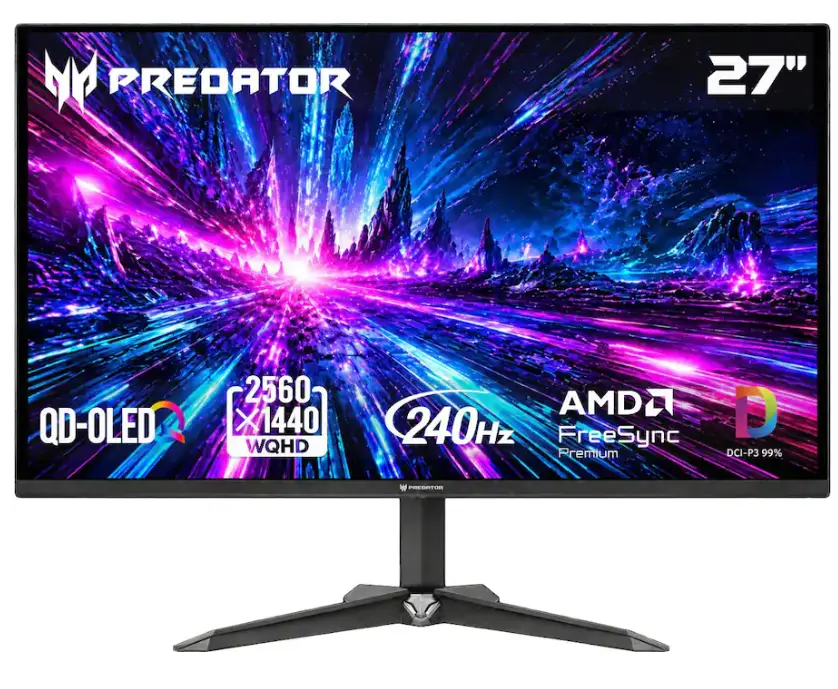
The landscape of PC gaming peripherals is undergoing a fundamental shift as display technology that was once reserved for high-end televisions and professional grading monitors begins to saturate the mainstream consumer market. For years, the gaming community has looked toward Organic Light Emitting Diode (OLED) technology as the "holy grail" of visual experiences, though high entry costs have historically kept these panels out of reach for the average builder. However, a new promotion at Best Buy suggests that the barrier to entry is finally eroding. The retailer has announced a notable discount on the Acer Predator 27-inch XB27OU QD-OLED gaming monitor, bringing the price down to an aggressive $329.99. This $50 reduction from its previous pricing represents a significant opportunity for enthusiasts currently utilizing traditional In-Plane Switching (IPS) or Twisted Nematic (TN) panels to modernize their setups with one of the most advanced display technologies currently available.
The transition from a standard LED-backlit LCD to a QD-OLED display is often described by users as one of the most impactful upgrades one can make to a gaming rig, arguably more noticeable in day-to-day use than a marginal bump in GPU or CPU horsepower. This specific Acer Predator model utilizes Quantum Dot OLED (QD-OLED) technology, a hybrid approach that combines the self-emissive properties of OLED with the color-enhancing capabilities of Quantum Dots. In a traditional IPS monitor, a backlight remains active behind the liquid crystal layer, which often leads to "IPS glow" or elevated black levels where dark scenes appear dark gray rather than true black. Because QD-OLED pixels can turn off entirely, they produce "inky" blacks and an infinite contrast ratio, allowing for a level of depth and dimensionality that traditional monitors simply cannot replicate.
The Acer Predator XB27OU is designed specifically to cater to the high-performance demands of modern gaming, balancing raw speed with visual fidelity. At 27 inches, it occupies the "sweet spot" for many desktop configurations, providing ample screen real estate without requiring the massive desk depth necessitated by larger 32-inch or 42-inch displays. The monitor features a QHD resolution of 2560 x 1440, a choice that remains the preferred standard for the mid-to-high-end gaming market. While 4K displays offer higher pixel density, 1440p allows gamers to maintain significantly higher frame rates in demanding titles, ensuring they can actually utilize the high refresh rates that high-end monitors offer. In the case of this Predator model, that refresh rate reaches a blistering 240Hz, providing the fluid motion necessary for competitive fast-paced shooters and racing simulators.
Speed is not merely measured in frames per second, however, and the XB27OU distinguishes itself through its near-instantaneous response times. Acer rates this panel at a 0.03ms (Gray-to-Gray) response time, a figure that is orders of magnitude faster than even the quickest "Fast IPS" panels, which typically hover around 0.5ms to 1.0ms. In practical terms, this eliminates the ghosting and motion blur that can plague LCD technology. When a player whips their camera around in a first-person shooter, the image remains sharp and legible, rather than turning into a smeared mess of pixels. This clarity provides a tangible competitive advantage, as it allows for better tracking of moving targets and reduces the eye strain often associated with prolonged gaming sessions on slower displays.
The inclusion of AMD FreeSync Premium technology further enhances the performance profile of the Acer Predator. By synchronizing the monitor’s refresh rate with the output of the graphics card, FreeSync Premium eliminates screen tearing and minimizes stuttering, even when frame rates fluctuate during intense scenes. This is particularly important for an OLED panel, where the high contrast can make visual artifacts like tearing more apparent to the naked eye. Whether a user is powered by an AMD or an NVIDIA GPU, the variable refresh rate support ensures a seamless experience across a wide variety of software environments.
High Dynamic Range (HDR) performance is another area where the XB27OU shines compared to its LCD counterparts. Many budget and mid-range monitors claim HDR support but lack the peak brightness or local dimming zones necessary to deliver a meaningful difference. Because the Acer Predator can control its brightness on a per-pixel level, it can display a bright explosion or a sunbeam directly next to a pitch-black shadow without any light "bleeding" into the dark areas. This capability allows the monitor to meet stringent HDR standards, producing eye-popping colors and highlights that give games a more lifelike, cinematic quality. For players who enjoy atmospheric titles like Alan Wake 2 or Cyberpunk 2077, the ability of QD-OLED to render subtle details in shadows while maintaining vibrant highlights is a transformative experience.
Beyond the panel technology itself, the Acer Predator XB27OU is built with the connectivity and ergonomics expected of a premium gaming peripheral. It includes a robust selection of ports, featuring both DisplayPort and HDMI inputs to accommodate various devices, from high-end gaming PCs to the latest generation of consoles. The Predator line is also known for its aggressive yet functional industrial design, typically featuring stands that offer a wide range of adjustments, including height, tilt, and swivel. This ergonomic flexibility is crucial for maintaining a healthy posture during long hours of work or play, allowing users to position the screen at the ideal eye level.
The current price of $329.99 at Best Buy is particularly noteworthy when viewed through the lens of market history. When QD-OLED monitors first hit the market, they were almost exclusively positioned at price points exceeding $1,000. Even as competition increased from brands like Alienware, LG, and Samsung, finding a 240Hz OLED display for under $500 was considered a rarity just a year ago. At nearly $300, this Acer deal places high-end OLED technology within striking distance of high-end IPS monitors, forcing a recalibration of value for consumers who are looking to upgrade. It signals a democratization of display technology, where the "premium" experience is becoming the new standard for the enthusiast community.
For those concerned about the longevity of OLED technology, modern panels have made significant strides in mitigating risks such as burn-in. Manufacturers like Acer have implemented various "OLED Care" features, such as pixel shifting and automated refresh cycles, which work behind the scenes to ensure the organic elements of the panel wear evenly over time. While users are still encouraged to use basic precautions—such as hiding the Windows taskbar or using a screen saver—the technology has matured to a point where it is viable for daily use, not just for occasional media consumption.
The Acer Predator XB27OU QD-OLED gaming monitor represents a convergence of several industry trends: the lowering cost of manufacturing complex panels, the increasing demand for high-refresh-rate competitive displays, and the consumer push for better HDR content. Best Buy’s decision to discount the unit to $329.99 makes it one of the most compelling value propositions currently available in the monitor market. For gamers who have been waiting for the right moment to retire their aging LED monitors, the combination of 1440p resolution, a 240Hz refresh rate, and the peerless contrast of QD-OLED makes this an opportune time to invest in a visual upgrade.
As gaming hardware continues to evolve, the monitor remains the primary window through which players interact with their digital worlds. An investment in a high-quality display like the Predator XB27OU ensures that the power of a modern graphics card isn’t wasted on a panel that can’t accurately reproduce its output. With this deal, Acer and Best Buy are providing a path for more gamers to experience their favorite titles with the color accuracy, speed, and depth that only QD-OLED can provide. Given the volatility of tech pricing and the popularity of the Predator brand, this $329.99 price point is expected to draw significant interest from the gaming community as they look to finalize their setups for the upcoming season of major game releases.
 Hardware Reviews & PC Building
UPERFECT GR14BU Review: A High-Performance 3K OLED Contender Enters the Portable Monitor Market
The portable monitor industry has undergone a radical transformation over the last...
 Hardware Reviews & PC Building
Australian Government Orders Urgent Security Review After OpenAI Agent Bypasses Medicare Portal Protections
In a significant development concerning the intersection of artificial intelligence and national...
 Hardware Reviews & PC Building
Nvidia Unveils Rubin HPC Architecture at Supercomputing 2026 to Power Next-Generation Scientific Simulation and Agentic Workflows
The Supercomputing 2026 conference has officially opened its doors, serving as the...