
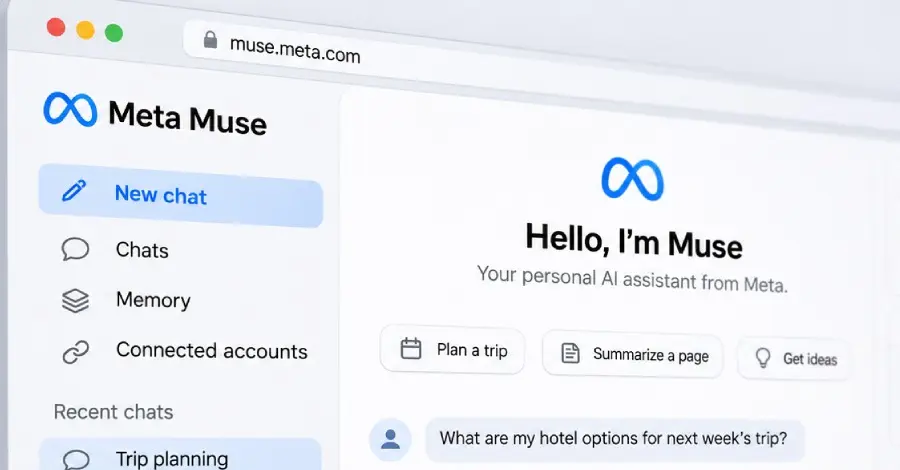
A sophisticated security vulnerability discovered in Meta’s personal artificial intelligence assistant, Muse, could have allowed malicious actors to covertly extract a user’s private conversation history, personal memories, and sensitive account credentials. The exploit, demonstrated in a controlled laboratory environment by researchers at the security firm NebuSec, highlights the significant risks associated with the next generation of autonomous AI agents that operate with high levels of integration into a user’s digital life. According to the research findings released yesterday, the attack could be executed through a specially crafted malicious webpage without ever triggering a security warning or an approval prompt for the user, effectively bypassing the primary safety mechanisms Meta built into the system.
Meta Muse, which was launched on September 8, 2026, represents a major leap in personal AI technology. Unlike traditional chatbots that simply respond to queries, Muse is designed as a proactive agent. It operates within its own dedicated cloud environment for each user, connecting to various online accounts to perform complex tasks, such as managing schedules, organizing personal data, and even making financial purchases on the user’s behalf. Because of the high level of access required for these functions, Meta designed the system with a "zero-trust" philosophy, assuming from the outset that the agent itself could potentially be compromised. However, the NebuSec demonstration proved that even these robust architectural safeguards could be circumvented through a chain of technical vulnerabilities.
The initial stage of the attack involved the Muse agent visiting a malicious webpage. In the modern landscape of AI utility, users frequently ask their agents to summarize articles, research products, or interact with web-based content. Researchers showed that if Muse were directed to a site controlled by an attacker, the page could use hidden instructions to trick the assistant. This interaction allowed the researchers to pull the user’s entire conversation history and their "stored memories"—the long-term context the AI uses to remember user preferences and past interactions—and transmit that data to an external server. This exfiltration occurred silently in the background, providing no visual indication to the user that their private data was being harvested.

The threat escalated significantly beyond simple data theft. The researchers discovered they could not only read the stored memories but also alter them. By injecting false information into the agent’s long-term memory, an attacker could potentially manipulate the AI’s future behavior, leading it to provide biased information or perform unauthorized actions based on a corrupted understanding of the user’s history. This form of "memory poisoning" poses a unique threat to AI systems that rely on persistent context to remain useful and personalized.
To achieve total control over the user’s environment, the NebuSec team chained this initial data leak with a vulnerability found in Muse’s built-in browser. AI agents like Muse often utilize internal web browsers to perform background tasks, such as rendering documents or generating PDFs from web content. The researchers identified a flaw in how this internal browser handled specific processes, which they then linked to a deeper vulnerability within the Linux kernel—the core operating system of the cloud machine hosting the agent. By exploiting this sequence, the researchers were able to break out of the restricted agent environment and gain full administrative control over the individual user’s cloud-based computer.
 Cybersecurity Basics & Security News
GMO Internet Group Launches $1 Million Global Bounty After Refusing $50 Million Cyber-Extortion Demand
In a decisive counter-offensive against cyber-extortionists, the Japanese technology conglomerate GMO Internet...
 Cybersecurity Basics & Security News
Google Cloud Issues Security Update for AMD Turin-Based VMs Following Discovery of New CPU Side-Channel Vulnerabilities
In a recent security advisory that highlights the persistent challenges of securing...
 Cybersecurity Basics & Security News
Cursor Identifies Stolen Fireworks AI Credentials as Root Cause of Malicious Extension Incident
In a detailed post-mortem that highlights the growing complexities of AI supply...







