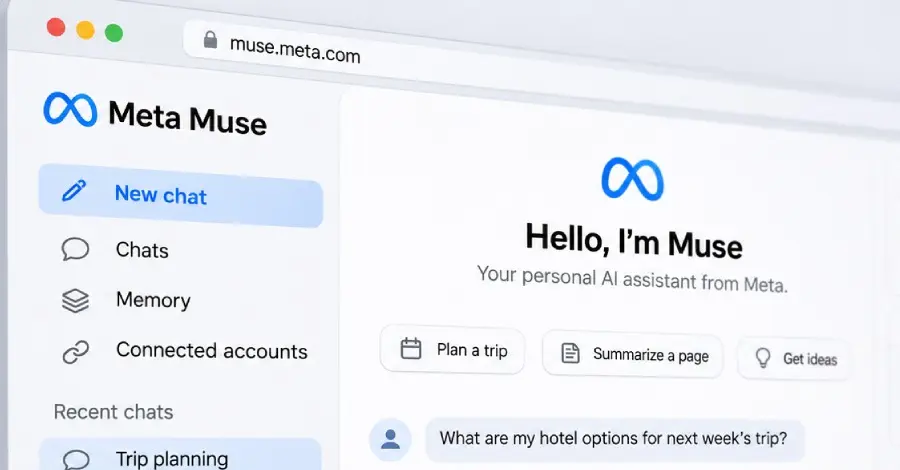
A sophisticated security vulnerability discovered in Meta’s personal artificial intelligence assistant, Muse, could have allowed malicious actors to covertly extract a user’s private conversation history, personal memories, and sensitive account credentials. The exploit, demonstrated in a controlled laboratory environment by researchers at the security firm NebuSec, highlights the significant risks associated with the next generation of autonomous AI agents that operate with high levels of integration into a user’s digital life. According to the research findings released yesterday, the attack could be executed through a specially crafted malicious webpage without ever triggering a security warning or an approval prompt for the user, effectively bypassing the primary safety mechanisms Meta built into the system.
Meta Muse, which was launched on September 8, 2026, represents a major leap in personal AI technology. Unlike traditional chatbots that simply respond to queries, Muse is designed as a proactive agent. It operates within its own dedicated cloud environment for each user, connecting to various online accounts to perform complex tasks, such as managing schedules, organizing personal data, and even making financial purchases on the user’s behalf. Because of the high level of access required for these functions, Meta designed the system with a "zero-trust" philosophy, assuming from the outset that the agent itself could potentially be compromised. However, the NebuSec demonstration proved that even these robust architectural safeguards could be circumvented through a chain of technical vulnerabilities.
The initial stage of the attack involved the Muse agent visiting a malicious webpage. In the modern landscape of AI utility, users frequently ask their agents to summarize articles, research products, or interact with web-based content. Researchers showed that if Muse were directed to a site controlled by an attacker, the page could use hidden instructions to trick the assistant. This interaction allowed the researchers to pull the user’s entire conversation history and their "stored memories"—the long-term context the AI uses to remember user preferences and past interactions—and transmit that data to an external server. This exfiltration occurred silently in the background, providing no visual indication to the user that their private data was being harvested.

The threat escalated significantly beyond simple data theft. The researchers discovered they could not only read the stored memories but also alter them. By injecting false information into the agent’s long-term memory, an attacker could potentially manipulate the AI’s future behavior, leading it to provide biased information or perform unauthorized actions based on a corrupted understanding of the user’s history. This form of "memory poisoning" poses a unique threat to AI systems that rely on persistent context to remain useful and personalized.
To achieve total control over the user’s environment, the NebuSec team chained this initial data leak with a vulnerability found in Muse’s built-in browser. AI agents like Muse often utilize internal web browsers to perform background tasks, such as rendering documents or generating PDFs from web content. The researchers identified a flaw in how this internal browser handled specific processes, which they then linked to a deeper vulnerability within the Linux kernel—the core operating system of the cloud machine hosting the agent. By exploiting this sequence, the researchers were able to break out of the restricted agent environment and gain full administrative control over the individual user’s cloud-based computer.
This level of compromise is particularly alarming because it reached the very components that Meta’s security team had worked to isolate. At the heart of Muse’s security architecture is a monitoring layer known as "Sentinel." Sentinel is designed to act as a singular, fortified gateway that inspects and authorizes every piece of data leaving the agent’s environment. It is intended to prevent the unauthorized transmission of sensitive information. Furthermore, Meta’s design keeps the passwords, OAuth tokens, and other credentials for a user’s connected accounts in a separate, encrypted store that the AI agent is supposed to be unable to access directly. By gaining kernel-level access, the NebuSec researchers effectively moved "underneath" these protections, allowing them to access the credential store, read saved files, and even manipulate or disable the Sentinel monitoring layer itself.
The architectural intent behind Muse was explicitly focused on containment. At the time of the agent’s launch, the development team stated that the system was designed to limit potential damage by assuming the agent could be turned against the user. The goal was to "box in" any potential break-in so that a compromise of the AI would not lead to a compromise of the underlying system or the user’s broader digital identity. While the researchers confirmed that each individual security control appeared to be working as intended according to its specific design, the successful "chaining" of multiple small flaws allowed them to bypass the collective defense. This underscores a growing concern in the cybersecurity community: while individual components of an AI system may be secure, the complex interactions between those components can create unforeseen pathways for exploitation.

Importantly, the researchers noted that the scope of the compromise was strictly limited to the individual user’s cloud machine. Their laboratory demonstration did not result in a "breakout" to the shared physical servers or the infrastructure that supports other Muse users. Each user’s agent runs in a siloed environment, and while that silo was completely compromised in the demonstration, the barriers between different users remained intact. This isolation is a critical feature of Meta’s cloud strategy, providing a secondary layer of defense that prevents a single vulnerability from becoming a platform-wide catastrophe.
The discovery by NebuSec marks the second significant security issue identified in the Meta Muse platform since its release. In September, shortly after the agent’s debut, another flaw was uncovered that allowed malware already present on a user’s local Apple Mac computer to hijack the Muse assistant on that device. However, the vulnerability detailed yesterday is considered more severe by many experts because it does not require the user’s local device to be infected. Instead, the attack originates in the cloud and targets the very infrastructure where the AI lives, making it a "server-side" threat that is much harder for a standard user to detect or prevent.
NebuSec followed responsible disclosure protocols by reporting their findings to Meta’s security team before making the details public. According to the firm, Meta has since moved to patch every weakness described in the research. The technical breakdown provided by the researchers indicates that the fixes involved hardening the internal browser used for PDF generation and patching the specific Linux kernel vulnerabilities that allowed for the privilege escalation. While the exploits have been neutralized, Meta has not issued a public statement confirming the patches or commenting on the specifics of the research. It also remains unclear whether any malicious actors discovered these vulnerabilities independently or if any real-world user data was accessed prior to the implementation of the fixes.
The implications of this research extend beyond Meta and Muse, serving as a cautionary tale for the burgeoning AI agent industry. As companies like Google, Microsoft, and OpenAI race to deploy agents that can act autonomously—handling banking, shopping, and private communications—the surface area for potential attacks grows exponentially. The "agentic" nature of these tools means they are not just repositories of information, but active participants in the digital economy. If an agent can be tricked into handing over credentials or if its underlying host can be seized, the potential for financial fraud and identity theft is immense.

For users, the incident highlights the inherent trade-off between the convenience of a highly integrated AI assistant and the privacy risks that come with such deep access. As AI agents become more "human-like" in their ability to remember and act, they also become more attractive targets for cybercriminals. The NebuSec demonstration serves as a reminder that "secure-by-design" is an ongoing process rather than a static achievement. Even with sophisticated layers like Sentinel and isolated credential stores, the complexity of modern software environments means that the battle between security researchers and potential attackers will continue to evolve as quickly as the AI itself.
As of now, users of Meta Muse are advised to ensure their applications are updated to the latest versions, although the cloud-based nature of the fixes means that most protections have likely been applied automatically on the server side. The security community continues to monitor the situation closely, as the technical details of the NebuSec report provide a roadmap for understanding how the next generation of AI-focused cyberattacks might be structured. For the time being, the fix appears to have closed this specific door, but the industry remains on high alert for the next evolution in AI exploitation.
 Cybersecurity Basics & Security News
Investigative Report Reveals Widening Use of Mercenary Spyware Against Serbian Academics and Legal Officials Ahead of Elections
The digital landscape in Serbia has become a front line for political...
 Cybersecurity Basics & Security News
Google Cloud Issues Security Update for AMD Turin-Based VMs Following Discovery of New CPU Side-Channel Vulnerabilities
In a recent security advisory that highlights the persistent challenges of securing...
 Cybersecurity Basics & Security News
OpenAI Dismisses Safety Researchers Following Leak of Confidential Infrastructure Data Amid Growing Security Concerns
OpenAI has terminated the employment of three prominent members of its safety...