
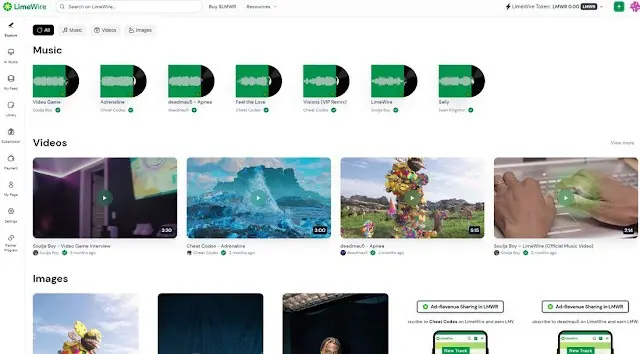
The digital landscape is witnessing a transformation of one of the most recognizable names from the early internet era. LimeWire, once a household name synonymous with the peer-to-peer file-sharing revolution of the early 2000s, has completed a radical evolution. Far from its origins as a controversial software client, the brand has re-emerged as a sophisticated, AI-centric content publishing platform. This new iteration of LimeWire is designed to bridge the gap between generative artificial intelligence and the creator economy, offering a comprehensive ecosystem where users can generate, share, and monetize digital assets through a unified interface.
In an era where generative AI tools are becoming increasingly commoditized, LimeWire is attempting to differentiate itself by focusing not just on the creation of content, but on the long-term value and ownership of that content. The platform provides a space where the barriers between a creative idea and a finished, monetizable product are significantly lowered, allowing both amateur creators and established artists to leverage advanced machine learning models to build their digital presence.
The Transformation of a Legacy Brand
To understand the significance of the current LimeWire platform, one must acknowledge its historical context. In its original form, LimeWire was a cornerstone of the early 2000s internet, facilitating the exchange of music and files globally. However, the current entity is a complete departure from its predecessor. Re-established as a cutting-edge AI content publishing hub, the new LimeWire is built on a foundation of legal compliance, creator rights, and blockchain technology.
This revamped version of the platform invites a global audience to register and explore the boundaries of their creativity. By providing a centralized "Studio," LimeWire allows users to craft original AI-generated content that can be showcased to a wider audience. The platform’s shift from a distribution tool to a creation and ownership hub has already attracted significant attention from the professional creative community. High-profile artists and musicians, including Deadmau5, Soulja Boy, and Sean Kingston, have utilized the platform to publish exclusive content, ranging from NFT-backed music and videos to unique digital imagery. This celebrity involvement serves as a testament to the platform’s viability as a legitimate professional tool in the modern digital age.
Beyond simple hosting, LimeWire introduces robust monetization models designed to empower creators. By integrating advertising revenue sharing and the burgeoning market of Non-Fungible Tokens (NFTs), the platform offers a path to financial sustainability for digital artists. This multi-faceted approach ensures that creators are not just producing content for engagement, but are building an arsenal of ownable, tradable assets.
The LimeWire AI Studio: A Hub for Digital Expression
At the heart of this ecosystem is the LimeWire AI Studio, a creative sanctuary where every piece of generated content is treated as a unique asset. In this environment, the traditional relationship between creator and fan is redefined. When a creator publishes work within the Studio, it becomes an ownable and tradable digital collectible. Fans are encouraged to do more than just view content; they can subscribe to their favorite creators’ pages, gaining deeper access to their creative journeys and acquiring digital assets that hold intrinsic value within the LimeWire community.
The platform’s economic structure is particularly favorable to the creator. Every time a piece of content is traded on the secondary market within the platform, the original creator earns a 2.5% royalty. This creates a recurring revenue stream that rewards the long-term popularity and cultural relevance of an artist’s work. Furthermore, LimeWire offers flexibility in how content is distributed. Creators can choose to release their work to the general public to build a broad following, or they can opt for a premium subscription model. The latter allows for the creation of "gated" content, providing exclusive access to specialized works for a dedicated base of paying subscribers.
Currently, the AI Studio is heavily focused on image generation, providing a diverse array of tools for visual artists. However, the roadmap for the platform is ambitious. LimeWire has signaled plans to expand its suite of tools to include AI-driven music and video generation in the near future. This expansion is expected to position LimeWire as a one-stop shop for multimedia AI creation, allowing artists to produce entire audiovisual experiences within a single ecosystem.
 Tech News & Digital Trends
The Artificial Intelligence Revolution in Marketing: 11 Essential Tools Powering the Next Generation of Data Strategy
The global marketing landscape is currently undergoing a fundamental transformation, driven by...
 Tech News & Digital Trends
The Digital Renaissance: How AI Content Generators Are Transforming the Marketing Landscape in 2022
The rapid evolution of artificial intelligence has moved beyond theoretical applications and...
 Tech News & Digital Trends
LimeWire’s Strategic Pivot: How the Iconic Brand is Reimagining Content Creation Through Generative AI and Blockchain Integration
The digital landscape is witnessing a remarkable transformation of one of the...







