
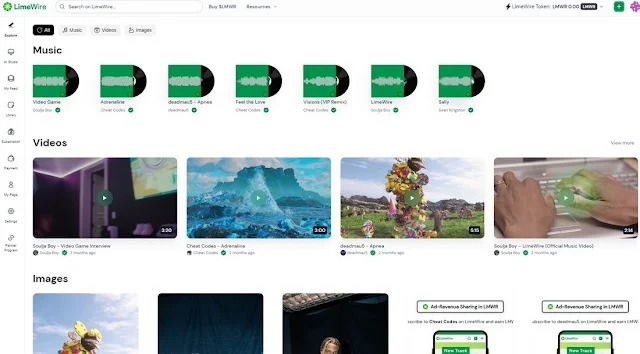
The digital landscape is witnessing a remarkable transformation of one of the internet’s most recognizable heritage brands. LimeWire, a name that once defined the early 2000s peer-to-peer file-sharing era, has successfully shed its controversial past to emerge as a sophisticated leader in the generative artificial intelligence and Web3 sectors. This evolution marks a significant departure from its origins, repositioning the platform as a comprehensive AI content publishing hub that seeks to democratize the creation, distribution, and monetization of digital art.
In an era where generative AI tools are becoming increasingly ubiquitous, LimeWire has distinguished itself by moving beyond simple content generation. The platform has developed an ecosystem that not only empowers users to create high-fidelity AI-generated imagery but also provides a structured framework for creators to maintain ownership and generate sustainable revenue. By bridging the gap between advanced AI modeling and blockchain technology, LimeWire is attempting to solve several long-standing issues in the creator economy, including copyright clarity, secondary market royalties, and equitable ad revenue sharing.
The Transformation of a Digital Legacy
The re-emergence of LimeWire is not merely a rebranding exercise but a complete foundational overhaul. The original file-sharing application, which was a staple of the early internet, has been replaced by a cutting-edge AI content publishing platform designed for the modern creator. This new iteration invites a global audience to register and explore the boundaries of their creativity by crafting original AI content, which can then be showcased within the LimeWire Studio.
This shift has already attracted significant attention from the traditional creative industries. High-profile artists and musicians, including the likes of Deadmau5, Soulja Boy, and Sean Kingston, have utilized the platform to publish exclusive content. These collaborations highlight the platform’s versatility, as these artists leverage LimeWire to distribute NFT-based music, videos, and digital imagery directly to their fanbases. The participation of established industry figures serves as a testament to the platform’s viability as a professional tool for content distribution in the age of decentralized media.
Central to LimeWire’s mission is the empowerment of the individual creator. The platform introduces several monetization models that allow users to earn revenue from their digital assets. This includes a robust ad-revenue sharing program and a streamlined entry point into the Non-Fungible Token (NFT) marketplace. By providing these avenues, LimeWire is positioning itself as a viable alternative to traditional social media platforms where creators often struggle to capture the full value of their work.
The LimeWire Studio serves as the heart of this creative community. Within this space, every piece of content generated is treated as a unique, ownable, and tradable asset. This creates a new dynamic between creators and their audiences; fans are no longer just passive consumers but can become active participants in a creator’s journey. By subscribing to a creator’s page, fans can gain access to exclusive content and acquire digital collectibles that hold tradeable value within the LimeWire ecosystem. To ensure the long-term sustainability of the creator, LimeWire has implemented a 2.5% royalty fee that is paid to the original artist every time their content is traded on the secondary market.
Advancing Creative Horizons with LimeWire AI Studio
Currently, the LimeWire AI Studio is primarily focused on the burgeoning field of AI Image Generation. It provides a sophisticated suite of tools that cater to both hobbyists and professional designers. However, the platform’s roadmap suggests a much broader ambition. LimeWire has announced plans to expand its toolkit to include AI-driven music and video generation in the near future. This expansion is expected to transform the Studio into a multi-modal powerhouse, allowing creators to produce complex, multi-media projects within a single unified interface.
 Tech News & Digital Trends
The Intelligent Revolution: Evaluating the Top 10 Artificial Intelligence Tools Shaping Industry Standards in 2023
The landscape of modern business and technology is currently undergoing a seismic...
 Tech News & Digital Trends
The State of Content Creation in 2025: How Artificial Intelligence is Redefining the Creative Economy
As the digital landscape enters the mid-point of the decade, the integration...
 Tech News & Digital Trends
The Artificial Intelligence Revolution in Marketing: 11 Essential Tools Powering the Next Generation of Data Strategy
The global marketing landscape is currently undergoing a fundamental transformation, driven by...







