
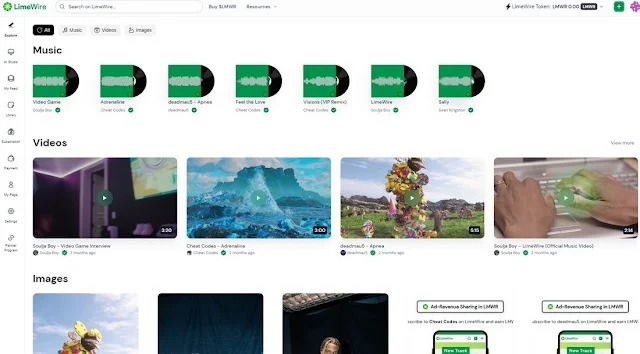
The digital landscape is witnessing a remarkable transformation of one of the internet’s most recognizable heritage brands. LimeWire, a name that once defined the early 2000s peer-to-peer file-sharing era, has successfully shed its controversial past to emerge as a sophisticated leader in the generative artificial intelligence and Web3 sectors. This evolution marks a significant departure from its origins, repositioning the platform as a comprehensive AI content publishing hub that seeks to democratize the creation, distribution, and monetization of digital art.
In an era where generative AI tools are becoming increasingly ubiquitous, LimeWire has distinguished itself by moving beyond simple content generation. The platform has developed an ecosystem that not only empowers users to create high-fidelity AI-generated imagery but also provides a structured framework for creators to maintain ownership and generate sustainable revenue. By bridging the gap between advanced AI modeling and blockchain technology, LimeWire is attempting to solve several long-standing issues in the creator economy, including copyright clarity, secondary market royalties, and equitable ad revenue sharing.
The Transformation of a Digital Legacy
The re-emergence of LimeWire is not merely a rebranding exercise but a complete foundational overhaul. The original file-sharing application, which was a staple of the early internet, has been replaced by a cutting-edge AI content publishing platform designed for the modern creator. This new iteration invites a global audience to register and explore the boundaries of their creativity by crafting original AI content, which can then be showcased within the LimeWire Studio.
This shift has already attracted significant attention from the traditional creative industries. High-profile artists and musicians, including the likes of Deadmau5, Soulja Boy, and Sean Kingston, have utilized the platform to publish exclusive content. These collaborations highlight the platform’s versatility, as these artists leverage LimeWire to distribute NFT-based music, videos, and digital imagery directly to their fanbases. The participation of established industry figures serves as a testament to the platform’s viability as a professional tool for content distribution in the age of decentralized media.
Central to LimeWire’s mission is the empowerment of the individual creator. The platform introduces several monetization models that allow users to earn revenue from their digital assets. This includes a robust ad-revenue sharing program and a streamlined entry point into the Non-Fungible Token (NFT) marketplace. By providing these avenues, LimeWire is positioning itself as a viable alternative to traditional social media platforms where creators often struggle to capture the full value of their work.
The LimeWire Studio serves as the heart of this creative community. Within this space, every piece of content generated is treated as a unique, ownable, and tradable asset. This creates a new dynamic between creators and their audiences; fans are no longer just passive consumers but can become active participants in a creator’s journey. By subscribing to a creator’s page, fans can gain access to exclusive content and acquire digital collectibles that hold tradeable value within the LimeWire ecosystem. To ensure the long-term sustainability of the creator, LimeWire has implemented a 2.5% royalty fee that is paid to the original artist every time their content is traded on the secondary market.
Advancing Creative Horizons with LimeWire AI Studio
Currently, the LimeWire AI Studio is primarily focused on the burgeoning field of AI Image Generation. It provides a sophisticated suite of tools that cater to both hobbyists and professional designers. However, the platform’s roadmap suggests a much broader ambition. LimeWire has announced plans to expand its toolkit to include AI-driven music and video generation in the near future. This expansion is expected to transform the Studio into a multi-modal powerhouse, allowing creators to produce complex, multi-media projects within a single unified interface.
The current image generation capabilities are built upon some of the most advanced models available in the industry today. By supporting Stable Diffusion 2.1, Stable Diffusion XL, and DALL-E 2, LimeWire ensures that its users have access to a diverse range of aesthetic outputs and technical capabilities. This variety is crucial in the generative AI space, as different models often excel at different artistic styles or technical requirements.
One of the platform’s most compelling features is its intuitive user interface, which simplifies the complexities of generative AI. Users can initiate the creative process using simple text prompts, or they can engage in more complex "prompt engineering" to achieve specific results. The platform’s flexibility allows for seamless transitions between different AI models and design styles. Whether a creator is looking for a cinematic look, digital art aesthetics, pixel art, anime styles, or the grainy texture of analog film, the LimeWire AI Studio provides the necessary presets and controls to realize that vision.
To further refine the output, LimeWire offers advanced features such as "samplers," which allow users to fine-tune the quality, detail, and variance of their generated images. This level of control is often missing from more basic AI tools, making LimeWire a more attractive option for those who require precision in their work. Furthermore, the company is actively developing its own proprietary AI model. This move toward vertical integration suggests that LimeWire aims to offer unique capabilities and styles that cannot be found on other platforms, further cementing its position as an innovator in the field.
Integrating Blockchain: Automated NFT Minting
A defining characteristic of the LimeWire experience is its deep integration with blockchain technology. Once a creator has finalized an image or a piece of content, the platform offers the option to publish it directly to the blockchain. This process is highly automated; LimeWire handles the complexities of minting the creation as an NFT on either the Polygon or Algorand blockchains.
The choice of these specific blockchains is strategic. Both Polygon and Algorand are known for their high transaction speeds and significantly lower environmental impact compared to older blockchain networks. By automating the minting process, LimeWire removes the technical barriers that have traditionally prevented many creators from entering the NFT space. This transformation gives each piece of artwork a unique digital signature, establishing a transparent record of authenticity and ownership.
Creators maintain full autonomy over how their content is accessed. They can choose to release their work publicly, allowing it to be discovered by the entire LimeWire community and enabling public trading. Alternatively, they can opt for a "subscriber-only" model. This creates a tiered access system similar to premium content platforms, where exclusive work is reserved for a creator’s most dedicated supporters. This flexibility allows creators to build intimate, high-value communities while still participating in the broader digital economy.
A New Economic Model: Ad Revenue and LMWR Tokens
Beyond the sale and trading of NFTs, LimeWire has introduced a groundbreaking ad-revenue sharing model. When a creator publishes content on the platform, they are eligible to receive 70% of the ad revenue generated from other users viewing their images, music, or videos. This is a significantly higher percentage than what is typically offered by mainstream social media or video-sharing platforms, making LimeWire a highly competitive option for digital artists looking to supplement their income.
This revenue model encourages experimentation. Designers can use the AI tools to generate a high volume of content, share their artistic journey with the public, and earn a steady stream of income based on the engagement their work receives. It shifts the focus from purely transactional sales to a more sustainable, engagement-based economy.
The financial backbone of this ecosystem is the LMWR token, LimeWire’s proprietary cryptocurrency. All earnings from ad revenue and royalties are distributed in LMWR tokens on a monthly basis. These tokens hold significant utility within the platform; they can be used to pay for the "credits" required to use the generative AI tools, creating a circular economy. Additionally, LMWR is a liquid asset that can be traded on several major cryptocurrency exchanges, including Kraken, ByBit, and UniSwap. This provides creators with the ability to convert their digital earnings into other currencies or assets as they see fit.
Accessibility and Subscription Tiers
LimeWire has adopted a "freemium" model to ensure that its tools remain accessible to a wide audience while providing advanced features for professional users. New users can sign up for free and receive an initial allocation of 10 credits, which allows for the generation of up to 20 AI images per day. Free users also participate in the ad-revenue sharing program, receiving a 50% share.
For those requiring more resources, LimeWire offers several premium subscription tiers:
- The Basic Plan: At $9.99 per month, this tier provides 1,000 credits, allowing for up to 2,000 image generations. Subscribers at this level receive early access to new AI models and a 50% ad revenue share.
- The Advanced Plan: For $29 per month, users receive 3,750 credits (up to 7,500 images) and an increased ad revenue share of 60%.
- The Pro Plan: Priced at $49 per month, this tier offers 5,000 credits (up to 10,000 images) and a 70% ad revenue share.
- The Pro Plus Plan: At $99 per month, the top-tier plan provides 11,250 credits, enabling up to 22,500 image generations and a 70% ad revenue share.
All premium subscribers benefit from a "Pro" profile badge, faster image generation speeds, a full history of their creations, and an ad-free browsing experience. This tiered structure allows LimeWire to cater to everyone from casual experimenters to high-volume professional studios.
Conclusion: The Democratization of Digital Artistry
LimeWire’s evolution represents a broader trend in the technology sector: the democratization of high-level creative tools. By integrating sophisticated AI models with a user-friendly interface and a transparent economic system, the platform is lowering the barriers to entry for digital artistry. It provides a space where the technical complexity of AI and the financial complexity of blockchain are abstracted away, leaving only the creative process.
As LimeWire continues to expand into music and video generation, its impact on the creator economy is likely to grow. The platform is positioning itself not just as a tool provider, but as a comprehensive infrastructure for the next generation of digital creators. By offering a clear path from creation to monetization, LimeWire is helping to define the future of how we produce, share, and value digital content in an AI-driven world. For artists and enthusiasts alike, the platform offers a glimpse into a future where creativity is limited only by imagination, rather than technical skill or financial resources.
 Tech News & Digital Trends
The Generative Shift: How AI Integration is Redefining Content Creation Standards for 2025
As the digital landscape enters the midpoint of the decade, the barrier...
 Tech News & Digital Trends
The 2025 AI Revolution: How Artificial Intelligence is Redefining the Content Creation Landscape
As the digital landscape enters 2025, the barrier between professional-grade production and...
 Tech News & Digital Trends
The Rise of AI Optimization: How Generative Models Are Redefining the Future of Organic Search
Three weeks ago, a digital creator stumbled upon a discovery that is...







