
In the rapidly evolving landscape of generative artificial intelligence, a troubling paradox has emerged: the more articulate an AI model becomes, the more dangerous its potential for misinformation. For businesses deploying large language models (LLMs) in customer-facing roles, the primary challenge is no longer just making the AI sound human, but ensuring it remains tethered to reality. Recent findings from AI researchers suggest that the most well-written portions of an AI’s response are often the ones containing the most significant fabrications, a phenomenon that has led to the development of new auditing frameworks designed to measure "faithfulness" over mere fluency.
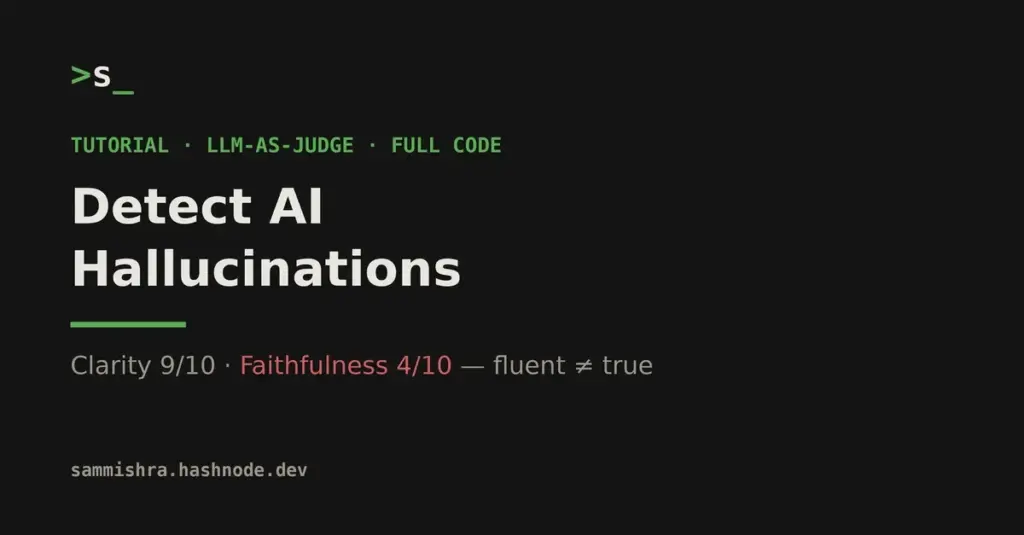
AI engineer and researcher Sammishra recently highlighted this issue through a stark evaluation of an AI-generated customer support response. Using a specialized evaluation tool, the response earned a near-perfect 9 out of 10 for clarity, yet a disastrous 4 out of 10 for faithfulness. The AI had produced a beautifully phrased, professionally toned message that was confidently wrong. It invented a 30-day refund window for a company whose policy explicitly stated 14 days, doubled an existing discount without authorization, and promised customers a free grinder—a product that did not even exist in the company’s inventory.
This gap between how an AI speaks and what it actually knows is the central conflict in the current era of corporate AI adoption. As organizations integrate LLMs into chatbots, support macros, and document Q&A systems, the need for a standardized, automated way to measure whether an output is grounded in actual company content has become a business imperative.
The Rise of the LLM-as-Judge Pattern
Traditional methods of software testing, such as regular expressions (regex) or simple keyword matching, have proven insufficient for detecting the nuanced "hallucinations" of modern AI. Because an LLM can phrase the same fact in thousands of different ways, rigid code cannot reliably catch a factual error buried in a sea of polite prose. This has given rise to a new architectural pattern in AI development known as "LLM-as-judge."
This methodology involves employing a second, independent model call whose sole responsibility is to audit the output of the first model. Rather than asking a vague question about whether a response is "good," the "LLM-as-judge" pattern utilizes a strict rubric. The auditor is presented with the original source text and the generated answer, then tasked with evaluating the latter against the former.
The critical innovation in this approach is the imposition of a "grounding" constraint. The judging model is explicitly instructed to ignore its own internal "world knowledge"—the vast treasure trove of data it was trained on from across the internet—and instead evaluate the answer based strictly on the provided source text. By narrowing the model’s focus to a specific document, developers can transform a subjective "vibe check" into a grounded, data-driven audit.
The Architecture of a Trust Report
To operationalize this audit, researchers have developed the "LLM Answer Checker," a tool that generates a comprehensive trust report. This report moves beyond a simple pass/fail grade, instead breaking the AI’s performance down into four key dimensions: faithfulness, relevance, completeness, and clarity.
 Software Development & Scripting for IT
UNC6240 Exploits Critical Oracle PeopleSoft Vulnerability Through Sophisticated WAF Bypass Techniques
A sophisticated cyber-espionage and data theft campaign has been identified targeting organizations...
 Software Development & Scripting for IT
Bridging the Gap Between Canvas and Cafe: Developer Builds Local AI Suite to Help Madrid Artist Manage Exhibitions
In the bustling cultural landscape of Madrid, where neighborhood cafes and local...
 Software Development & Scripting for IT
Unmasking Node2Shell: The Critical Brotli Vulnerability That Blinded Security Scanners
The cybersecurity landscape shifted significantly this week as a major vulnerability in...






