
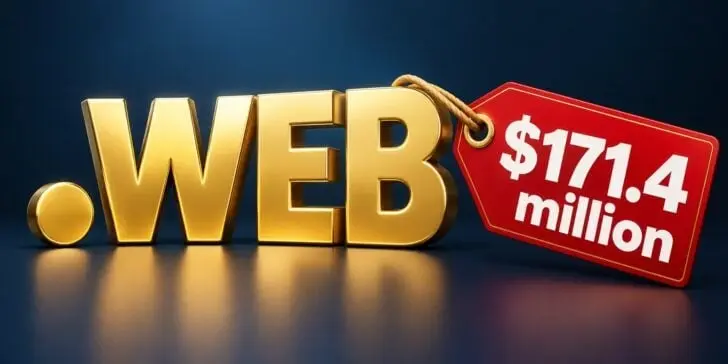
In a detailed disclosure that sheds light on one of the most protracted and expensive battles in the history of the internet’s domain name system, Verisign has finally confirmed the full financial weight of its acquisition of the .web top-level domain (TLD). According to a recent filing with the Securities and Exchange Commission (SEC), the Virginia-based registry giant spent a total of $171.4 million to secure the rights to the extension. The revelation comes as the company prepares for a mid-December launch, marking the end of a nearly decade-long saga defined by legal disputes, proxy bidding, and intense industry speculation.
The $171.4 million figure represents a significant escalation from the initial auction price and underscores the premium Verisign was willing to pay to keep .web under its umbrella. While many of the financial broad strokes had been a matter of public record for years, the new filing provides the first comprehensive look at the "hidden" costs associated with bringing this specific generic TLD to market. For Verisign, which already operates the internet’s most valuable real estate in .com and .net, the successful rollout of .web is no longer just a strategic expansion—it is a high-stakes attempt to recoup a massive capital investment.
The Financial Path to Ownership
The journey to this $171.4 million valuation began in 2016 during a high-profile ICANN (Internet Corporation for Assigned Names and Numbers) auction. At the time, a company called Nu Dot Co won the rights to .web with a staggering $135 million bid, a record-breaking sum that sent shockwaves through the domain industry. It was later revealed that Verisign had provided the funding for Nu Dot Co’s bid, acting through a proxy to secure the extension.
Subsequent filings in 2016 indicated that Verisign had paid $145 million for the asset, suggesting a $10 million premium paid to Nu Dot Co for its role in the acquisition. However, the most recent SEC disclosure clarifies the final tally: Verisign ended up paying $145.2 million to the proxy entity, plus an additional $26.2 million in what the company described as "certain other acquisition costs." While Verisign noted that these individual costs were "not material" on their own, the aggregate $26.2 million represents a substantial overhead that highlights the complexity of the acquisition.
Industry analysts suggest that this $26.2 million likely covers a decade of legal fees, administrative overhead, and potential settlements. A significant portion of this expenditure may be tied to the long-standing legal challenges from competitors like Altanovo (formerly Afilias), which fought the results of the 2016 auction for years. Altanovo argued that the use of a proxy bidder violated ICANN’s auction rules, leading to a series of appeals and Independent Review Process (IRP) proceedings that effectively mothballed .web for eight years. The recent disclosure suggests that Verisign may have finally cleared these hurdles, possibly through a settlement aimed at ending the litigation and clearing the path for a commercial launch.
The Launch Strategy: Leveraging the .Com Monopoly
With the financial cards now on the table, the focus shifts to how Verisign intends to generate a return on its $171.4 million investment. During a recent investor conference call, the company outlined a rollout schedule that begins in mid-December. The launch will follow a traditional phased approach, starting with a 30-day "Sunrise" period. This phase is legally mandated to allow trademark holders to register their brand names before the general public, preventing "cybersquatting" and protecting intellectual property.
 Web Hosting & Domain Management
Qatar Announces Major Policy Shift for .Qa Domains with New Residency and Documentation Requirements
The landscape of the Qatari digital space is undergoing a significant transformation...
 Web Hosting & Domain Management
DNX Expands Domain Investor Ecosystem with Launch of Dedicated Registrar Services
The landscape for professional domain investors is undergoing a significant shift as...
 Web Hosting & Domain Management
Domain Registrants Face Looming Deadline as Verisign Prepares to Increase .Com Pricing on November 1
The global market for .com domain names is approaching a significant financial...







