
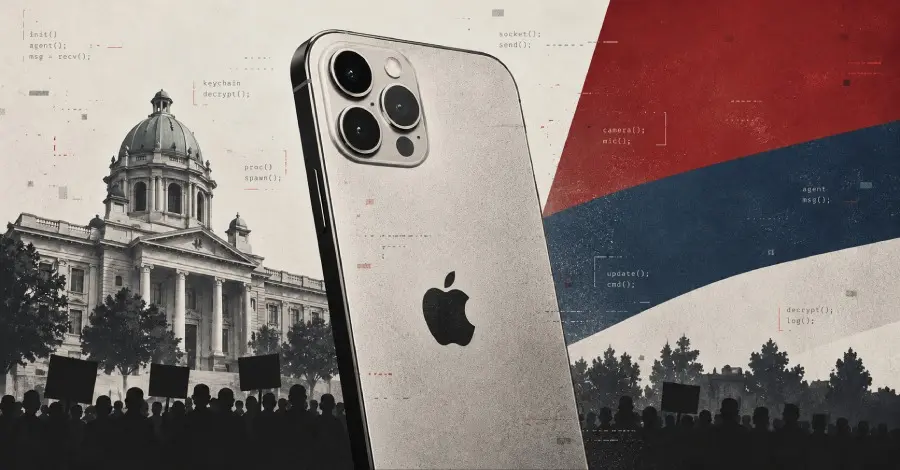
The digital landscape in Serbia has become a front line for political surveillance as new forensic evidence reveals that high-profile members of academia and the judiciary have been targeted by sophisticated mercenary spyware. In a report released on October 19, the Citizen Lab, a renowned research group based at the University of Toronto’s Munk School of Global Affairs & Public Policy, confirmed that the iPhone of Vladan Đokić, the rector of the University of Belgrade, was infected with NSO Group’s Pegasus spyware. The discovery comes at a moment of intense political sensitivity, appearing just six days before Serbia is scheduled to hold a snap parliamentary election on October 25, 2026.
The infection of Rector Đokić’s device is particularly notable due to the method of delivery. According to the Citizen Lab, the attack utilized a "zero-click" exploit. Unlike traditional phishing attempts that require a user to interact with a malicious link or download a compromised file, a zero-click exploit allows the spyware to install itself silently without any action from the victim. This level of sophistication is a hallmark of Pegasus, a tool developed by the Israeli firm NSO Group and marketed exclusively to government agencies for the stated purpose of combating terrorism and serious crime. However, the rector is a prominent figure within Serbia’s academic community and a known supporter of the country’s student protest movement, raising questions about the political motivations behind the surveillance.
While the Citizen Lab expressed high confidence in its findings regarding the infection, the researchers noted that their investigation remains ongoing. The current data confirms that the infection occurred within the year 2026, though a specific date has not yet been pinpointed. Furthermore, the technical analysis does not explicitly identify the entity responsible for deploying the spyware. NSO Group has long maintained that it does not operate the software itself, but rather licenses it to state clients.
The timing of this revelation is inextricably linked to the broader political unrest that has gripped Serbia for nearly two years. The upcoming parliamentary elections were called in September 2026 following a prolonged period of civil dissatisfaction and mass demonstrations. This wave of protests was originally ignited by a tragedy in November 2024, when a concrete canopy at the Novi Sad railway station collapsed, resulting in the deaths of 16 people. The incident became a catalyst for widespread anger over alleged government corruption, poor infrastructure oversight, and a lack of institutional accountability. Rector Đokić’s vocal support for the student activists who emerged as leaders in these protests has placed him at the center of the country’s civic discourse.

The investigation into Đokić’s phone was initiated at his own request and conducted in collaboration with the SHARE Foundation, a leading Serbian digital rights organization. The SHARE Foundation has been at the forefront of documenting digital repression in the region, having previously led an investigation into a separate wave of spyware cases that were made public in September. The emergence of Đokić’s case suggests that the scope of surveillance is broader and more persistent than previously understood.
In addition to the rector, another significant case has surfaced involving Rade Bajić, a senior prosecutorial associate at Serbia’s Public Prosecutor’s Office for Organized Crime. Bajić’s situation came to light through official channels when he received an Apple Threat Notification on August 13, followed by a reminder on August 27. Apple issues these alerts to users when it detects patterns of activity consistent with an attack by mercenary spyware. While these notifications are a strong indicator of targeting, they do not specify the perpetrator. The Citizen Lab views the receipt of such a notification as a high-confidence sign that Bajić’s device was likely targeted for intrusion. Forensic analysis of his phone is currently underway to determine if a successful infection occurred.
 Cybersecurity Basics & Security News
Critical Ghostscript Vulnerability Exposes Linux Servers to Remote Command Execution
A newly disclosed security vulnerability in Ghostscript, a ubiquitous but often invisible...
 Cybersecurity Basics & Security News
Microsoft Addresses Critical Remote Code Execution Vulnerability in Windows Paint via Microsoft Store Update
Microsoft has officially released a definitive patch for CVE-2026-83844, a significant remote...
 Cybersecurity Basics & Security News
Critical Linux Kernel TCP Vulnerability Triggers Urgent Patching Cycle Across Enterprise Distributions
A severe security flaw residing within the Linux kernel’s networking stack has...






