
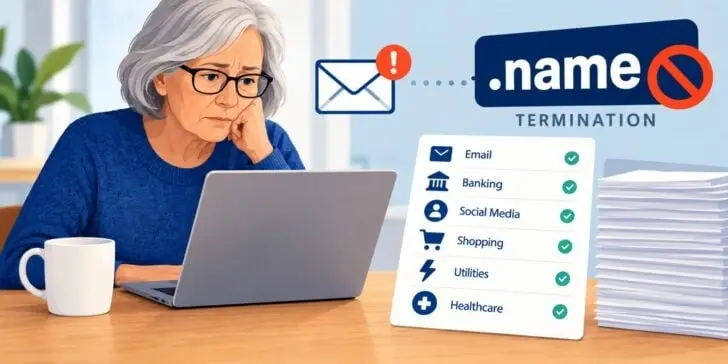
For more than two decades, Judy Johnston and her 97-year-old mother have shared a digital home. Since 2002, they have relied on a third-level .name domain for their primary email communications, a period spanning nearly the entire history of the modern consumer internet. However, a recent administrative decision by the Internet Corporation for Assigned Names and Numbers (ICANN) and Verisign, the registry operator for the .name top-level domain, has effectively issued them a digital eviction notice. The looming termination of third-level .name domains is not merely a technical sunsetting of an obsolete product; for users like Johnston, it represents a catastrophic disruption of their digital identities and a bureaucratic nightmare that has transformed into a grueling, full-time job.
The plight of the Johnston family came to light through a formal reconsideration request recently published by ICANN. This document serves as a poignant testimony to the unintended consequences of high-level policy changes within the internet’s infrastructure. Johnston’s grievance highlights a growing friction between the technical evolution of the web and the lived experiences of the long-term users who inhabit it. As Verisign moves to streamline its operations by eliminating the complex third-level registration system of the .name registry, users who have spent twenty-five years building their lives around these addresses are being left to pick up the pieces.
To understand the scale of the issue, one must look at the unique structure of the .name top-level domain (TLD). Launched in 2001 as part of ICANN’s initial expansion of the domain name system, .name was designed specifically for individuals. Unlike .com or .org, it offered a unique three-level structure—such as "john.doe.name"—intended to provide a personalized, permanent digital handle. For a generation of early adopters, this was an attractive proposition. It offered a sense of permanence in an era when email providers were often tied to specific internet service providers (ISPs). However, as the industry moved toward second-level domains (such as "doe.name"), the third-level registrations became a legacy feature, eventually viewed by the registry as a technical burden rather than a core service.
For Judy Johnston, the technical "legacy" status of her domain is irrelevant compared to its practical utility. Over twenty-five years, she has integrated this email address into every facet of her administrative life. By her own count, she is now faced with the monumental task of updating at least 211 separate online accounts. This list includes everything from essential utilities and financial institutions to healthcare portals and government services. For a senior citizen managing her own affairs as well as those of her nearly centenarian mother, the sheer volume of this transition is overwhelming.
The process of changing an email address in the modern security environment is no longer a simple matter of clicking "edit profile." In an age of heightened data protection and multi-factor authentication, the email address serves as the foundational "anchor" of a digital identity. When that anchor is pulled, the entire structure of account security can collapse. Johnston notes that she has already encountered significant hurdles. Some service providers, sensing a major change in account credentials, have flagged her attempts as suspicious. She has been required to submit multiple forms of identification and navigate complex data protection protocols just to prove she is authorized to change her own contact information.
 Web Hosting & Domain Management
The Rapid Evolution of Web Development: AI Tools Drive Unprecedented Speed in Domain Utilization and Aftermarket Demand
The secondary market for domain names has long been a barometer for...
 Web Hosting & Domain Management
Virginia Department of Health Files Federal Lawsuit to Reclaim Expired Domain Redirecting to Adult Content
The Virginia Department of Health has initiated a federal legal battle to...
 Web Hosting & Domain Management
D3 Unveils Frontier: A New Pre-Order Ecosystem Designed to Gauge Demand and Streamline Next-Generation TLD Launches
In a strategic move to reshape how new top-level domains (TLDs) are...







