
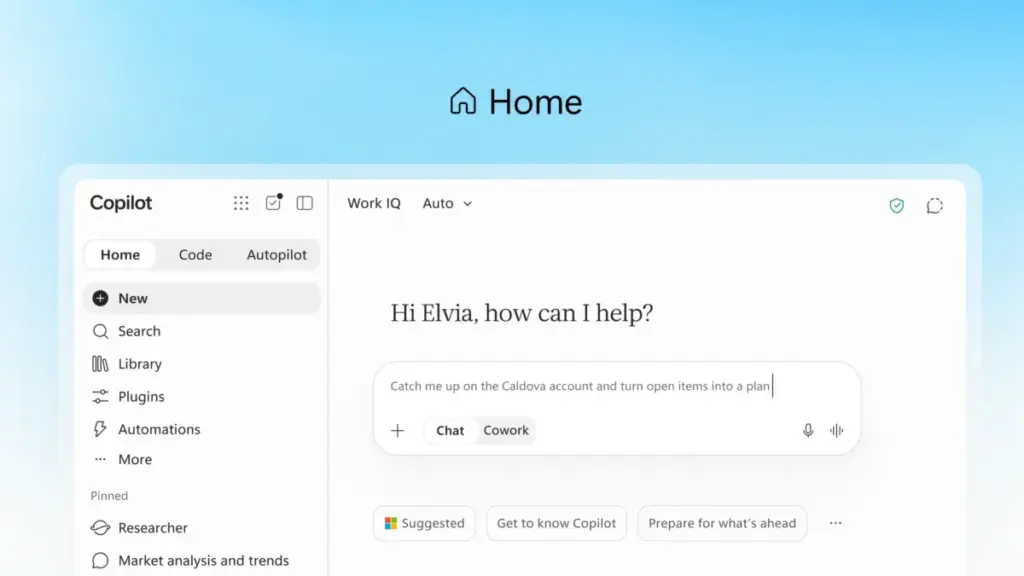
Microsoft has officially launched its highly anticipated Copilot “super app,” marking a significant milestone in the company’s strategy to consolidate its rapidly expanding suite of artificial intelligence tools into a single, cohesive interface. The move, which comes two months after CEO Satya Nadella first confirmed the project’s development, is designed to provide a standardized environment for how employees interact with AI across productivity suites, business applications, data repositories, and development tools.
The new unified experience merges several previously distinct AI capabilities: the conversational Chat interface, the autonomous Cowork agent, a redesigned coding environment appropriately named Code, and Autopilot—a persistent agent formerly known as Scout. By bringing these elements under one roof, Microsoft aims to transform Copilot from a series of embedded assistants into a comprehensive orchestration layer capable of managing complex enterprise workflows.
Industry analysts suggest that this consolidation is more than just a user interface overhaul; it represents a strategic shift intended to give Chief Information Officers (CIOs) much-needed visibility into AI application sprawl and the escalating costs associated with agentic workloads. As organizations move beyond simple generative AI experimentation and toward full-scale deployment, the need for a centralized platform for management, security, and financial oversight has become a primary concern for IT leadership.
Moving Toward a Unified AI Orchestration Layer
The central philosophy behind the Copilot super app is to reduce the friction inherent in choosing between different AI tools. Rather than requiring a user to decide whether a task requires a chatbot, an automation script, or a specialized agent, the unified experience allows users to simply describe what they wish to accomplish. The system then handles the internal routing, directing the task to Chat, Cowork, Code, or Autopilot as needed.
Microsoft’s vision is for the AI to act as a proactive partner that understands the context of a request without being explicitly told which "mode" to operate in. While the individual components of this experience have been introduced or consolidated over the past several months, the super app represents the first time they have functioned as a singular, interconnected ecosystem.
The roadmap for this unification began in earnest during a July earnings call, where Satya Nadella described an architecture that would separate the orchestration layer, context, and memory from any specific underlying AI model. This "model-agnostic" approach allows Microsoft to swap or upgrade the intelligence powering the system while maintaining a consistent user experience. Following that announcement, Microsoft began the process of aligning its consumer-facing and Microsoft 365 Copilot applications, laying the groundwork for the broader enterprise overhaul unveiled this week.
Much of the foundational technology for this shift was established following the November 2025 Ignite conference. Since then, Microsoft has rolled out Cowork for delegated, multi-step tasks and Scout (now Autopilot) for persistent agentic work. The company also introduced natural-language app-building capabilities that have since matured into the Code environment. The current update synthesizes these various threads into a platform intended to serve as the primary gateway for enterprise work.
More Enterprise Context Could Boost Productivity
A critical component of this new architecture is the integration of Fabric IQ and Work IQ. These tools provide the "semantic intelligence" layer necessary for the AI to understand the specific nuances of an organization’s data and internal processes. By integrating Fabric IQ into the Chat and Cowork functions, Microsoft is giving Copilot a deeper reach into an organization’s data estate, which analysts believe will significantly improve the accuracy of the AI and reduce the frequency of "hallucinations."
Abhishek Satapathy, principal analyst at Avasant, noted that this inclusion of enterprise context marks a shift in the fundamental nature of AI tools. He observed that the practical transition is moving from AI that merely "knows" information to AI that can understand the causal links between events—connecting what happened, why it happened, and what the logical next step should be.
 Small Business IT & Cloud Computing
OpenAI Terminates Contractors for Utilizing Artificial Intelligence in Model Training Processes
In an industry defined by the rapid advancement of artificial intelligence, a...
 Small Business IT & Cloud Computing
Meta’s AI Vision Is the Best in the Industry—But Its History Makes It Impossible to Trust
We are currently standing on the precipice of a fundamental revolution in...
 Small Business IT & Cloud Computing
GhostCode: The Emerging Phishing Threat Exploiting Microsoft 365 Device Authorization Flows
In a significant escalation of identity-based cyberattacks, security researchers have uncovered a...







