
The updated Agent 365 features will allow administrators to implement AI spending policies at scale. This includes the ability to control which departments have access to specific model families and the implementation of approval workflows for credit requests. Crucially, it provides visibility into the actual outcomes generated by these AI agents, allowing CIOs to determine which automations are delivering a return on investment and which need to be optimized or retired.
The financial transparency extends to the end users as well. Employees will be able to monitor their own credit usage and remaining balances directly within the Copilot interface. This level of visibility is intended to foster a culture of responsible AI usage across the workforce.
Bhupendra Chopra, chief revenue officer at IT consulting firm Kanerika, emphasized that these FinOps (financial operations) capabilities are essential for evaluating the true business value of automation. He noted that the tools can reveal "correction rates" for agents—if an employee constantly has to fix or undo the work an agent has performed, it serves as an early warning sign of poor data foundations or outdated business rules.
Furthermore, Chopra argued that these tools help verify whether the time saved by AI actually leads to measurable business results. Automating twenty minutes of a worker’s day only provides value if that time is redirected toward high-impact activities. The new visibility provided by Microsoft’s FinOps tools allows enterprises to track these outcomes with greater precision.
The Shift to Usage-Based Billing
The consolidation of these tools also brings a shift in how enterprises will pay for AI. While the standard Chat and Microsoft 365 Copilot functions will remain under the traditional per-user subscription license, more advanced capabilities like Cowork, Code, and Autopilot will utilize a usage-based billing model.
This hybrid approach requires a change in how CIOs approach budgeting. Rather than simply counting the number of seats or licenses, IT leaders must now account for the volume of work being delegated to autonomous agents. Satapathy noted that two employees with identical licenses could incur vastly different costs depending on how much "long-running" work they assign to agents.
This transition to consumption-based pricing reflects the high computational costs of running frontier AI models and persistent agents. By providing the tools to monitor and control this spending, Microsoft is attempting to make the transition to agentic workflows more palatable for risk-averse finance departments.
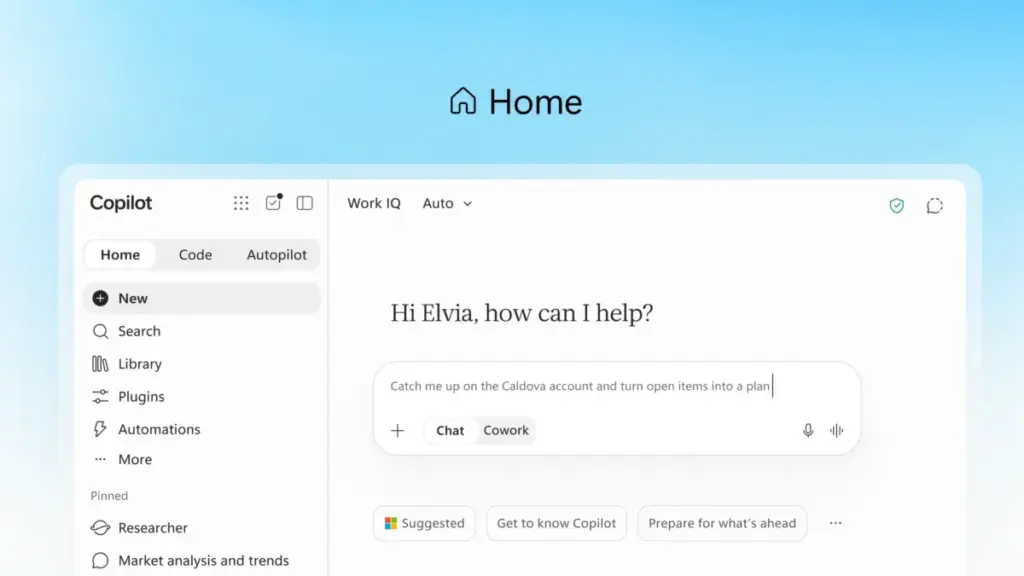
While many of these features are still in preview, the rollout marks a definitive turn in Microsoft’s AI strategy. The "Home" interface, where Chat and Cowork first converge, will begin rolling out to Frontier program members in the coming weeks. Meanwhile, Autopilot is set to enter private preview at the end of the month, signaling that the era of the unified AI "super app" has officially begun for the enterprise.
 Small Business IT & Cloud Computing
WordPress Issues Emergency Patch for Critical RCE Vulnerability as Attackers Strike Within Hours of Disclosure
The global cybersecurity community is on high alert following the release of...
 Small Business IT & Cloud Computing
Securing the Digital Hub: A Comprehensive Strategy for Google Account Fortification
In the modern digital landscape, the concept of a "sensitive account" has...
 Small Business IT & Cloud Computing
Bridging the AI Value Gap: Why Organizations Must Shift from Cost-Cutting to a ‘Return on Intelligence’
As the initial wave of artificial intelligence enthusiasm transitions into a period...







