
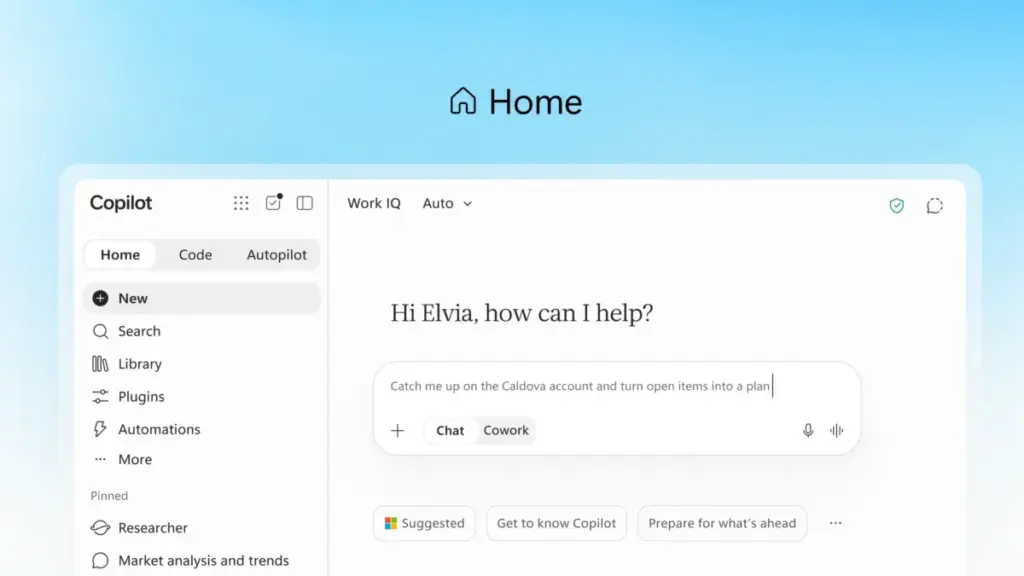
Microsoft has officially launched its highly anticipated Copilot “super app,” marking a significant milestone in the company’s strategy to consolidate its rapidly expanding suite of artificial intelligence tools into a single, cohesive interface. The move, which comes two months after CEO Satya Nadella first confirmed the project’s development, is designed to provide a standardized environment for how employees interact with AI across productivity suites, business applications, data repositories, and development tools.
The new unified experience merges several previously distinct AI capabilities: the conversational Chat interface, the autonomous Cowork agent, a redesigned coding environment appropriately named Code, and Autopilot—a persistent agent formerly known as Scout. By bringing these elements under one roof, Microsoft aims to transform Copilot from a series of embedded assistants into a comprehensive orchestration layer capable of managing complex enterprise workflows.
Industry analysts suggest that this consolidation is more than just a user interface overhaul; it represents a strategic shift intended to give Chief Information Officers (CIOs) much-needed visibility into AI application sprawl and the escalating costs associated with agentic workloads. As organizations move beyond simple generative AI experimentation and toward full-scale deployment, the need for a centralized platform for management, security, and financial oversight has become a primary concern for IT leadership.
Moving Toward a Unified AI Orchestration Layer
The central philosophy behind the Copilot super app is to reduce the friction inherent in choosing between different AI tools. Rather than requiring a user to decide whether a task requires a chatbot, an automation script, or a specialized agent, the unified experience allows users to simply describe what they wish to accomplish. The system then handles the internal routing, directing the task to Chat, Cowork, Code, or Autopilot as needed.
Microsoft’s vision is for the AI to act as a proactive partner that understands the context of a request without being explicitly told which "mode" to operate in. While the individual components of this experience have been introduced or consolidated over the past several months, the super app represents the first time they have functioned as a singular, interconnected ecosystem.
The roadmap for this unification began in earnest during a July earnings call, where Satya Nadella described an architecture that would separate the orchestration layer, context, and memory from any specific underlying AI model. This "model-agnostic" approach allows Microsoft to swap or upgrade the intelligence powering the system while maintaining a consistent user experience. Following that announcement, Microsoft began the process of aligning its consumer-facing and Microsoft 365 Copilot applications, laying the groundwork for the broader enterprise overhaul unveiled this week.
Much of the foundational technology for this shift was established following the November 2025 Ignite conference. Since then, Microsoft has rolled out Cowork for delegated, multi-step tasks and Scout (now Autopilot) for persistent agentic work. The company also introduced natural-language app-building capabilities that have since matured into the Code environment. The current update synthesizes these various threads into a platform intended to serve as the primary gateway for enterprise work.
More Enterprise Context Could Boost Productivity
A critical component of this new architecture is the integration of Fabric IQ and Work IQ. These tools provide the "semantic intelligence" layer necessary for the AI to understand the specific nuances of an organization’s data and internal processes. By integrating Fabric IQ into the Chat and Cowork functions, Microsoft is giving Copilot a deeper reach into an organization’s data estate, which analysts believe will significantly improve the accuracy of the AI and reduce the frequency of "hallucinations."
Abhishek Satapathy, principal analyst at Avasant, noted that this inclusion of enterprise context marks a shift in the fundamental nature of AI tools. He observed that the practical transition is moving from AI that merely "knows" information to AI that can understand the causal links between events—connecting what happened, why it happened, and what the logical next step should be.
For example, a business insight generated in a report could become the automated starting point for a follow-up analysis or a cross-functional action item. This eliminates the need for employees to manually transfer context between disparate reports, documents, and business systems. Satapathy highlighted that this is particularly valuable for managers and operations teams who frequently work across different departments and data silos.
The rollout of these context-aware features is already underway. Fabric IQ’s integration with Chat and Cowork is now generally available, with plans to bring it to the Code environment via Microsoft’s Frontier program in the near future. Work IQ, which provides access to workflows within Dynamics 365 and the Power Platform, is scheduled to enter public preview within the next month.
Redesigned Code Expands the Scope of Software Creation
The redesigned Code environment is another pillar of the super app, aimed at democratizing software creation within the enterprise. By utilizing natural language as the primary interface for building tools, Microsoft is attempting to capture the "middle ground" of development—tasks that are too complex for simple automation but perhaps too small or niche to justify a full-scale professional development project.
According to Satapathy, this broadens the audience for software creation significantly. It allows business users to build internal dashboards, custom workflow tools, and specialized applications without needing to navigate the traditional IT development queue. Simultaneously, professional developers can use the same environment to prototype more rapidly, focusing their high-level engineering skills on production requirements rather than basic scaffolding.
To support this surge in user-generated applications, Microsoft has introduced the Copilot Managed Runtime. This provides a governed hosting environment for applications created within Code, Cowork, and Copilot Studio. The runtime ensures that these applications remain within the organization’s secure Microsoft 365 environment, allowing IT departments to maintain control over security protocols, data access, and governance.
Manoj Chandra Jha, principal analyst at Nord-IQ Research, pointed out that the Managed Runtime is a vital tool for CIOs looking to curb "shadow IT." In the past, when employees created their own workarounds or used third-party tools to solve specific problems, IT often lost visibility into how data was being handled. By providing a governed environment for AI-built apps, IT departments can ensure that every agent and application created by an employee follows consistent policies regarding identity, lifecycle management, and observability.
The Copilot Managed Runtime is currently in public preview and will be integrated into the redesigned Code experience. Microsoft expects this to roll out to the Frontier program by the end of the month, with broader availability following shortly thereafter.
Managing the Costs and Sprawl of Agentic AI
As AI agents become more prevalent, the challenge of managing "agent sprawl" and the associated consumption costs has become a top priority for enterprise leaders. To address this, Microsoft is expanding its Agent 365 management suite to include oversight for Code and the Copilot Managed Runtime.
The updated Agent 365 features will allow administrators to implement AI spending policies at scale. This includes the ability to control which departments have access to specific model families and the implementation of approval workflows for credit requests. Crucially, it provides visibility into the actual outcomes generated by these AI agents, allowing CIOs to determine which automations are delivering a return on investment and which need to be optimized or retired.
The financial transparency extends to the end users as well. Employees will be able to monitor their own credit usage and remaining balances directly within the Copilot interface. This level of visibility is intended to foster a culture of responsible AI usage across the workforce.
Bhupendra Chopra, chief revenue officer at IT consulting firm Kanerika, emphasized that these FinOps (financial operations) capabilities are essential for evaluating the true business value of automation. He noted that the tools can reveal "correction rates" for agents—if an employee constantly has to fix or undo the work an agent has performed, it serves as an early warning sign of poor data foundations or outdated business rules.
Furthermore, Chopra argued that these tools help verify whether the time saved by AI actually leads to measurable business results. Automating twenty minutes of a worker’s day only provides value if that time is redirected toward high-impact activities. The new visibility provided by Microsoft’s FinOps tools allows enterprises to track these outcomes with greater precision.
The Shift to Usage-Based Billing
The consolidation of these tools also brings a shift in how enterprises will pay for AI. While the standard Chat and Microsoft 365 Copilot functions will remain under the traditional per-user subscription license, more advanced capabilities like Cowork, Code, and Autopilot will utilize a usage-based billing model.
This hybrid approach requires a change in how CIOs approach budgeting. Rather than simply counting the number of seats or licenses, IT leaders must now account for the volume of work being delegated to autonomous agents. Satapathy noted that two employees with identical licenses could incur vastly different costs depending on how much "long-running" work they assign to agents.
This transition to consumption-based pricing reflects the high computational costs of running frontier AI models and persistent agents. By providing the tools to monitor and control this spending, Microsoft is attempting to make the transition to agentic workflows more palatable for risk-averse finance departments.
While many of these features are still in preview, the rollout marks a definitive turn in Microsoft’s AI strategy. The "Home" interface, where Chat and Cowork first converge, will begin rolling out to Frontier program members in the coming weeks. Meanwhile, Autopilot is set to enter private preview at the end of the month, signaling that the era of the unified AI "super app" has officially begun for the enterprise.
 Small Business IT & Cloud Computing
Tech Manufacturing Faces Triple Threat of Surging Component Costs, Logistics Strain, and Global Sovereignty Shifts
The consumer electronics landscape is currently navigating a period of unprecedented volatility,...
 Small Business IT & Cloud Computing
WordPress Issues Emergency Patch for Critical RCE Vulnerability as Attackers Strike Within Hours of Disclosure
The global cybersecurity community is on high alert following the release of...
 Small Business IT & Cloud Computing
GhostCode: The Emerging Phishing Threat Exploiting Microsoft 365 Device Authorization Flows
In a significant escalation of identity-based cyberattacks, security researchers have uncovered a...







