The .name top-level domain (TLD) was originally launched in the early 2000s with a specific vision: to provide a dedicated space on the internet for individuals. Unlike .com or .net, which were viewed as commercial or infrastructure-oriented, .name was marketed as a permanent digital home for people. A unique feature of this TLD was the support for third-level registrations, such as "jane.doe.name," which often included a corresponding email forwarding service. For many early adopters like Johnston, who registered her domain in 2002, this was not merely a technical utility but a "name for life" that promised a permanent way to manage communications and online identities.
Now, that promise is being dismantled. Verisign, the registry operator for .name, in coordination with ICANN, has moved toward terminating these third-level registrations. While the second-level domains—such as "doe.name"—will remain supported, those who built their digital lives on the third-level structure are being forced to migrate. For Johnston, this shift is far more than a minor inconvenience; it has evolved into what she describes as a "full-time daily job" that threatens to lock her and her family out of the modern digital world.
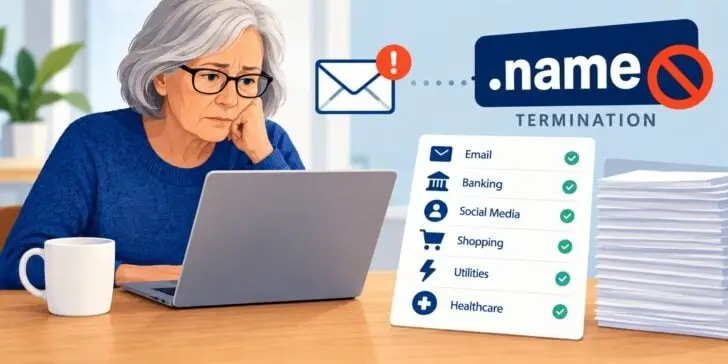
In her formal filing to ICANN, Johnston detailed the extensive reach of her .name email address. Over the course of 25 years, the domain has become the primary identifier for at least 211 different online accounts. This includes essential services such as banking, healthcare, government portals, and social utilities. The termination of the domain does not just mean losing an email address; it means losing the primary key used to access, verify, and recover every other account tied to it. When a domain is terminated, the "forgot password" link on every website Johnston uses will point to a mailbox that no longer exists, effectively orphaning her digital presence.
The complexity of the situation is compounded by the demographic challenges facing Johnston and her family. Both she and her 97-year-old mother rely on the .name domain for their daily communications and account management. As senior citizens, the process of navigating modern security protocols is already a significant hurdle. Johnston noted that the sheer volume of work required to update 211 accounts is overwhelming. Many of these services, particularly those involving financial or sensitive personal data, do not allow for a simple email update. Instead, they require a manual recovery process that often involves submitting multiple forms of government-issued identification and navigating complex data protection regulations.
This manual intervention is becoming a source of extreme frustration. Johnston reported that some organizations are requiring her to fill out extensive data protection forms just to prove her identity before they will consider updating her contact information. The time and effort required to satisfy these security requirements for over 200 accounts represent a monumental task, one that Johnston says has already consumed weeks of her life and will continue to do so as the termination date approaches.
The hardship is further exacerbated by a lack of clear communication and support from the domain registrars responsible for managing these accounts. Johnston’s experience with Network Solutions, a prominent registrar, illustrates a systemic failure in how the sunsetting of .name third-level domains is being handled. Upon receiving a notification regarding the termination, Johnston reached out to the company to explore her options and seek clarification. She was met with a startling lack of awareness from the front-line staff.

According to Johnston, multiple customer service representatives at Network Solutions insisted that the notification she received was a scam. They pointed to the fact that her domain was officially registered and paid for through the year 2030 as evidence that her service was secure. It was only after Johnston insisted that a representative perform a specific search for ".name termination" that the company’s staff realized the notice was legitimate. This confusion at the registrar level suggests that many other users may be operating under a false sense of security, believing their long-term registrations protect them from a policy change that overrides their existing contracts.
The situation raises significant questions about the responsibilities of ICANN and Verisign toward long-term users of the internet’s naming system. Critics of the termination, including industry experts like Andrew Allemann of Domain Name Wire, have argued that the decision-makers should reverse course. The argument is that the technical overhead of maintaining third-level .name domains is a small price to pay for preserving the digital identities of thousands of individuals who were told decades ago that these domains were a permanent solution for personal branding and communication.
The "reconsideration request" is one of the few formal avenues available to stakeholders within the ICANN ecosystem to challenge a policy decision. It is a process designed to ensure that the ICANN Board or staff did not violate established policies or ignore material facts when making a decision. In Johnston’s case, the material fact is the "human cost" of the termination—a factor that she argues was not sufficiently weighed against the technical or business reasons for ending the service.
The broader implications of this case touch on the concept of "digital permanence." As the internet matures, the industry is increasingly grappling with how to handle "legacy" systems. However, unlike a software application that can be replaced by a newer version, a domain name is a piece of infrastructure. When that infrastructure is removed, it creates a cascading failure across the user’s entire digital ecosystem. For a person who has used the same email address since the early days of the web, that address is more than a tool; it is a vital component of their legal and social identity.
For Johnston and her 97-year-old mother, the technicalities of registry management are secondary to the reality of their daily lives. They are facing a situation where they must prove who they are to hundreds of entities, often without the help of the very tool—their email—that was designed to provide that proof. The manual recovery of accounts, the submission of sensitive identity documents, and the navigation of bureaucratic red tape have turned what should be a simple phase-out into a period of significant distress.
As the ICANN Board reviews the reconsideration request, the eyes of the domain industry are on the outcome. The case serves as a stark reminder that behind every technical policy and registry agreement, there are individual users whose lives are inextricably linked to the strings of characters they registered decades ago. For Judy Johnston, the battle to keep her .name domain is not just about a website or an email address; it is a fight to maintain the integrity of her digital life and to avoid the "full-time job" of rebuilding an identity that she believed was secured until 2030 and beyond.
The outcome of this request will likely signal how ICANN intends to handle similar sunsetting events in the future. If the termination proceeds as planned, it may set a precedent that technical efficiency and registry streamlining take priority over the long-term stability of personal digital identities. For now, Johnston continues the arduous task of manually updating her accounts, one form and one ID submission at a time, while waiting to see if the governing bodies of the internet will hear her plea to preserve a system that has served her and her family for a quarter of a century.
 Web Hosting & Domain Management
Identity Digital spins out agentic effort, now called Known
The transition marks a significant milestone for the project previously known as...
 Web Hosting & Domain Management
XYZ.com LLC Emerges as Major Contender in 2026 Domain Expansion with 139 New Applications
The landscape of the internet’s naming system is on the verge of...
 Web Hosting & Domain Management
Atom Enhances Domain Seller Experience with Launch of Dedicated Mobile Application
The landscape of the domain name aftermarket is one defined by speed,...