
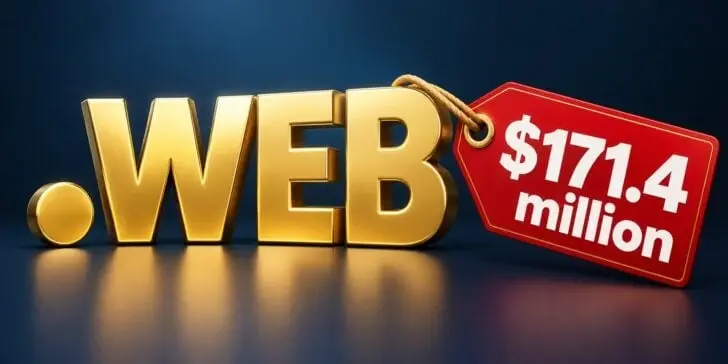
For nearly a decade, the domain name industry has watched from the sidelines as one of the most contentious and expensive battles in internet history unfolded over the rights to the .web top-level domain (TLD). Now, according to recent financial disclosures, the true cost of that battle—and the scale of Verisign’s ambition for the extension—has finally come into sharp focus. In a recent filing with the Securities and Exchange Commission (SEC), Verisign (NASDAQ: VRSN) disclosed that its total investment in acquiring the .web registry has reached a staggering $171.4 million.
The disclosure provides a rare, detailed look at the financial weight behind what is arguably the most anticipated generic top-level domain (gTLD) since the Internet Corporation for Assigned Names and Numbers (ICANN) opened the floodgates for new extensions over a decade ago. As Verisign prepares for a mid-December launch, the company is not just releasing a new product; it is attempting to recoup a massive capital outlay that has been tied up in legal and administrative limbo for years.
The journey of .web began in earnest in 2016, during a high-stakes ICANN auction intended to resolve competing applications for the string. At the time, a company called Nu Dot Co won the auction with a record-breaking bid of $135 million. The industry was stunned by the figure, which far eclipsed previous auction prices for other sought-after strings like .shop or .app. However, the mystery of how a relatively unknown entity like Nu Dot Co could afford such a price was quickly solved when it was revealed that Verisign had provided the funding for the bid through a secret proxy agreement.
Verisign’s involvement immediately sparked a firestorm of controversy. Competitors, most notably Afilias (now Altanovo), argued that the proxy arrangement violated ICANN’s auction rules and transparency requirements. This triggered a marathon of litigation, including appeals to ICANN’s Independent Review Process (IRP) and various court filings. While the core auction price and a subsequent $10 million premium paid to Nu Dot Co—bringing the initial asset cost to $145 million—were previously known to investors through Verisign’s 2016 quarterly filings, the new $171.4 million figure highlights the significant "hidden" costs of a ten-year legal war.
In its most recent disclosure, Verisign clarified that while the asset purchase itself accounted for $145.2 million, it incurred an additional $26.2 million in "other acquisition costs." While the company characterized these costs as individually immaterial, the aggregate sum is anything but. This $26.2 million likely represents a combination of capitalized legal fees, administrative overhead, and potential settlements. Specifically, there has been speculation within the industry that a portion of these funds may have been used to settle long-standing disputes with Altanovo, effectively clearing the final hurdles to bring .web to market.
The timing of the launch is a critical factor in Verisign’s quest for a return on investment. During a recent investor conference call, Verisign executives outlined a rollout strategy that will begin in mid-December with a 30-day "Sunrise" period. This phase is a standard requirement for new TLDs, allowing trademark holders to register their brand names before the general public to prevent cybersquatting. Following the Sunrise period, Verisign plans to initiate a "limited registration period," a strategic window where the company will focus on a specific, high-value demographic: current owners of .com domains.
This limited registration period is the cornerstone of Verisign’s monetization strategy. By offering .com registrants the first opportunity to secure the matching .web version of their existing domains, Verisign is leaning into the concept of brand protection and defensive registration. The success of this phase will likely determine whether .web becomes a lucrative asset or a cautionary tale of overpayment.
Industry analysts often point to the launch of the .xxx extension as a historical precedent for this type of strategy. When .xxx debuted, the registry and its partner registrars aggressively marketed the extension to corporations, universities, and public figures as a necessary defensive purchase. The message was clear: buy your domain now, or risk it being used for adult content by someone else. This created a massive windfall for the registry, as thousands of entities that had no intention of using a .xxx site paid to keep their names off the market.
However, the value proposition for .web is fundamentally different. Unlike .xxx, which carried a specific reputational risk, .web is a generic, professional-sounding extension. The urgency for a defensive registration is less about avoiding scandal and more about general brand consolidation. The question for Verisign is whether that motivation is strong enough to drive the volume of registrations needed to justify a $171.4 million price tag.
The role of domain registrars—the consumer-facing companies like GoDaddy and Namecheap—will be pivotal during this period. Registrars are the gatekeepers of the industry, and they have a significant financial incentive to promote .web. Because new TLD registrations often carry higher margins than the highly competitive and price-sensitive .com market, registrars are likely to push the "domain match" offer heavily to their existing customer bases. For a registrar, selling a .web counterpart to an existing .com customer is an easy upsell that requires little additional support.
Despite the potential for aggressive marketing, Verisign faces two major uncertainties. The first is the critical issue of pricing. Verisign has yet to publicly announce the wholesale pricing for the limited registration period or the subsequent general availability phase. The company is currently tasked with a delicate balancing act: if they set the price too high, they risk alienating small business owners and individual registrants who are already fatigued by the sheer number of available domain extensions. If they set it too low, they may struggle to recoup their massive $171.4 million investment in a reasonable timeframe.
The second uncertainty is more existential: does the market still care about .web? The digital landscape has shifted dramatically since Verisign first placed its bet in 2016. In the early days of the new gTLD program, there was a sense of scarcity and a belief that "generic" terms would hold immense value. Today, the market is saturated with hundreds of extensions, ranging from .online and .site to niche options like .photography or .guru.
Furthermore, the very terminology of the internet is evolving. While "the web" was once synonymous with the internet experience, the rise of mobile applications, social media platforms, and "walled garden" ecosystems has somewhat diluted the primacy of the browser-based web. To some younger users and modern tech companies, the term "web" may feel slightly dated, perhaps even "passé" compared to more modern identifiers. For a business that already owns the .com, .net, and perhaps a .org or .io, the addition of a .web may feel like a luxury rather than a necessity.
Verisign, however, remains the dominant player in the industry due to its stewardship of .com, the undisputed king of domain extensions. The company’s deep integration with the global registrar network and its reputation for technical stability give .web a significant advantage over other generic extensions launched by smaller registries. Verisign is betting that the natural affinity between .com and .web—both being three-letter, generic, and globally recognized—will create a "gold standard" pairing that businesses feel compelled to own.
For investors, the upcoming limited release period will serve as a high-stakes litmus test. It will provide the first real data on conversion rates—specifically, what percentage of the massive .com user base is willing to open their wallets for a .web equivalent. If the conversion rates are high, Verisign could see a rapid influx of cash that justifies the nearly $200 million spent on acquisition and legal fees. If the response is lukewarm, it may signal that the window for high-value generic extensions has started to close.
As mid-December approaches, the domain industry is bracing for what could be the last great "land grab" of the current gTLD era. After a decade of legal maneuvers, secret proxies, and mounting costs, Verisign is finally ready to let the market decide the true value of .web. Whether it proves to be a brilliant strategic move or an expensive relic of a different era of the internet remains to be seen, but the financial stakes have never been clearer.
 Web Hosting & Domain Management
Afternic Expands Automation Capabilities with Public Release of Portfolio API for Domain Investors
In a significant move aimed at modernizing the infrastructure of the domain...
 Web Hosting & Domain Management
Executive Leadership Transition at fTLD: Craig Schwartz to Retire as Search for Successor Begins
The landscape of the specialized domain name industry is preparing for a...
 Web Hosting & Domain Management
Domain Registrants Face Looming Deadline as Verisign Prepares to Increase .Com Pricing on November 1
The global market for .com domain names is approaching a significant financial...







